winter wedding

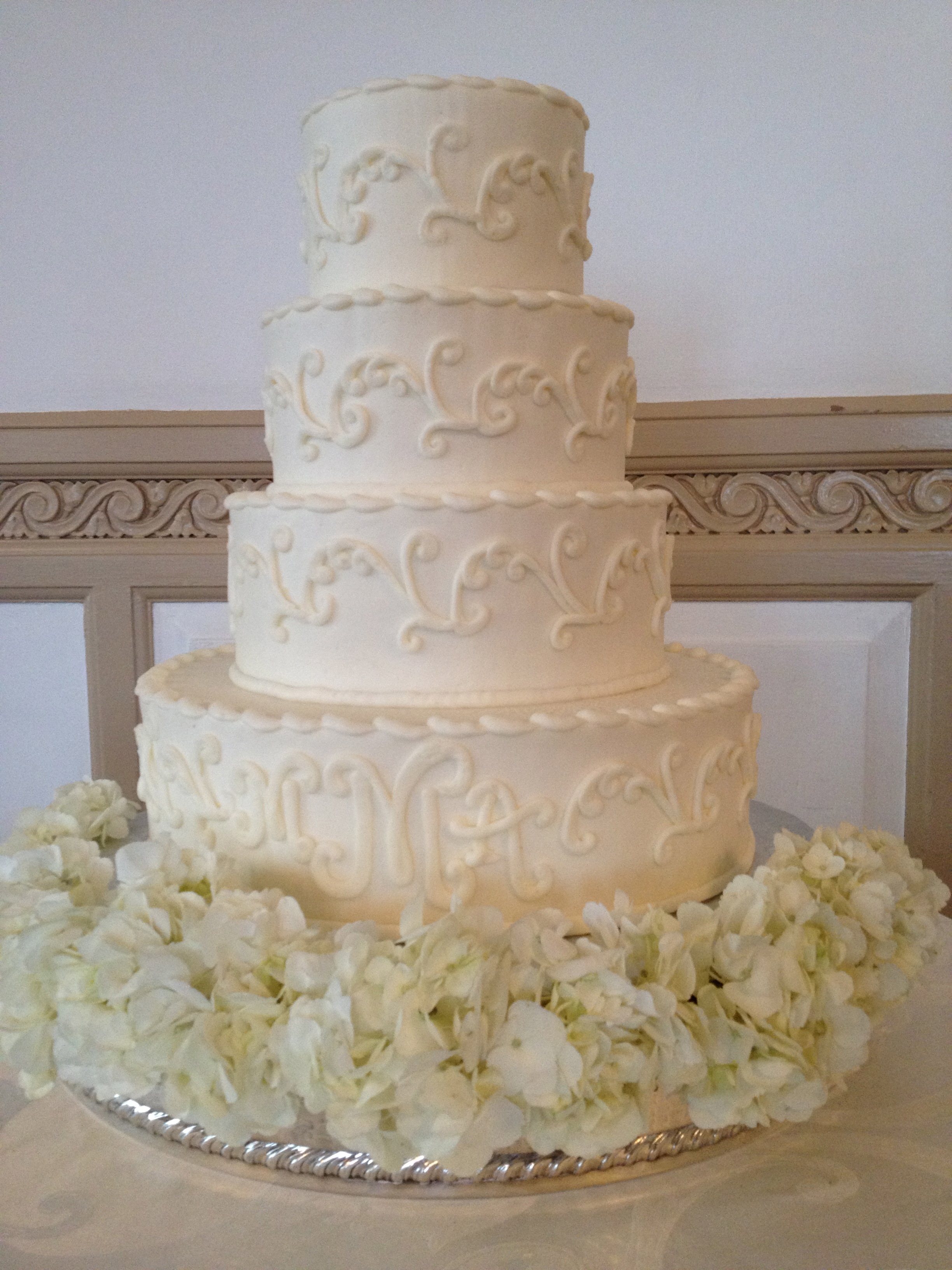
wedding cake

white hydrangea skirts the tiered cake

This week at the shop, we prepared for Saturday’s wedding, a floral event conceived back in June 2011.  The couple approached proprietor and lead designer Peicha Chang, asking for “bright” flowers within a certain budget.  Peicha met with them throughout the months to get to know their style, the colors they preferred, the color of the bridesmaids’ dresses, and the types of different floral selections they needed: from centerpieces to wrist corsages.  The week before the event, she purchased all the beautiful blooms for the big day.  On Thursday, she began making the centerpieces for the tables…starting with the greens (salaal and umbrella fern) as a base.

the stunning umbrella fern

After she was happy with the first centerpiece, using bright purples, dark pinks and solid reds coupled with light and dark greens; she cranked out the others (I think there were around 25.) Each centerpiece is slightly different when you look closer; some have darker tulips, some have hypericum berries, etc. But you’ll have to wait until they’re in their proper setting to really see them.  I watched her work, as miraculous creation took place, one beautiful arrangement after the next.

creating the centerpiece arrangements
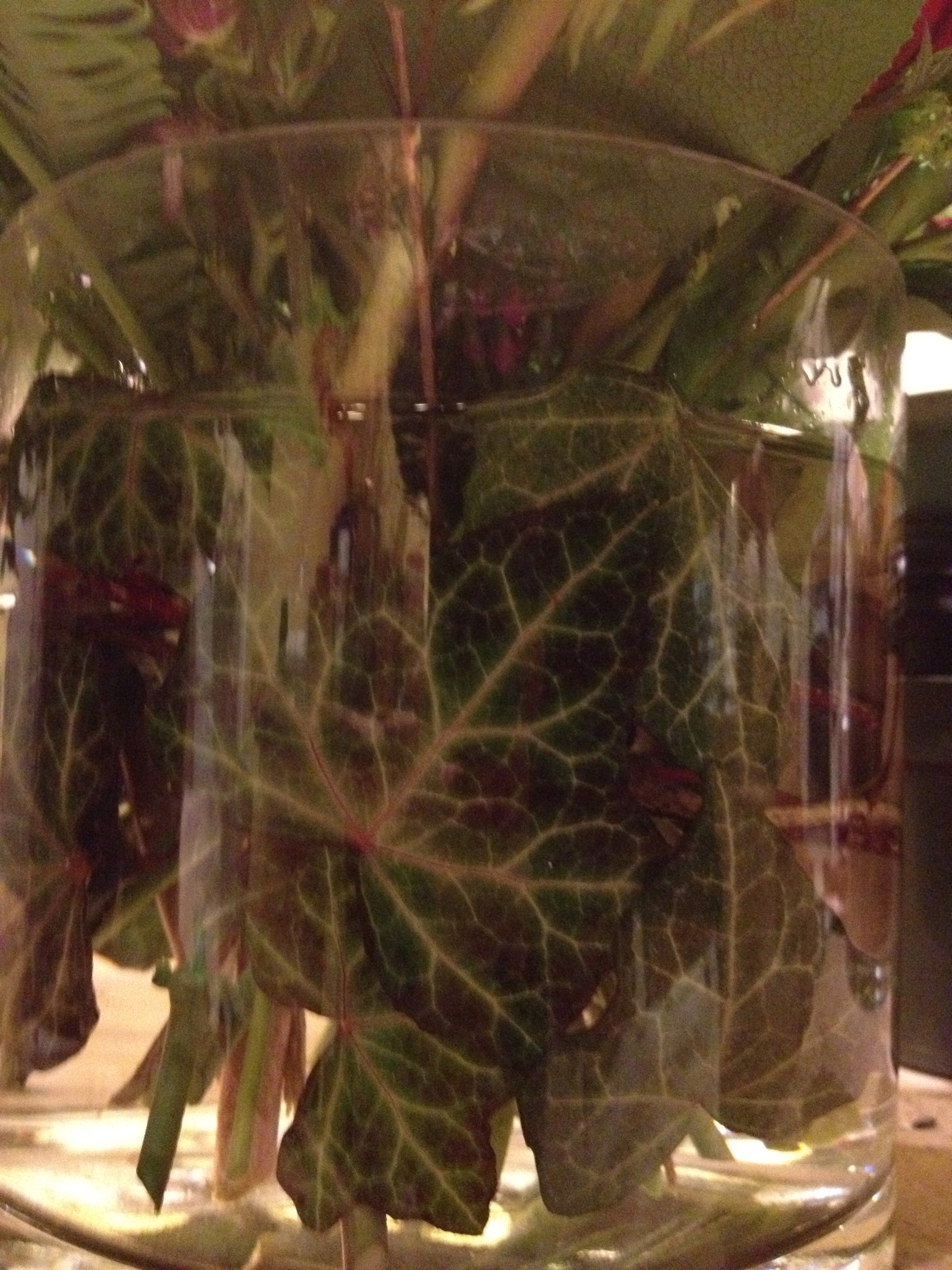
ivy wrapped around the stems adds another layer of interest to the centerpieces...cool!

While Peicha did her thing, I was doing mine.  I was given a BIG job this day – making two wreaths of fresh white hydrangeas!  I really had a great time doing it.  Using a pre-made form filled with floral foam which had already been soaked, I cut down the hydrangea stems (my knife skills are getting better!) and poked each stem in, being careful to place the blooms in an alternating pattern.  You get big bang for your buck with these guys!

creating the hydrangea wreath
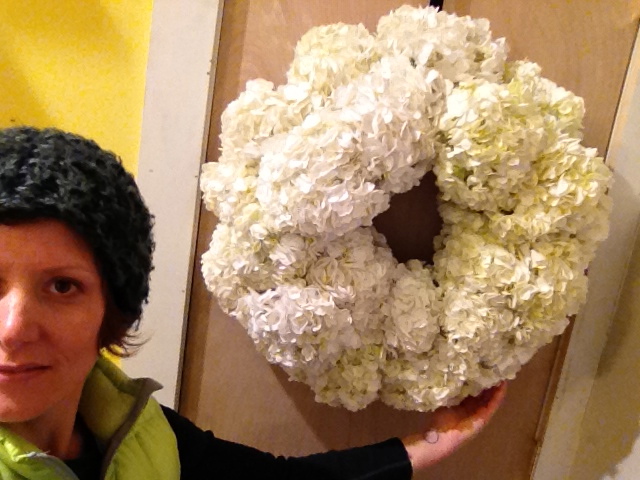
my first creation! thanks for trusting me with this, Peicha!

Okay so after the first one was done, then I did the second, and guess what, they were slightly different. So I had to go back to the first and press some blooms in a little farther to create a more uniform appearance.  While I was working, these wreaths were quietly dripping away – the reason behind doing this job a few days in advance of the big day.  You sure don’t want your product dripping onto wedding guests!
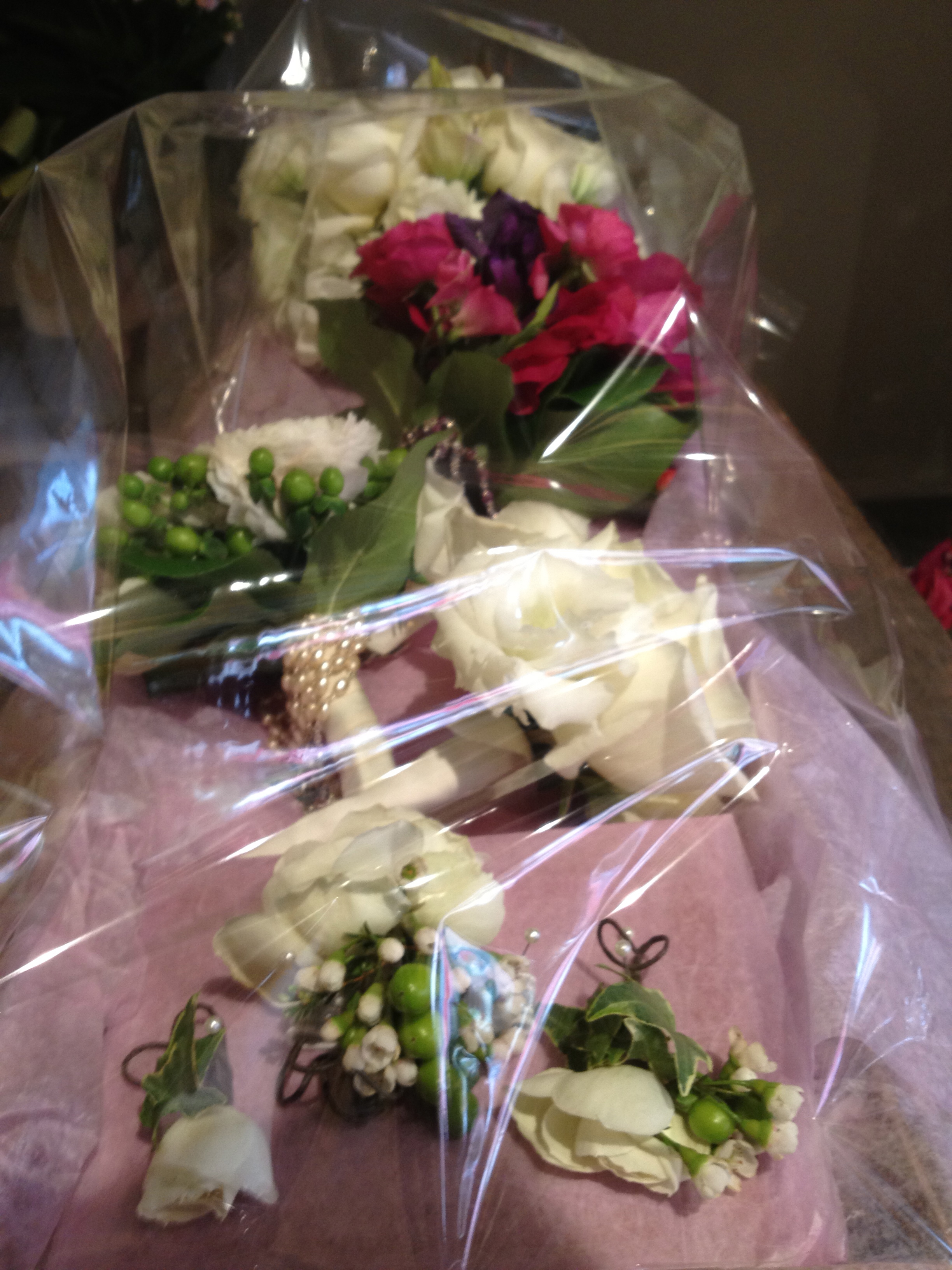
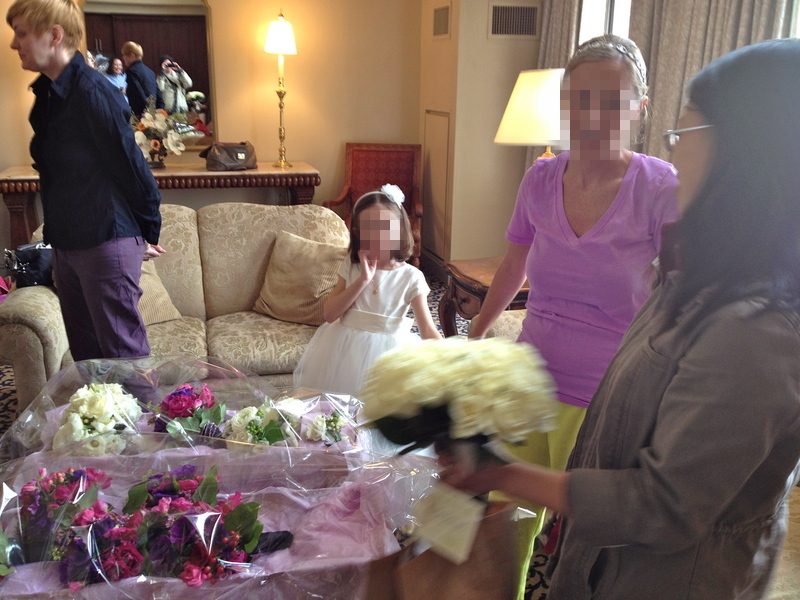
bouquets and personal flowers for bride's side- some wrapped in rosaries! beautiful!

Now for Saturday, the big day…I arrived at work very excited to see what was in store.  While Peicha finished the bouquets for the ladies, I was given a surprising task – delivering the personal flowers to the groom’s side of the family.  The groom was calm and happy as I showed him how to pin his flowers on.  Here, the best man models his boutinnière comprised of red ranunculus, waxflower and ivy.
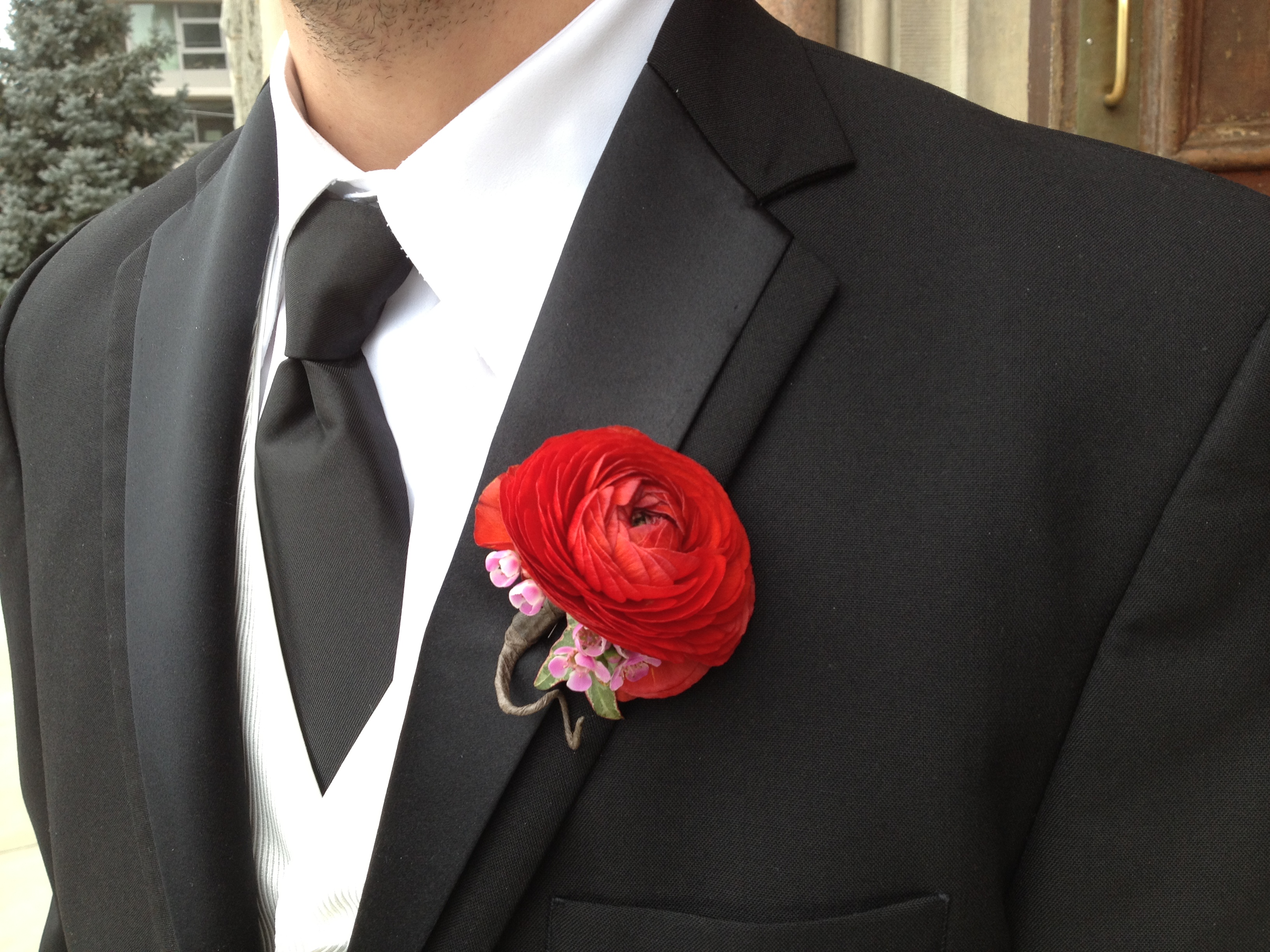
the word boutinnière is french for "buttonhole" - ooh la la!

Back at the shop, my new colleague Emily packed up the centerpieces for delivery. Each vase is wrapped carefully in plastic air packets and put into a crate.

Then Peicha and I hit the road to deliver the bridal flowers.  Arriving at the Omni Hotel, everyone right down to the valet was happy to see us…well, maybe it was the flowers they were happy to see.   And after all her intense hours of labor, this is payoff day for Peicha – will the bride be happy? Will everything go off without a hitch?

elevator moment

Methinks the bride was more than happy.  Her exact words were “I’ve never seen more beautiful flowers.”  And Peicha and I both, upon leaving the bridal suite, began tearing up a little.  This is what it’s all about!
Next, we stopped off at the church to hang “my” wreaths on the front doors, and to add floral accents to the front pews meant for the bride and groom’s families.  (I had to do some guerilla bow-making on the steps of the church – thank God Peicha had taught me some rudimentary bow skills last Thursday!)
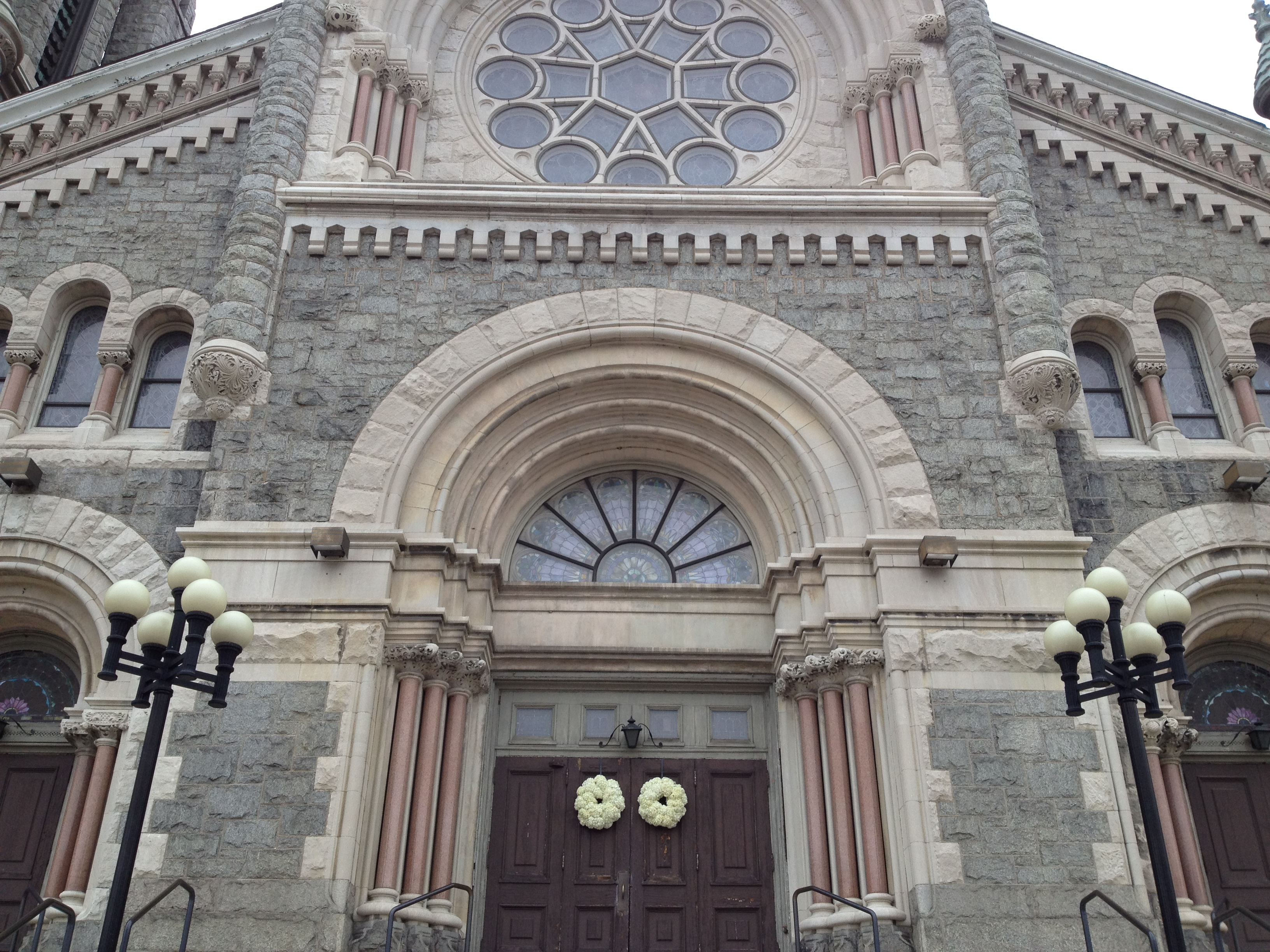
St Francis of Xavier - a beautiful church!

Alrighty, this day was moving right along! Let’s get going over to the Down Town Club to set up the flowers for the reception.

Jerome helps us - great guy with a great handshake

the Down Town club was founded in 1897 - i'm having a 'shining' moment
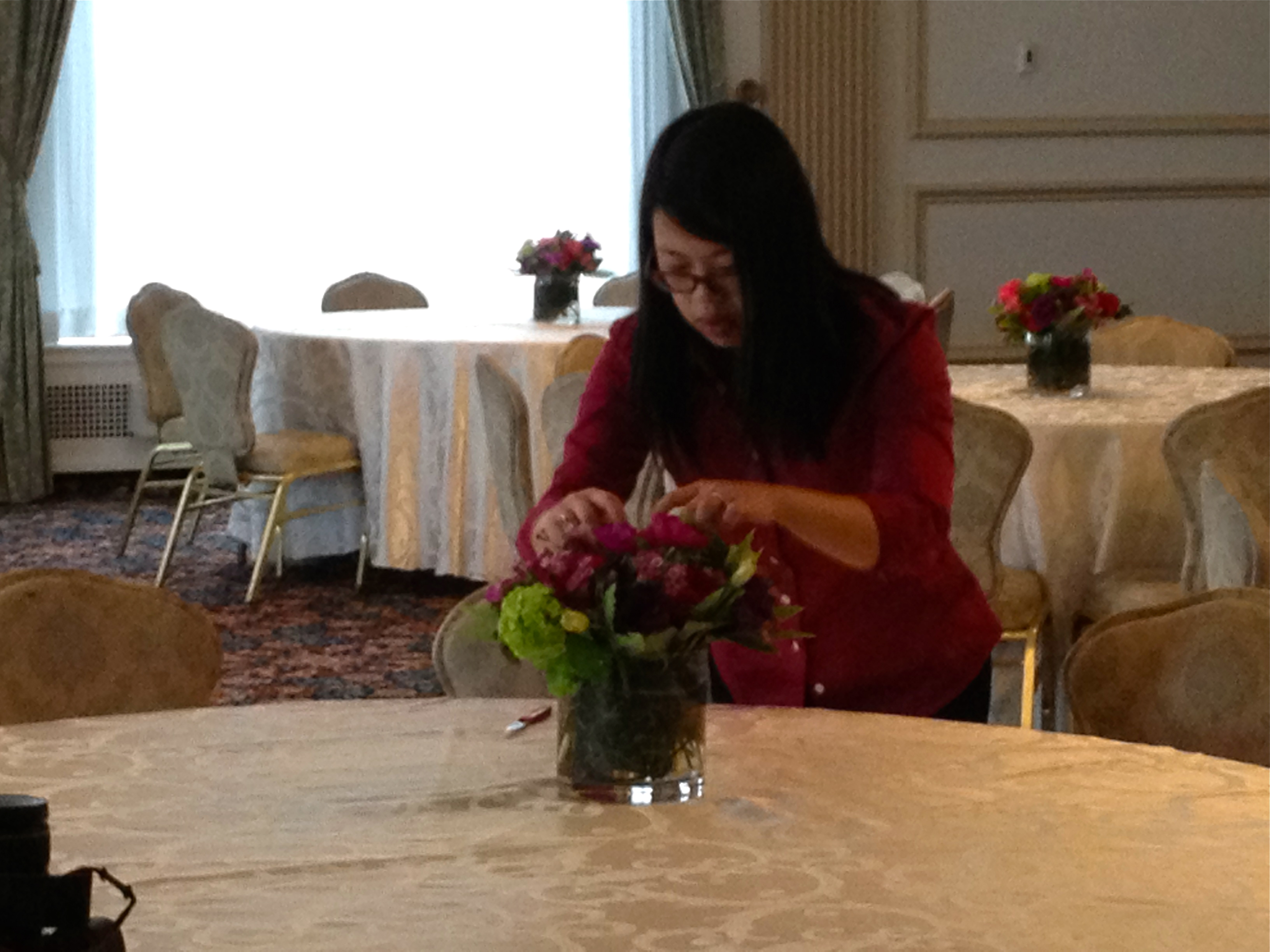
Peicha "fluffing" the centerpieces

Here they are in all their stunning glory! Amazing work, Peicha.

centerpiece in jewel tones: rose, anemone, waxflower, tulip, astrantia, umbrella fern

peony tulip centerstage
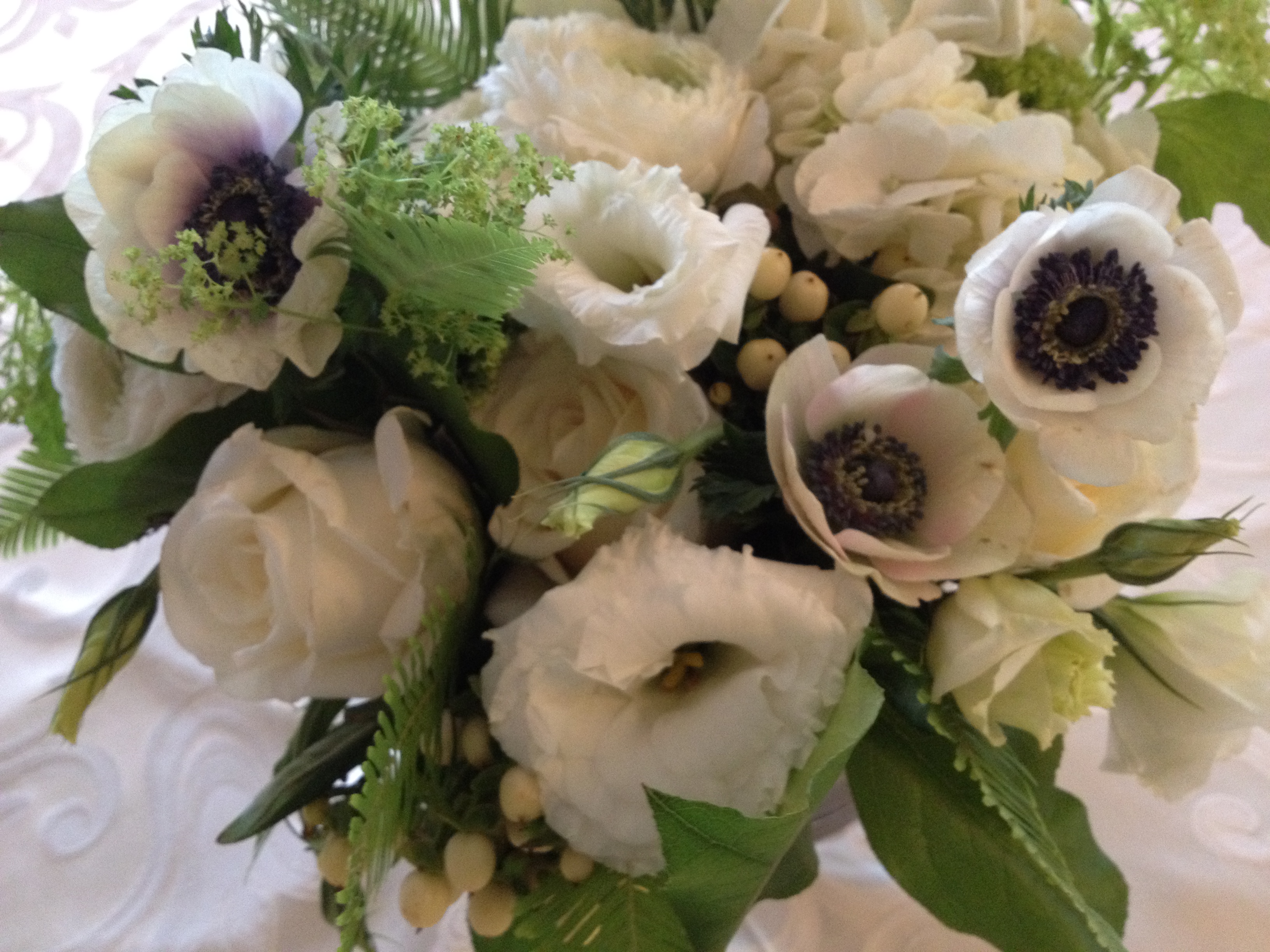
all white for the bridal table - gosh look at those anemones with dark purple centers!

I had such a great day – from witnessing Peicha’s grace under pressure and exceptional designing talent, to meeting all the ‘behind-the-scenes’ folks, and most importantly, seeing how flowers really touch the people whose event you’re involved in – I cherished every part of this new experience, and hope that there will be many more to follow.  Best wishes to the bride and groom!
heaven scent

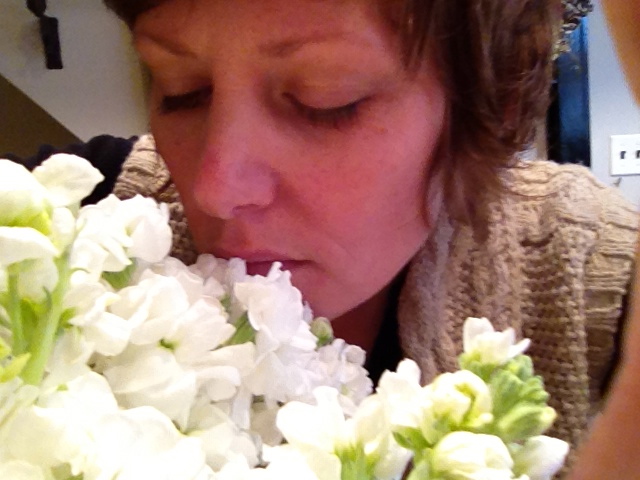
Another Thursday spent at Falls Flowers with Peicha Chang. We processed flowers for display, did some arranging, and even talked about the meaning of life.  Guess what, there is none!  No but really, I’m here at the shop because I’m trying to bring some meaning to my life by learning new things.  That, and the aromatherapy!  This Stock flower was super fragrant…and smelled exactly like cloves.  The white variety was much stronger smelling than the lavender one.

Me sniffing some stock ... mm mmm!

Stock, or Matthiola incana - Lavender and White - so fragrant!

We started by processing some MUMS, first removing most of their foliage and cutting them at a 45 degree angle (so their stems don’t butt up against the bottom of the container – for maximum drinking potential.)

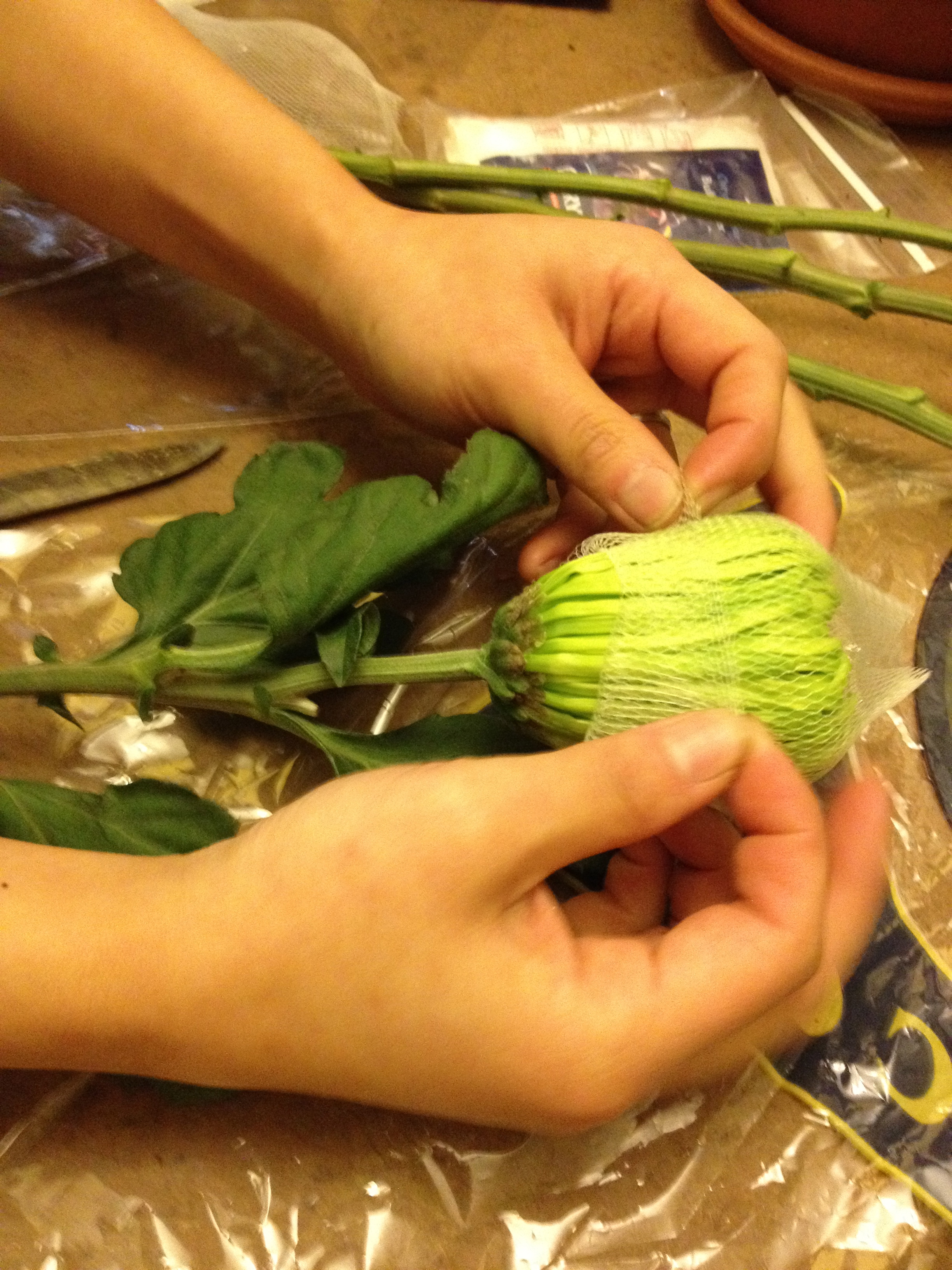
remove the mum's net gently, up and over


These big chartreuse babies are Spider Mums and like other blooms with fat heads, they come with their own mini nets to secure and protect them.  DON’T JUST TEAR THE NETS OFF WILLY NILLY.  I learned that taking the nets off should be the last step before you set them into their container, and don’t rush it.  BE GENTLE – just peel the net up and over the bloom so your mum isn’t decapitated and the petals remain intact.

Chrysanthemum aka 'spider mum' free of net - POW!

When these huge Chrysanthemums are set free of their nets they span 4-6″ across and put on quite a show! They are a really intense green, so green and so big that rather than being considered “neutral,” like most other greens, they count as their own color family.  When creating a bouquet or arrangement, Peicha says to choose 2 color families to work with, and you can add neutral greens like this Grevillea to the mix.

Grevillea for greens

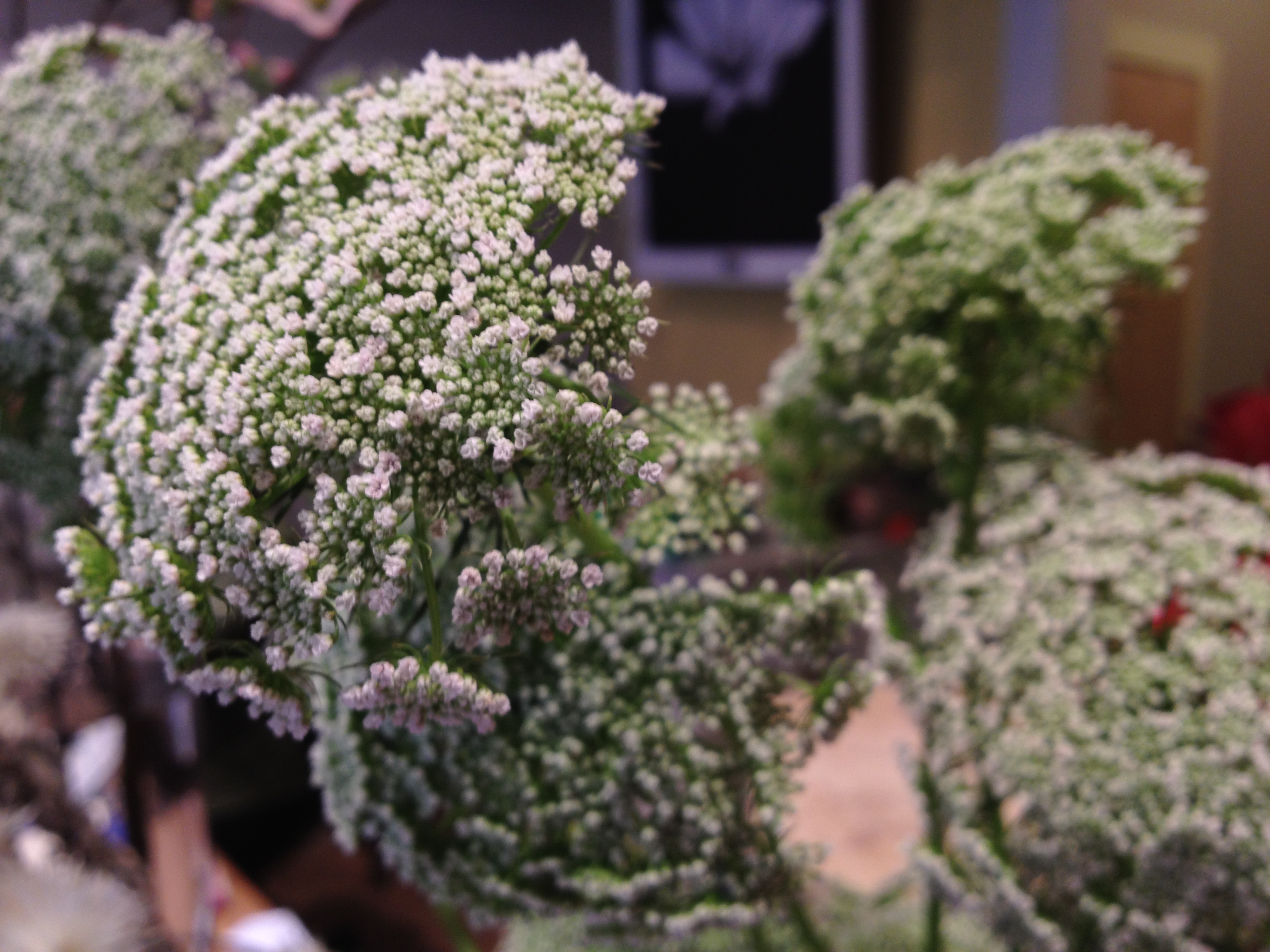
Interestingly enough, WHITE is NOT a neutral color in arranging.  I learned this the hard way in a lesson towards the end of the day when I created my own bouquet…uh oh…no picture means it wasn’t too great! If you’re using whites, Peicha says choose only one other color family.  I used the green mums, some pinky-yellows, some deep rosy reds, AND white…too much! But I’m learning, I’m learning.  I think I just couldn’t resist using the Queen Anne’s lace, because though it’s a European introduction and considered a weed by many, it’s a wildflower at the very top of my list.  I love it’s lacy umbels of green and white – these had just come in and were so tight  (come back later when they’re fully opened!)

Queen Anne's Lace, or Daucus carota (Wild Carrot) - lovely lacy umbels

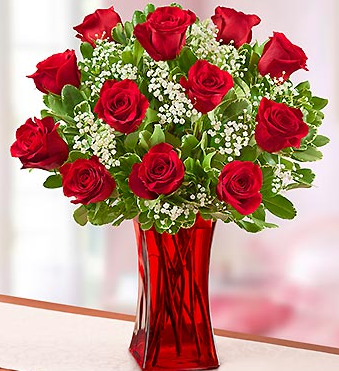
Speaking of WHITE and FILLER…there is a scourge sweeping across the nation as we speak.  This plant is the go-to airy fairy filler of most florists, and you’ll see a LOT of it at Valentine’s Day.  Yes, it’s Baby’s Breath or Gypsophila, and it may be pretty, but when it’s the only filler ever used it loses it’s charm, doesn’t it? Peicha “doesn’t do Baby’s Breath,” but she also doesn’t rule it out entirely.  She does caution clients against using it for events for a pretty specific reason (aside from the fact that it’s boring.) And here it is: do you know WHY it’s called Baby’s Breath? Because it SMELLS like baby’s breath.  Sweet, milky, powdery, and slightly rotten! Not my cup of tea, for sure, and probably not something you want to smell at your wedding.

you won't see anything like THIS come out of Falls Flowers

Instead of Baby’s Breath, Peicha prefers the lemon pledge scent of the Waxflower, a lovely shrub from the Myrtle family endemic to Western Australia.  And I can see why: it’s darling bell-like waxy flowers are borne on woody stems so brittle one can simply break them off between your fingers (translation: quick and easy for the florist to use.)  That, combined with it’s needle-like dark green leaves, and clean, citrusy scent make the Waxflower a much better choice for filler.  Expect to see a lot of this used during Valentine’s Day – only 2 weeks away!

Waxflower, or Chamalaucium uncinatum - GREAT choice for filler smells citrusy

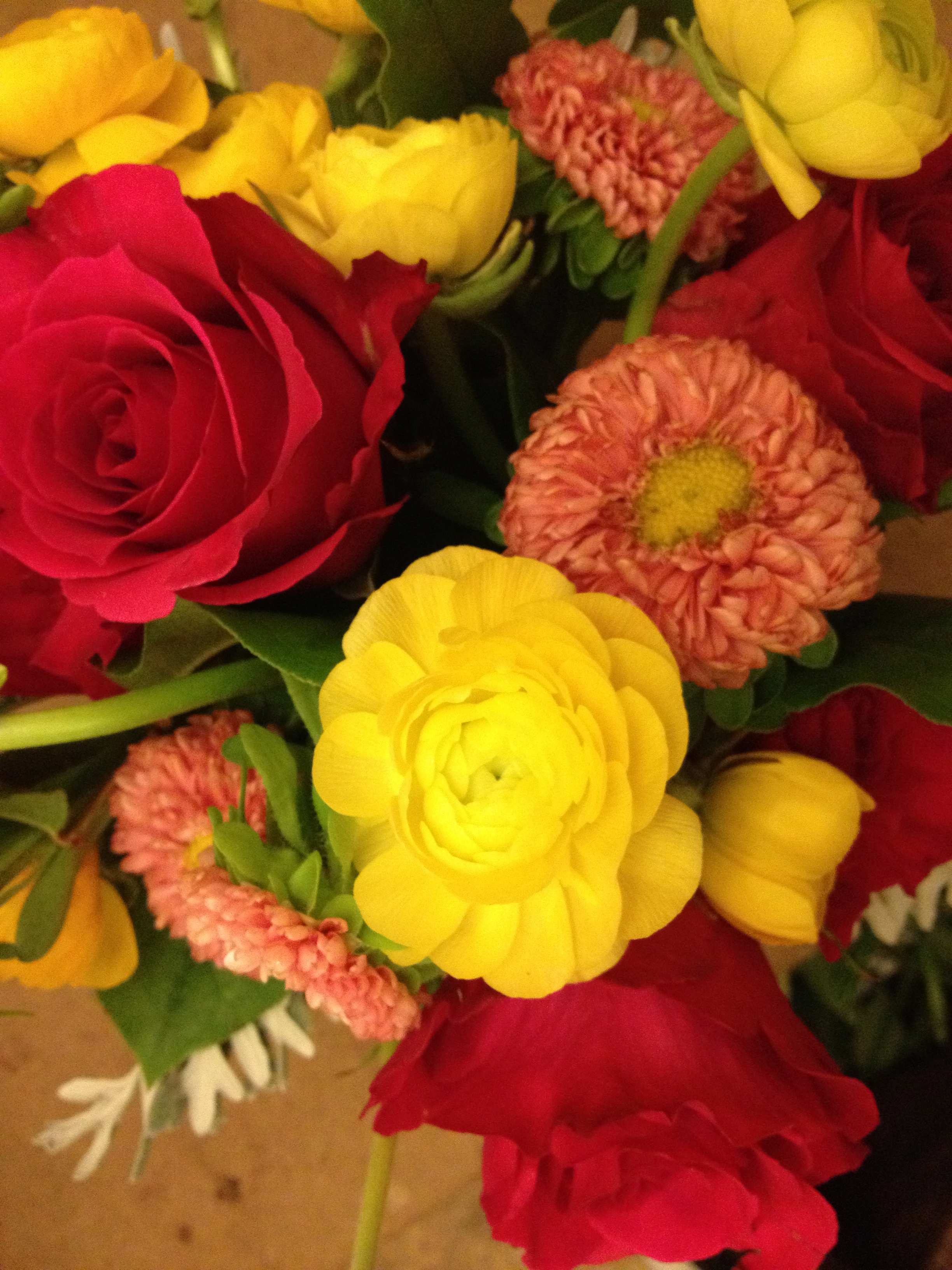
Okay, want to see how it’s done? Check out what Peicha did here for this bright and cheerful birthday arrangement.  Oh it happened pretty quickly, her hands darting in and out of the display vases, measuring the stems against the container, and knifing the stems down to size so fast I couldn’t even capture the process.  The final result, a delight in reds and yellows, is here:

Birthday arrangement by Peicha

Birthday arrangement: Ranunculus, Roses, Mums, Dusty Miller, Salaal

That’s it for now, from my messy mind.  More this week – we have a wedding on Saturday!

bloomin’ fun

My first day at Falls Flowers – Jan 19th, 2012…a quiet Thursday in East Falls.  I started by processing flowers that had been hydrating; and I learned a lot today!  For example, when flowers first arrive, they should hydrate for an hour minimum – if you don’t, their little heads could droop beyond rescue.  Some flowers are more prone to wilting than others; but initial hydration is a big must for everything.

you won't find these flowers in most shops, feast your eyes

The proprietor, Peicha Chang, gets her flowers from a variety of Philly vendors, who get their stuff from NYC or local growers when possible, and the NYC flowers come from Holland, Japan, South America, and beyond.  For Christmas and Easter, she’ll go up to the NYC flower market herself.  I guess there’s no way around being slightly uncomfortable at the environmental impact shipping flowers all over the world has, and if there were a way to stock only locally grown flowers, she would be doing this, but for the kind of variety she wants it’s just impossible.  Not sure how I feel about this part of the industry, as flowers are not a ‘necessity,’ really.  It would at least be nice to know if the farms that are growing your flowers are growing them sustainably, not just for the soil’s sake but for the workers and their exposure to chemicals.  More on this later as I dig deeper.

Gloriosa superba 'Rothschildiana'

gloriosa lily - exotic and toxic

Meet the Gloriosa lily.  This gorgeous lily is actually a climbing vine, and looks as if she’s throwing her petals back from the exertion of the journey.

And hello to you, French Ranunculus.  I have never seen the likes of you before.

french ranunculus (but grown in Holland)

My other favorite of the day is the Astrantia, a cut flower I believe she said was Dutch grown but I’ve seen growing quite happily in gardens in the Northeast.  The stems have a purplish tinge to them and so do the leaves and as you gaze at this plant’s structure you may be reminded of Queen Anne’s Lace, or Fennel, or Dill…all members of the Carrot Family.  Oh, I love you Starflower.

astrantia (A. major) member of carrot family, starflower. LOVE

Now for some how-to, so I can remember what the heck I did:  in processing flowers, the key is to remove any leaves/thorns that will be sitting in water.  It’s important from a ‘rot’ standpoint but also super important when you’re in a busy floral shop to be able to pull a stem easily from it’s container without it tangling up in others.   This is something I hadn’t really thought of before.  Removing 2/3 of the lower leaves also creates a cleaner visual impact, something that most people don’t do when they bring a bouquet home from the grocery store, and it makes all the difference in the world to me.  After removing the leaves, I cut the stems at a 45 degree angle for maximum drinking potential.  Some of the woody stems (Quince) are also cut vertically to create more surface area for the water to climb.  I mostly used pruners, but lots of floral pros use knives to trim thorns off of roses and cut the stems.  There is an art to it, for sure.  Check out the quick video of my first KNIFE LESSON!

I then changed the water out of all the containers on display, which she does once or twice a week or when the water starts to look cloudy.  Flowering branches like Quince make the water cloudy more quickly. Vases are washed once a week on Saturdays.  We cleaned out the walk in fridge together (keeps below 40deg F,) discarding flowers that were past their prime.  At this point Peicha began making little sad noises for each of the flowers she had to toss.  To her, flowers are not just “product.” These are living items she chooses carefully and spends a lot of effort trying to preserve for as long as possible. Meanwhile, I was saying things like “off with their heads,” and cutting them up into smaller pieces for the compost pile.  (All of her vegetable matter waste goes to a local grower for composting…more on this later as I get more details.)

i was in heaven making little labels for everything

One of the areas I really need to learn more on is vase expectancy!  When I made labels for the display items, we put the number of days you could expect the flower to thrive after bringing it home.  Some were 3, others were 14, others were ∞ because they were dried (Protea, Everlasting, etc.)  She just rattled off the numbers! This is a very important piece of the puzzle I’d like to learn.

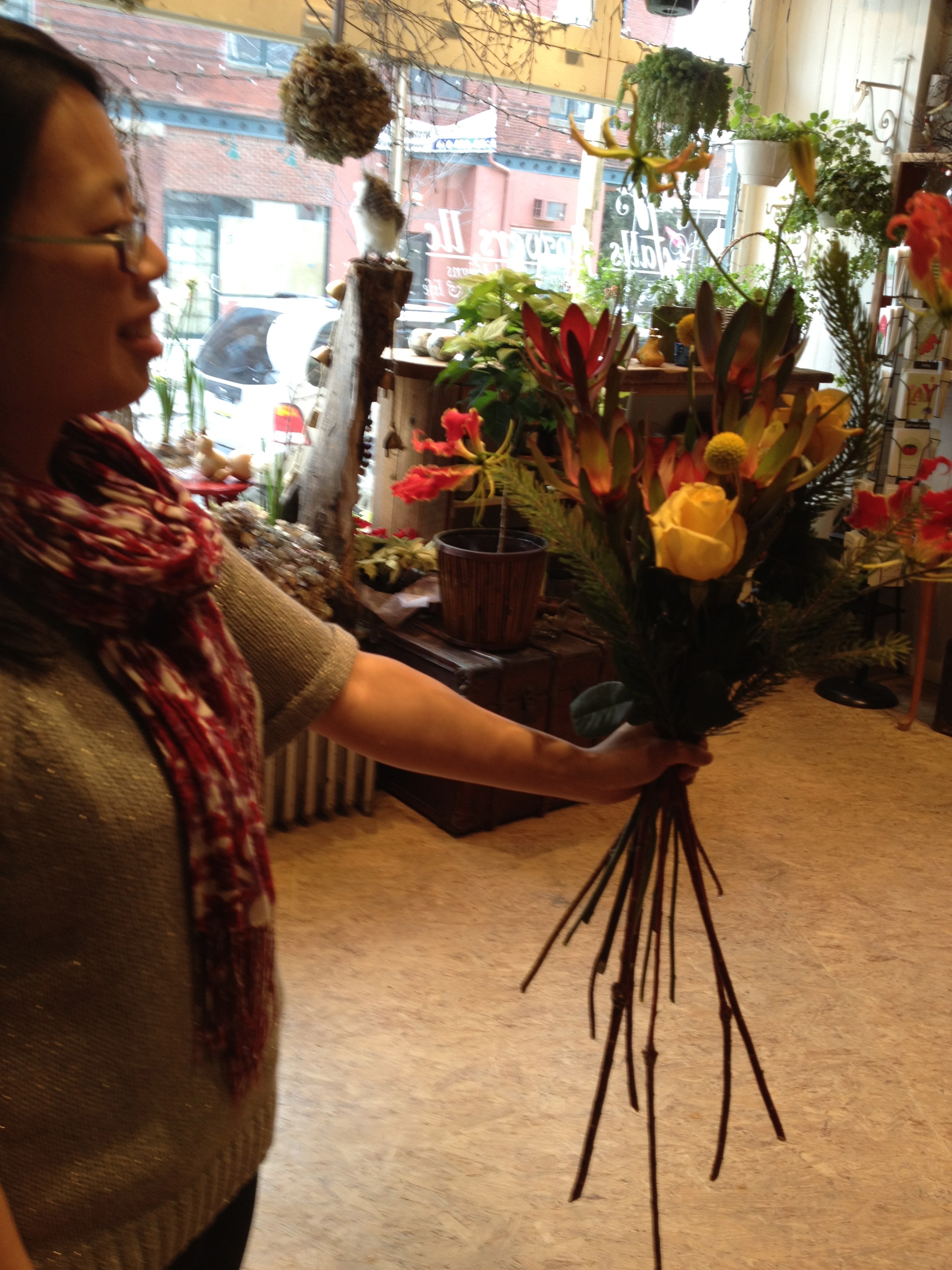
the master makes a quick bouquet, showing me how to hold stems vertically so they spiral together naturally

The quick bouquet lesson at the very end of the day was probably the most fun to watch for me, because Peicha’s experience really shined.  I like to think I have some skill with flowers, and I may have more than the average person, but when you see a master working, you’ll be blown away.  She confidently chose an array of materials for two different bouquets, but I only took a pic of the second one.  She used the South African Leucodendron as her base, following by the flaming Gloriosa Lily, ‘Gold Rush’ Roses, some Billyballs, and even a few evergreens which I thought really made it work (salvaged from the holiday buckets in the fridge.)  She likes to work with odd numbers as they’re “more dynamic,” but if you have to go even use 2…or 6 I think she said. In the end she was holding a $40-$50 bouquet of unusual and beautiful flowers.  I have so much to learn!

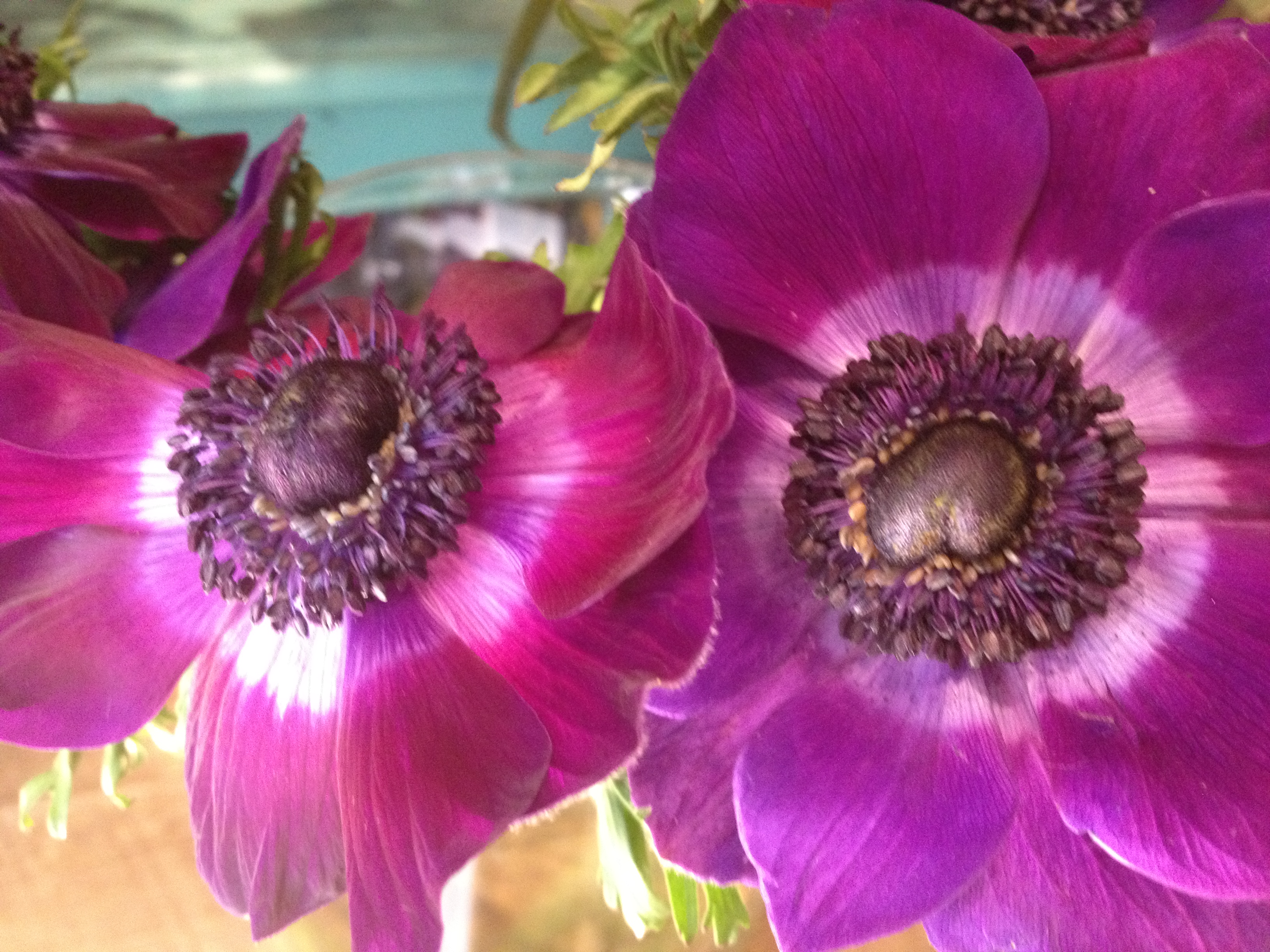
I’ll leave you with this plum beauty, the showy Anemone grown from a tuber…

anemone (A. coronaria) - dive into pure plum! grown in Holland