oriental paper bush in bloom

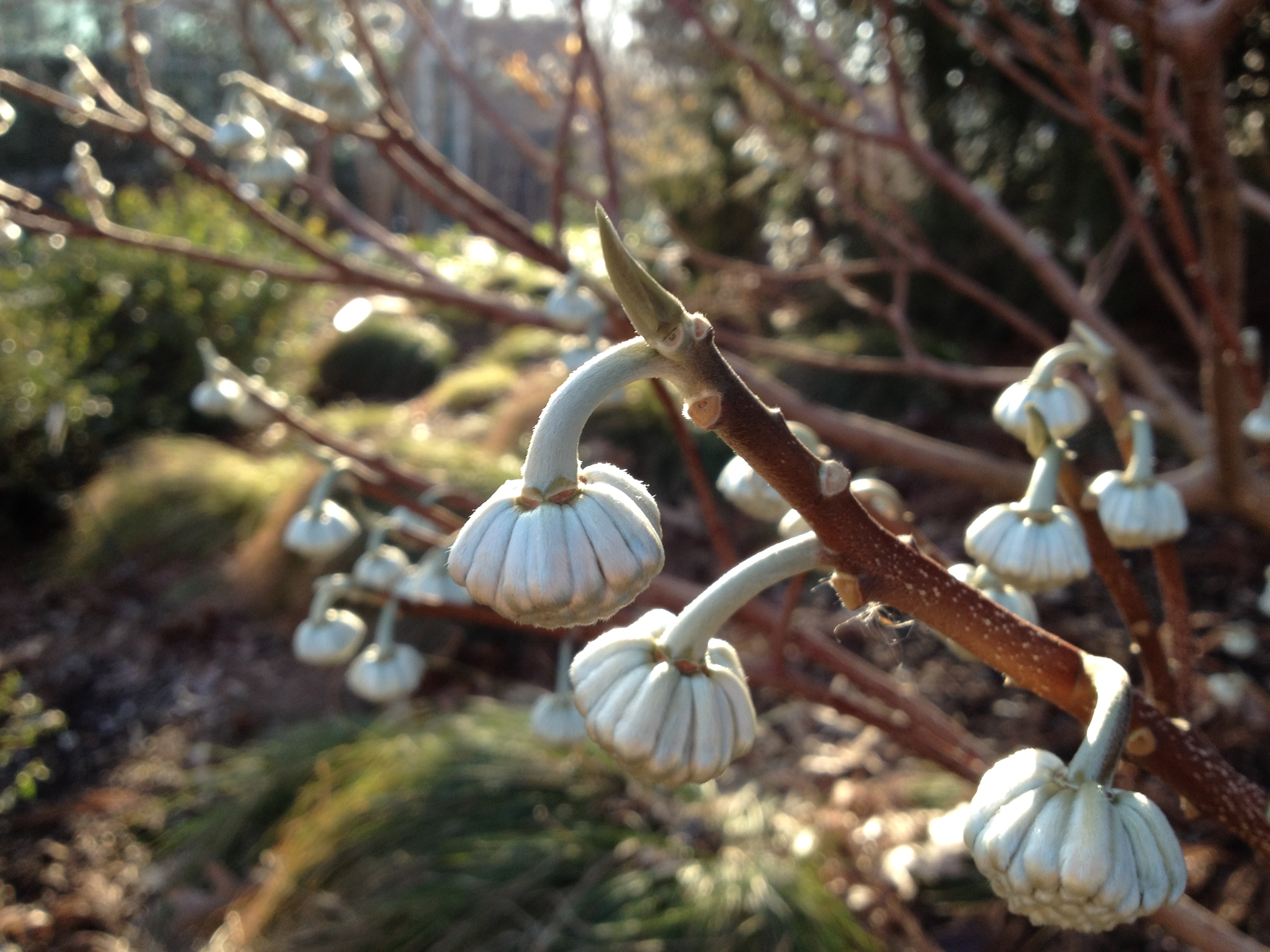
Back in January, I came across the magnificient Paper Bush in bud on the grounds of the Scott Arboretum, blogged here. Back then it was hung with delicious metallic furry fairy-attracting buds.

Edgworthia chyrsantha Jan 25th - buds

I took a walk the other day and was hit by the scent first – a clean sweet just utterly delicious smell that transported me to a magical kingdom where everyone has good intentions.  Then I saw the blooms – BOOM – they are huge and almost Seussian!

Edgworthia chrysantha 'Tony's Clone' or 'Snow Cream' Mar 19

This member of the Daphne family is high on my list of must-have shrubs!

the little garden that could

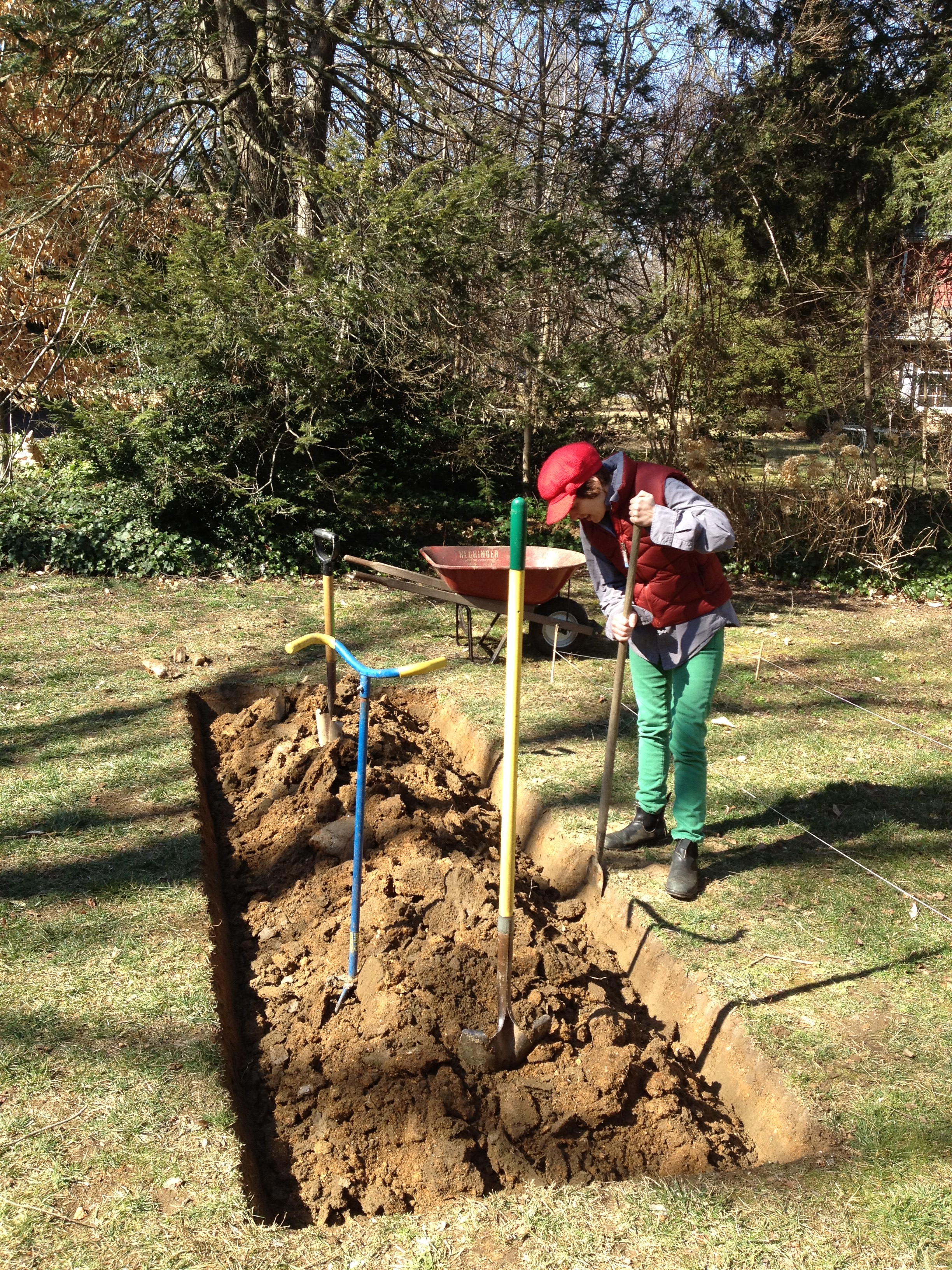
Back in February, my parents said they’d let me turn a patch of earth at their house into a garden of my own(ish).  Turns out they weren’t kidding after all, and made good on the promise.  At the end of February, I did some soil excavation to test the tilth and drainage of the area.

holding the ball of soil, then seeing how easily it breaks apart - it stayed in the ball so it's pretty much clay (feb 21st)

i dug a foot-deep hole and poured water in twice to see how it would drain - good news, it drained right away both times! (feb 21st)

Satisfied enough to try this garden experiment, I roped off two 4′ x 13′ beds in a mostly full sun spot by the garage with all the best intentions.

Larry the dog sniffs out the projected garden site (feb 26th)

My dad and I started the sod removal/soil amendment at the end of February, deciding just to see what the work was like between the two of us for one bed.  One bed at a time.  I have a bad back, and he’s 72.  (That’s never stopped us from doing stupid things, though.)

My dad, the ex-Marine, is going along with this folly and helping me remove sod (feb 27th)

a nice crisp edge is how we like it (feb 27th)

dad the incredible hulk does the bulk of the work, we have to remove quite a bit of crap soil to make way for the good stuff (feb 27th)

While I’m not looking, Dad (and Larry) double-dig much of the bed, despite my wishes to wait to do that until we had the soil amendment materials. There is no stopping him!  He is a machine!  We get into a heated discussion that’s not really about the garden at all, but more about my current life situation (I call it a ‘pickle’) and the fact that I can’t do this all myself because of my back.  He lets me yell at him for a while until I realize I am not treating my only laborer with the kindness he deserves.  Many apologies and a few tears later…we both agree that gardening brings out the best in me!

double digging and lots of sniffing (feb 27th)

Ok, now we got the goods: Bumper Crop, the new and improved organic soil builder we purchased from Mostardi’s Nursery.  It contains Sphagnum Peat Moss, Peat Humus, Worm Castings, Kelp Meal, Dolomitic Lime, Composted cow manure, Lobster and Crab Shells (wait, I’m getting hungry) Aged Bark, dehydrated Poultry manure, and both endo and ectomycorrhizae.  This soil needs all the help it can get!

subarus rock for garden jobs! (feb 28th)

i can't thrash like i used to. adding bumper crop soil amendment (feb 28th)

Capt Mac works in the luscious good stuff with the garden weasel and later i help a little with a pitchfork (feb 28th)

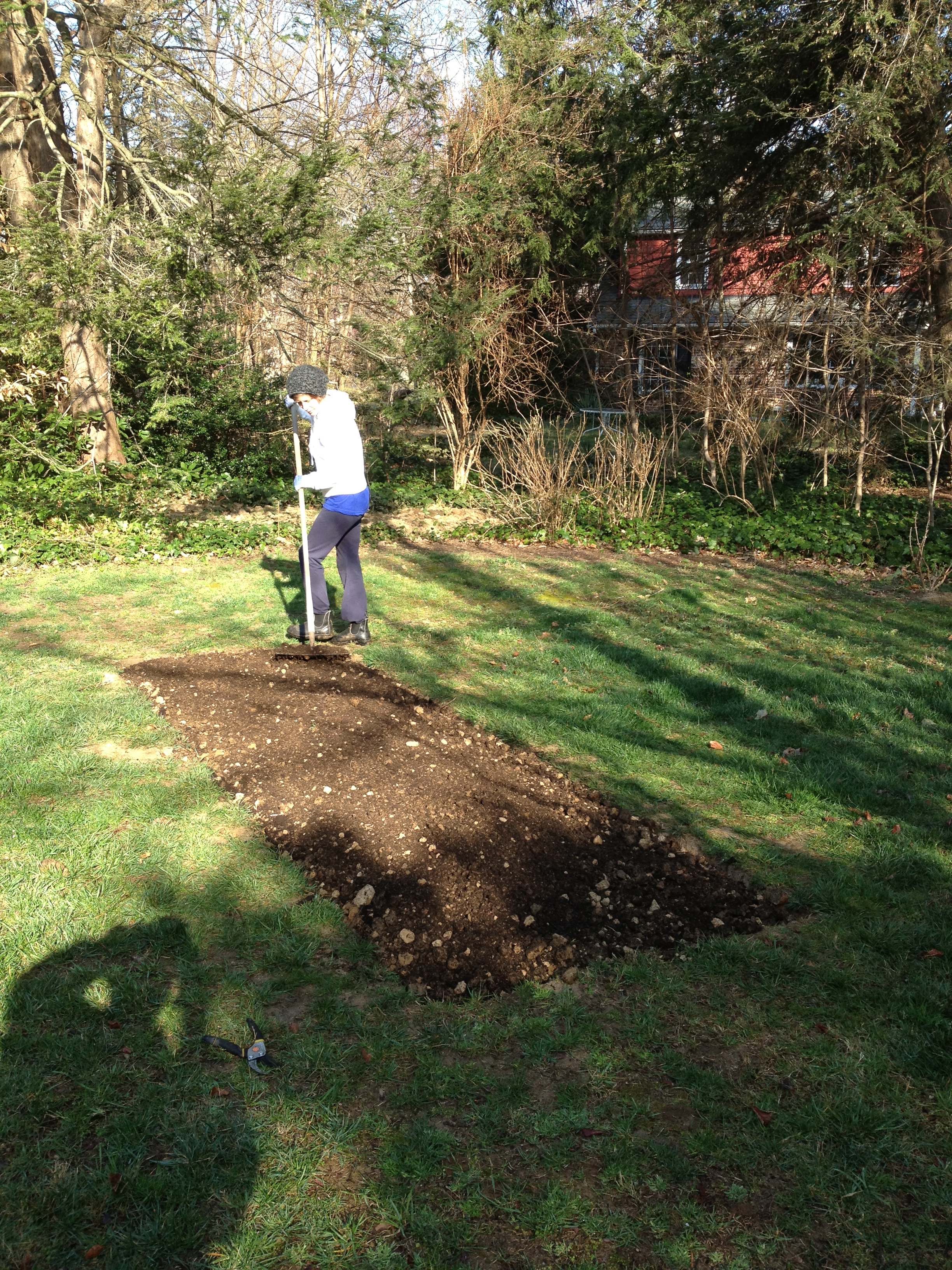
We let the bed sit, and carefully watch as rains come, sun shines, and bunnies hop.  All looks good.   I go back to Boston to see my husband.  I come back. Then the temps warm up. I decide that in my current situation (living a few different places) it might be best not to have two garden beds to maintain, so it will be one for now.  I also decide to get the ball rolling and add some more of the black stuff since we aren’t using it for the other bed.  And do some fine raking to break up some remaining clumps.  There is a voice in my head saying, “Be careful Ann, this is one of the ways you threw your back out once.”  Again, it doesn’t stop me (but now I do my back stretches almost every day to counter the gardening etc.)

raking out clumps, added another bumper crop bag (mar 19th)

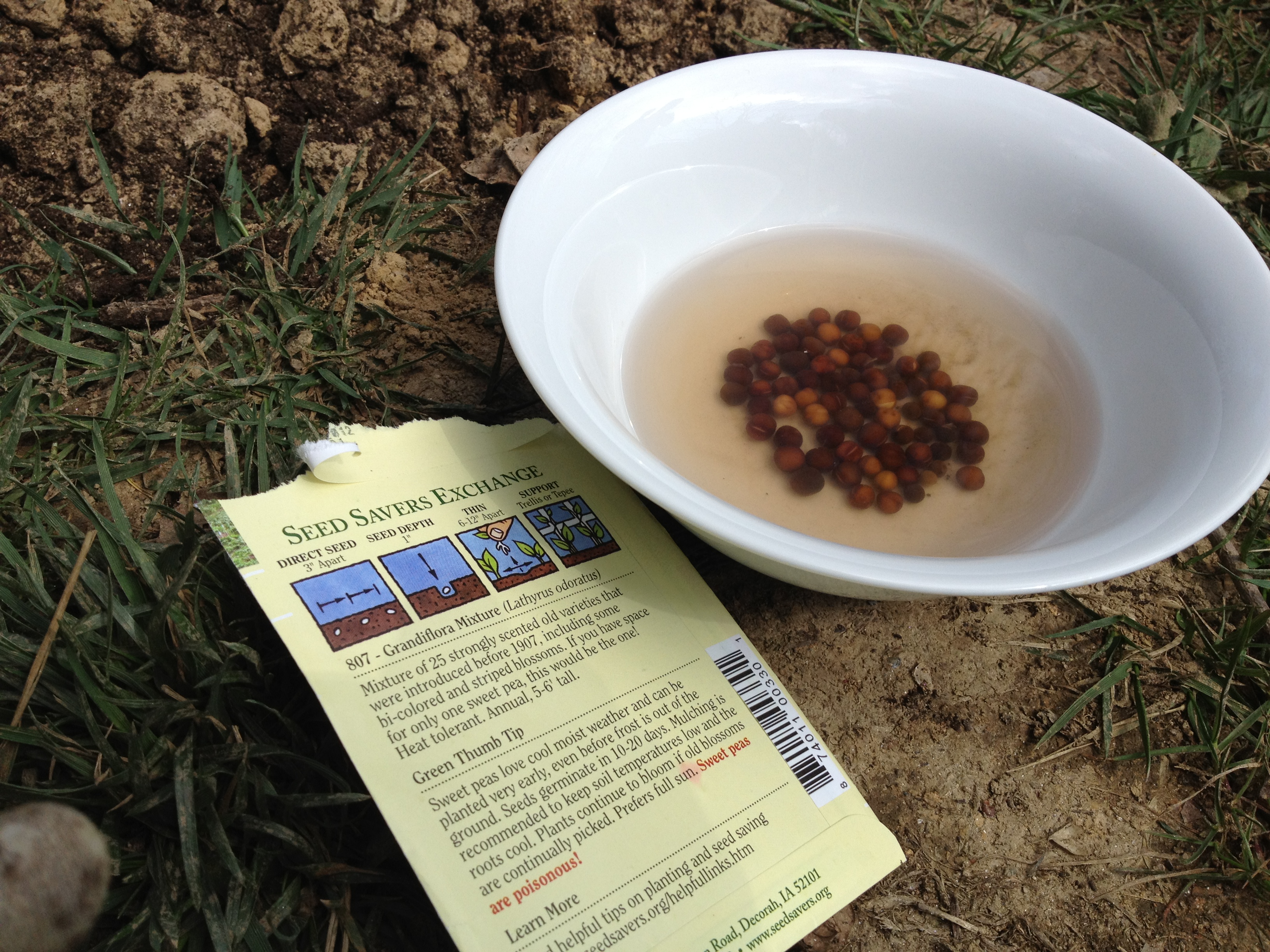
i read in my Flower Farmer book it's good to soak sweet peas for 24 hours before planting. they got all swelled up and look ready to burst here. (mar 20th)

And then it’s TIME TO SOW!  Here’s everything I planted today…Sweet Peas (Grandiflora mixture,) Hungarian Blue Poppy (Papaver somniferum,) Blue Boy Bachelor’s Button (Centaurea cyanus), White Lace Bishop’s Flower (Ammi majus) and Grandma Einck’s Dill.

first round of sowing (mar 20th)

Julie and I also bought some more stuff at Mostardi’s – I found some Euphorbia x martinii ‘Ascot Rainbow’ which I really dig for the foliage, although it is blooming now.  It will get 2-3′ tall and spread a bit.

Euphorbia x martinii 'Ascot Rainbow' (mar 20th)

garden diagram gone haywire, at least i can read it (mar 20th)

after first round of sowing/planting (mar 20th)

The red-stemmed dogwood will hopefully support the sweet peas, and also looks neat while there’s nothing happening.  Heck, maybe it will actually root! (Doubtful.) The plan is to see what germinates and perhaps add a few other things like sunflowers, zinnias or stuff I see in nurseries I like.  (Not doing the cukes this year because I think my huzz and I should do that project together.)  All watered and ready to grow…so think good thoughts for the little garden that could.  And happy first day of Spring!

day five – basic floral design I at longwood

Roman fresco with garland of laurel leaves, pomegranates, sheaths of wheat, and pine cones - photo courtesy of metmuseum.org

In today’s class we talked about garlands, which were popularized during the Greek and Roman Periods.   “Garland:  a wreath or festoon of flowers, leaves, or other material, worn for ornament as an honor or hung on something as a decoration.”  Personally, I like the idea of festooning long garlands all around the house and wearing a head garland at the same time.  In ancient Greece, head garlands (also called chaplets) were made of predominately foliage, and were awarded to honor athletes and heroes as symbols of allegiance and dedication.

Apollo crowned with a laurel wreath / photo courtesy of http://www.theoi.com

During the Roman period, garlands and wreaths were heavy and elaborate with fragrant and colorful blooms.  An abundance of lavish flowers was seen as a sign of opulence and wealth.  According to our teacher Jane Godshalk, there’s a story of one rich Roman Emperor who had a dinner party with a fragrant surprise: ceiling panels full of roses and other flowers. The idea was to let the canvases fall deliciously over the heads of his guests.  But it didn’t go like that –  a few of his guests were in fact smothered by his fabulous flowers.

party gone wrong at Elagabalus the Roman Emperor's place

There are a few ways of going about making a garland, and though we weren’t able to cover actually doing them all in this class, we were given a quick demo on how to make a wire garland, using pre-soaked Oasis blocks wrapped in plastic wrap and enclosed in chicken wire.  You just stick the materials into that, careful of the dripping.  A rope or twine based garland seems easy enough – just wire bundles of flowers/foliage around a stretch of rope or twine, making a loop with the twine on either end to hang it easily.  Work from one end to the middle, and then the other end to the middle. These are good for wrapping around pillars or poles, hanging swags on a table, or framing a window or door.

small garland of purple limonium, seeded eucalyptus, and bupleurum made by Jenny in class

And then there’s the table garland – essentially a wreath formed out of Oasis that you poke your plant materials into. Start with a basing of greens – in this case we used Ruscus, Myrtle, Galax and Seeded Eucalyptus.  Place them inside and out of the ring at varying angles.

my table garland/wreath in action - dinner courtesy of Dad and Julie with the wonderful company of Meg

Then add your main flowers – in this case spray roses and carnations.  Group them evenly throughout.  I used the seeded Eucalyptus as a filler flower really, but Limonium or I hate to say it Gypsophila also work well as a filler.  All of these items except the carnations (these were left over from another class) will dry pretty well and therefore this table garland borders on everlasting.

my first table garland/wreath - put a candle in the center and call it a day

All of these garlands are quite labor intensive and therefore should be done the day before an event.  That goes for head garlands too. In fact, I had just enough time in class to squeeze out a quickie for my niece June.

Niece June modeling the head garland I made

This was super fun to make and not too hard at all.  I measured out a piece of honeysuckle wire (just a wire with a brown wrapping, also comes in green,) making one end into a loop.  Then I made small bunches of daisy mums, Bupleurum, and Gypsophila or Baby’s Breath in my hand, which I then wired onto the main wire using bind wire.  Many mini bundles later the garland was filled, and I added some white ribbon on.

Head garland of Bupleurum, daisy mums and gypsophila on June

I really, really liked making the head garland.  I love the idea of wearable flowers – this might be a niche for me.  And when you put them on you feel like a total princess! (Or Greek goddess!)

Despite it's small size, I couldn't resist putting on the garland myself. photo courtesy of Juliet

wrist corsages

At falls flowers this week, I got a lesson in making wrist corsages.  There are a few different styles and ways of doing it, but as the request was for almost 40 simple white roses for a sorority gathering, we went with the simplest and fastest method – GLUE.  Gluing saves time when you have a bulk order, because the alternative is wiring and taping – a lesson I hope to get one day, too.  And this glue is like no other I’ve worked with – Oasis Florist Adhesive.  It’s a “fast-drying and waterproof liquid adhesive formulated for use with fresh flowers.” It won’t brown fresh flower petals, and it will hold up in cold storage. In other words, it’s a must-have for all you budding floral designers out there!

In making the wrist corsages, Peicha and I start by using well-hydrated roses, removing their sepals (the small spiky leaves at the base) and then trimming the stem down to near nothingness.  Shave the stem down with a knife so it’s as flat as possible.  Add a tiny blob of glue to both the bottom of the rose and the Elastic Wrist Corsage Band, making sure to spread the glue evenly.  Let the glue set for about 30 seconds and then carefully press the rose onto the band’s flat metal plate.  Earlier, we removed the little metal prongs that would normally fold over and enclose a bunch of wired flowers.  As with any glue, it’s better not to touch it with your fingers or you’ll be trying to get it off all day – this is especially true with this glue, though scrubbing with Lava soap does get it off pretty well.  Also – when working with this glue PLEASE choose a well-ventilated spot and take breaks to venture out into the fresh air or you will get silly like I did.

As far as wrist corsages go, I think there are a lot of possibilities out there on what you could do, and I think they are a great alternative for prom season.  Remember your date awkwardly trying to pin a corsage on your chest? This is so much easier.  And a wrist corsage doesn’t get in the way during the slow dance!  I really think we should all wear flowers a little more often, don’t you?

day four – basic floral design I at longwood

My parallel design (photo courtesy of hugh and juliet)

Today’s lesson was to create a Parallel Design, a design that’s meant to have a calming effect.  In a regular decorative design, like the Roundy Moundy, the overall shape is dominant. But in a formal linear design, the forms and lines are dominant.  The lines in this design are created by grouped plant material set in a vertical pattern with negative space between each section.  The negative or empty spaces allow the eye to travel through the arrangements.  We talked about parallel designs with Landscape Designs, but this one is different because we are not mimicking how you’d see plants in nature, and we’re not necessarily combining plants that are seasonally compatible.  In other words, let her rip!

Oasis fit to edge of container, covered by Apidistra leaf and "terracing" with Galax leaves

We started by filling a low container with Oasis floral foam, shaved to the lip of the container (important for a clean line, clean look.)  Nothing much should be hanging over the edges in the parallel design.   Jane recommends attaching an Apidistra leaf with greening pins to cover up the foam at this stage, rather than going back and filling in with moss at the end.  (Some stems will poke right through the leaf, whereas a hole will have to be made for other, more tender ones.)  We’ll be using a lot of basing techniques at the end to conceal the mechanics, but the terracing using Galax leaves is easier to do at the beginning.  Terracing is simply placing materials on top of one another, divided by space, like a staircase.

We get our materials for class from Delaware Valley Wholesale. Doesn't Jane look nice today?

Linear plant material is a must for this design, and we had lots to choose from, like gladiola, liatris, and equisetum.  Hold the line flowers/foliage up over the design to see where it looks best, and vary the heights.  The idea is to keep the same plant material grouped together for a bigger impact and to keep the lines stronger. They should all be placed in as straight as possible!  With lilies in the mix, the only way to go was to keep them low or they took up too much of the space at the top of the design – reserved for negative space.

Design in yellows and whites - very restful

Depth is created by angling stems, overlapping materials, and the use of color (light colors pop out while darker ones recede.)  The lines create negative and positive space.

Afeefa's Design - powerful color choices

Notice how Pat trimmed her Equisetum on a diagonal cut for effect (sorry Pat I didn't get the bottom of your design!)

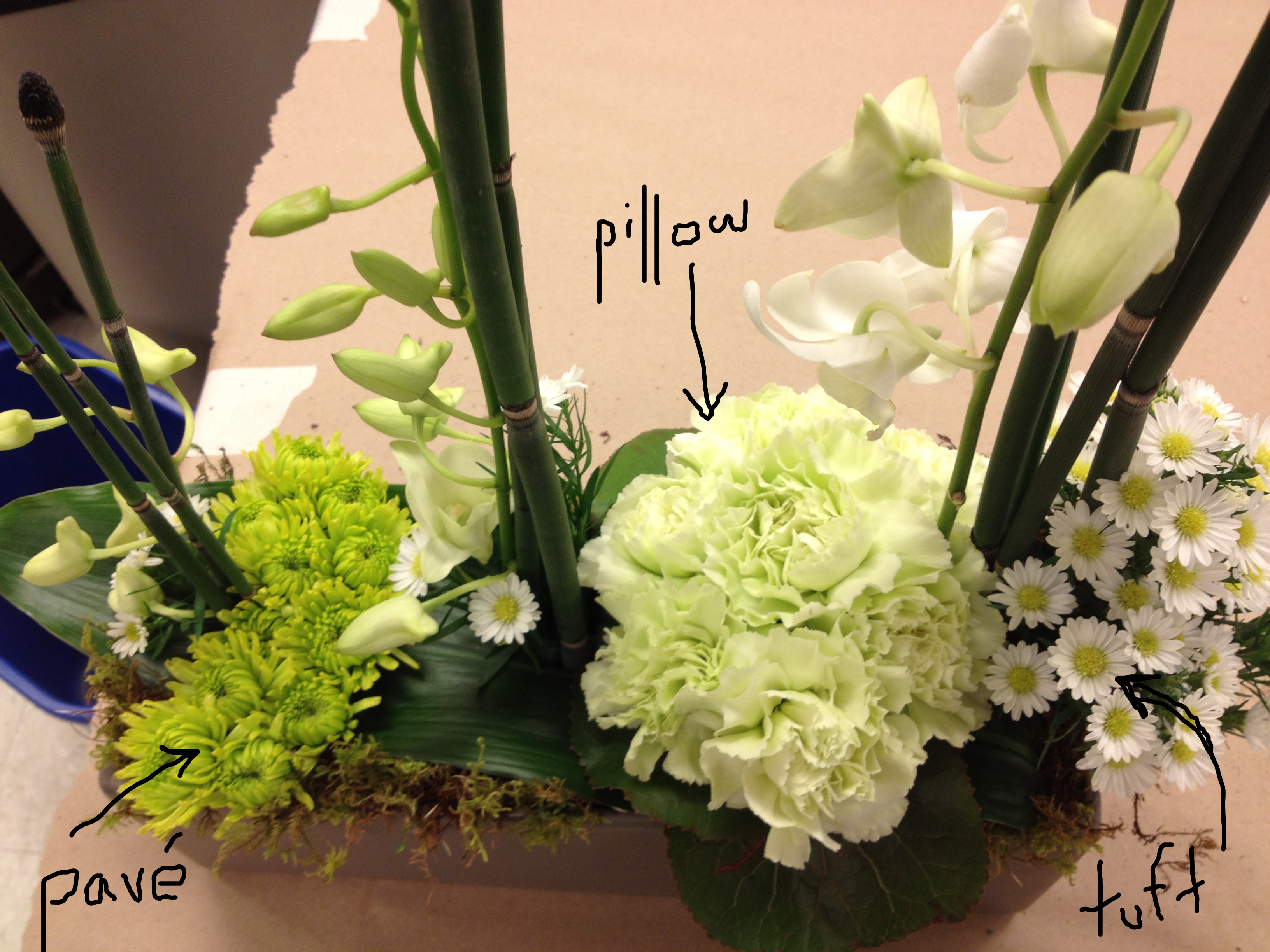
Next, we did our basing techniques to cover the mechanics and to create color and texture.   Pillowing is creating a tight, round pillow out of a few stems placed radially.  Tufting uses bunches of short stems to create an airy look.   Pavé-ing is a tight clustering technique where the surface of the bunches remains totally flat, creating a cobblestone effect. (Pavé as in the jewelry technique, too.)

Jeny's Design to show basing techniques

class critique - don't worry, we all get As here (Melissa's design up close, I think)

This design really opened my eyes to the possibilities of parallelism.  I think these would make great table centerpieces because you can see through them easily and they look good from all sides.  You create a little mini world in a box that has nothing to do with the way plants would really be growing and it’s kind of liberating.  Also, it’s been said that men prefer these vertical designs.

my design in home environment (photo courtesy of hugh and juliet)

(photo courtesy of hugh and juliet)

intro to ikebana – longwood – day two

Midori Tanimune, Longwood Ikebana Instructor, Sogetsu School

Instructor Midori Tanimune, a diminutive and ageless Japanese woman with twinkling eyes, begins the class with a story about herself.  When she was 11, living in Japan with her family, her father tragically passed away.  She had spent every day talking to her father in the fields, and they were very close, so when he died she didn’t know what to do with her grief.  Her mother, having no other answers, sent her to tea ceremonies and Ikebana class once a week after school.  Midori would listen to her Ikebana teacher, and talk about herself, and as long as she came home with a flower in her hand her mother did not question her.  “Ikebana saved my life,” she whispers, but through a smile.  It will teach you to “clean up your soul” and respect nature, respect silence.  I look around at my classmates in surprise at this raw emotion I did not expect to feel at 9am in the Acer Room at Longwood.  There are some other watery eyes too.

Poem by Midori

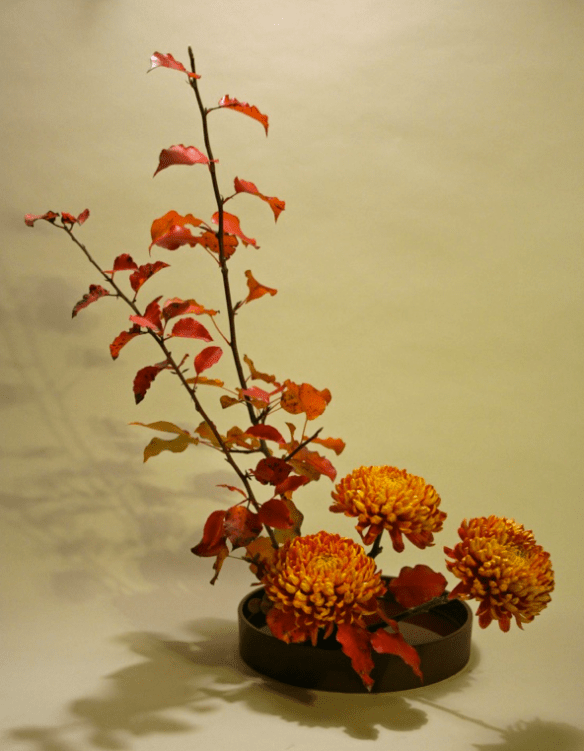
Midori is in the Sogetsu School, the newest Ikebana school founded in 1927.  In this school, they use unconventional materials alongside fresh flowers.   Their philosophy of Ikebana is that “it can be created anytime, anywhere, by anyone in any part of the world and with any kind of material.”

one of Midori's designs courtesy of epochtimes.com

Also, the teacher must make the arrangement towards the student, which I imagine might be difficult, given all the precise angles, etc.  Midori explains that if we see something we want her to do or to change, to speak up.  I know I certainly don’t feel qualified to do that at this point!   As she creates several different designs for us, none of which I got very good pictures of I’m sorry to say, certain words of wisdom pop out at me.

  • The moment you’re making it is the most important.
  • Never put the kenzan in the middle of the container in Moribana. (Kenzan is the device with points meant to hold the stems.)
  • Use a cutting bowl to cut stems underwater especially for spring flowers.
  • There are 3 main elements when creating an arrangement in Sogetsu Ikebana: Line, Color and Mass.  Line = Space.

Basic Upright Moribana photo courtesy of http://keithstanley.com - 365 days of ikebana

Our first lesson is to create a Basic Upright Moribana Arrangement. Moribana, as you may recall from Day 1, means “piled up flowers.”  And the basic upright arrangement is the most important, “because all freestyle comes from this.”  There are 3 main stems and specific rules about how long they should be and at what angle they are placed in the kenzan.  We’re using a long low container for this.

Julie's moribana design - beautiful

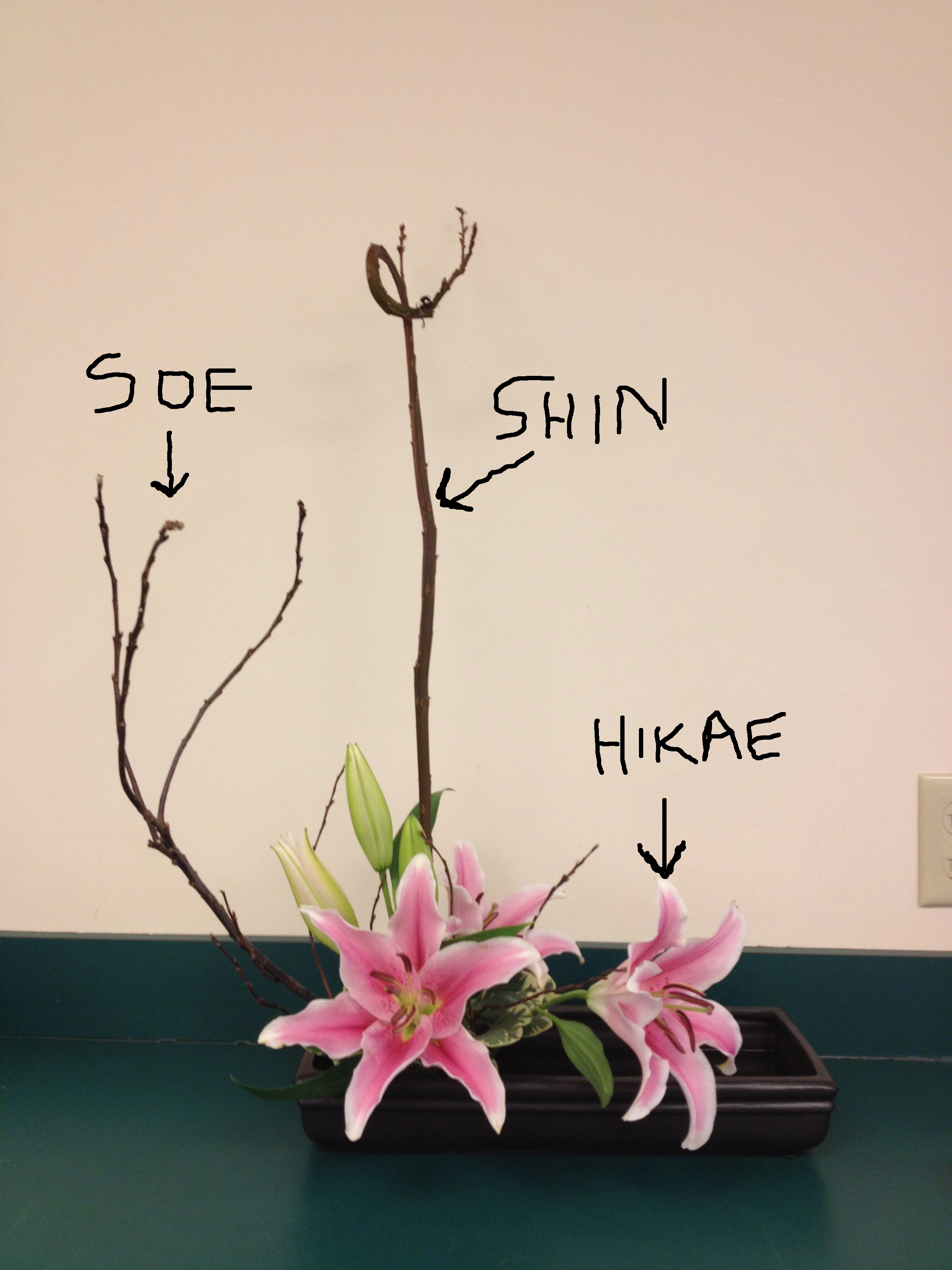
Shin is the First Main Stem, and Midori calls this stem “the husband.”  The measurement of this stem is the most important, as the other stems will be fractions of it.  The shin should be 1 1/2 times (the depth of the container + the diameter of the container.)  The Shin stem goes in first, in the back center position, placed straight into the kenzan and then turned slightly to the left, as if bowing.  In the arrangements we’re doing, the Shin is a Willow stem.  Choose a side of the stem that will create depth, and trim the stem accordingly to create the strongest line.

Soe is the Second Main Stem, and Midori calls this stem “the wife.”  The Soe is 3/4 the size of the Shin, and goes in second in the left front position.  She is placed straight into the kenzan, then pushed to a 45 degree angle towards the arranger’s left shoulder. The Soe is also a Willow stem.  In choosing how to place the stem visually, don’t think radially.  Think about the stems ‘conversing’ with themselves.  (This was not a natural thing for me to do! I’m so radially oriented!)

Hikae is the Third Main Stem, and Midori calls this stem “the child.”  The Hikae is the shortest stem, and 3/4 the size of the Soe, and goes in the right front position. She should be placed straight into the kenzan, then pushed to a 75 degree angle towards the arranger’s right shoulder and opposite from the mother or Soe. We used a Lily for this stem.

my Moribana with diagram

Next, you should “invite all your friends to the house,” by placing in other supporting stems of the same material – lilies and willow.  But these supporting stems, or Jushi, must never compete with the main stems for line or space.  Always keep the spaces between the main stems open.  And when placing the supplemental “friends” in, make sure some of them are angled towards the main action of the house, so they’re all having a conversation with each other, rather than angling them radially.  Make sure they create movement.  Also, remember that smaller blooms are placed higher in an arrangement, and larger ones LOWER.  Then, place one main flower at the center to “close the door,” and add some greens or pittosporum in our case, to hide the mechanics of the kenzan (not too much but just enough).

Midori helps us get our moribanas right

After a nice long lunch break, we’re back to create the Basic Upright Variation No 4 – Nageire Arrangement in a Tall Vase.

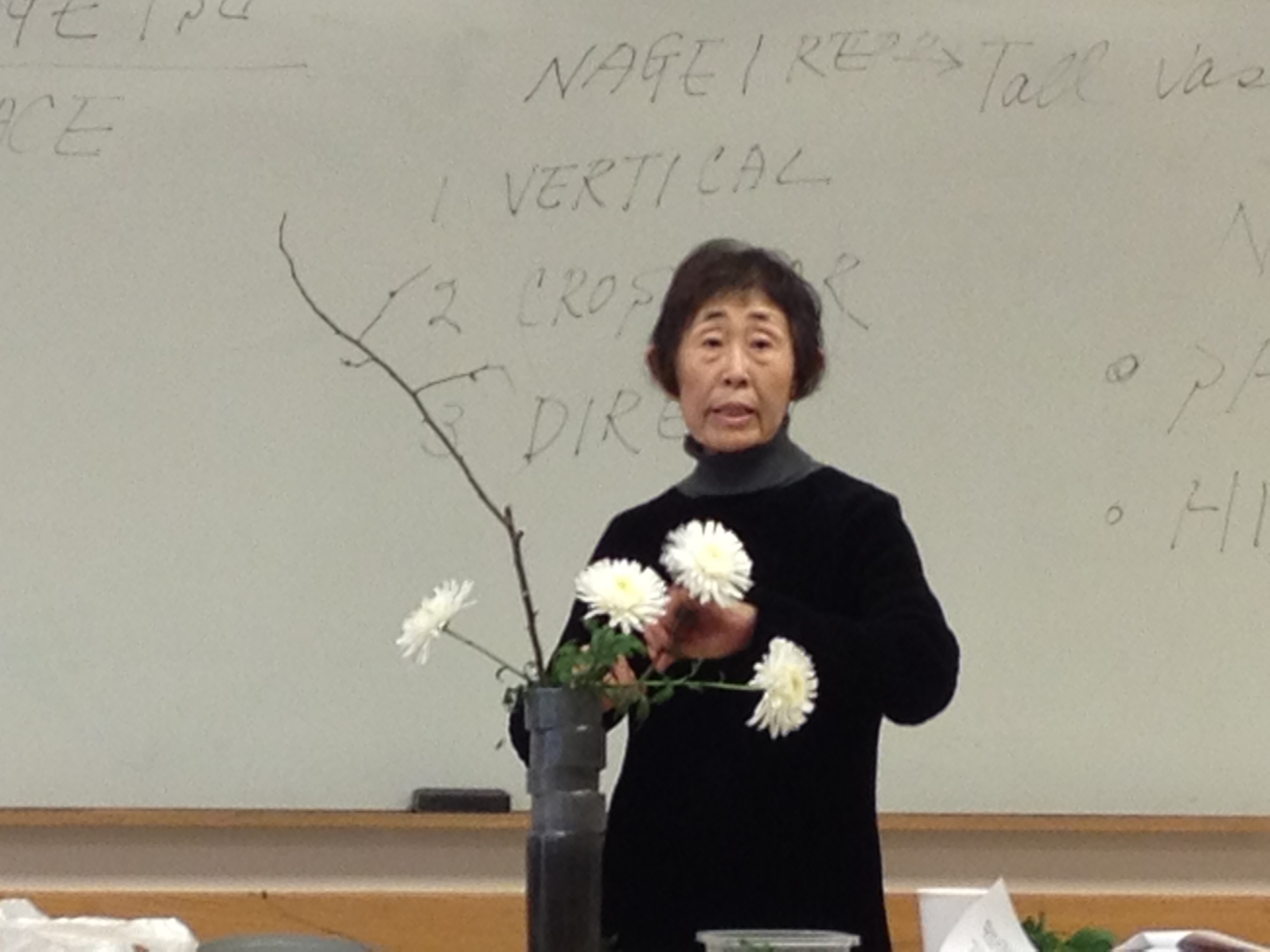
Midori with Upright Nageire Design we are to make

Nageire is Japanese for “thrown in” and usually utilizes a single long branch with shorter branches and flowers at the base arranged in a tall upright vase. And while there are only 2 main stems (the Shin and the Hikae,) there is NO KENZAN, or device to hold the stems in place, so the mechanics of this will be a little tricky.

Create a supporting branch in the shape of a Y for your Shin stem

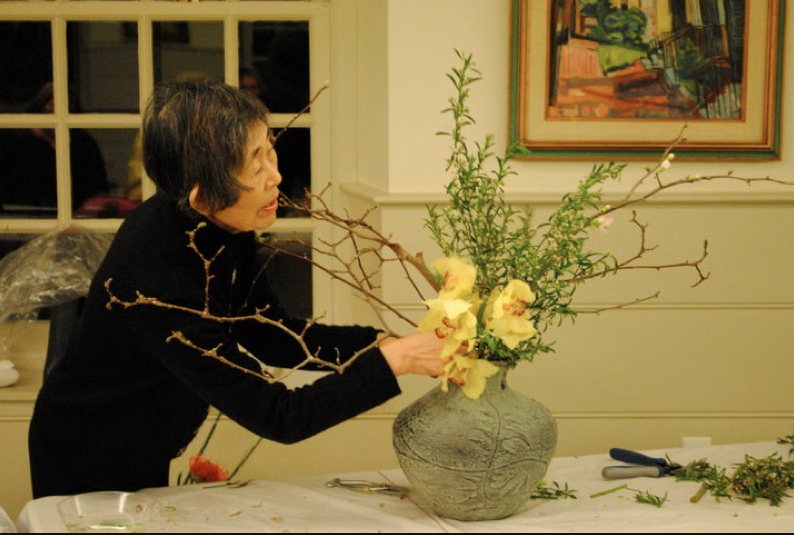
The first order of business is to cut a supporting branch that will hold the Shin, making sure there is water in the vase first.  Once you place your stems in, that’s it, it’s really hard to move the container without displacing the stems!  So, your supporting branch will be a few inches lower than the container’s depth – and where it touches the bottom of the container, it will be cut straight, not on a slant.  Cut a slit in the top side and widen it out – this will create a Y for the Shin to sit in.  The Shin stem, a flowering Quince branch, should be as straight as the material will allow, and should be cut up the center so that it can connect strongly with the supporting branch.  The end of the Shin should be cut on a slant and touch the side of the container for support.  Actually there are some rules about the stems and where they can touch, that are basically all about how to anchor things so they stay in place best.

rules about stem placement in nageire

Getting the Shin in right is easier said than done! Midori has to help all of us with this.  We are not used to working with this mechanic but it’s SO cool once you learn it!
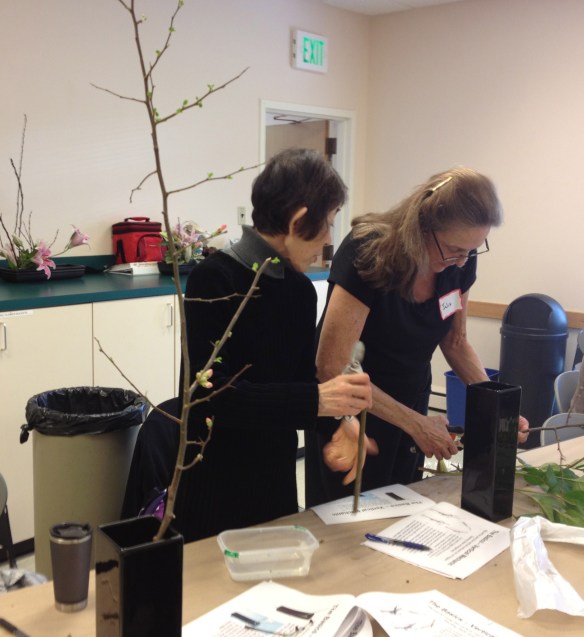
Julie trims the Shin stem to create an even straighter line

Then you will add the Hikae stem – in this case a big white Chrysanthemum.  The Hikae must be placed at a 75 degree angle towards the arranger’s right shoulder, just like in the Basic Moribana arrangement.  But in this design, there is no Soe.  The Hikae stem should be against the back wall of the container to get the proper angle away from the Shin, and you can gently bend your stems to fit them in.  Then place some supporting mums in, and then take a little left over mum foliage to hide the mechanics.  Nothing in this design should be hanging over the back edge of the container!
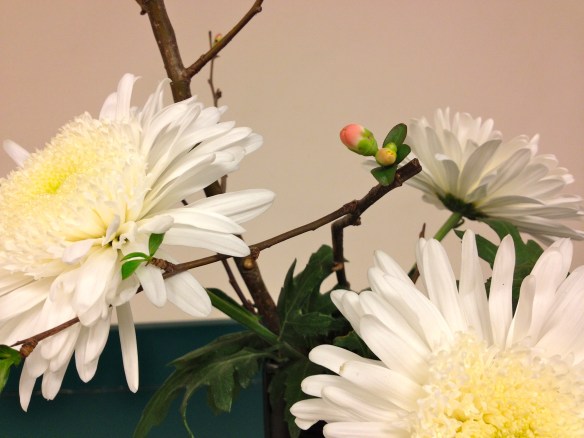
Midori helped my design by pruning back the quince branch to reveal the buds that were popping - so they became more evident
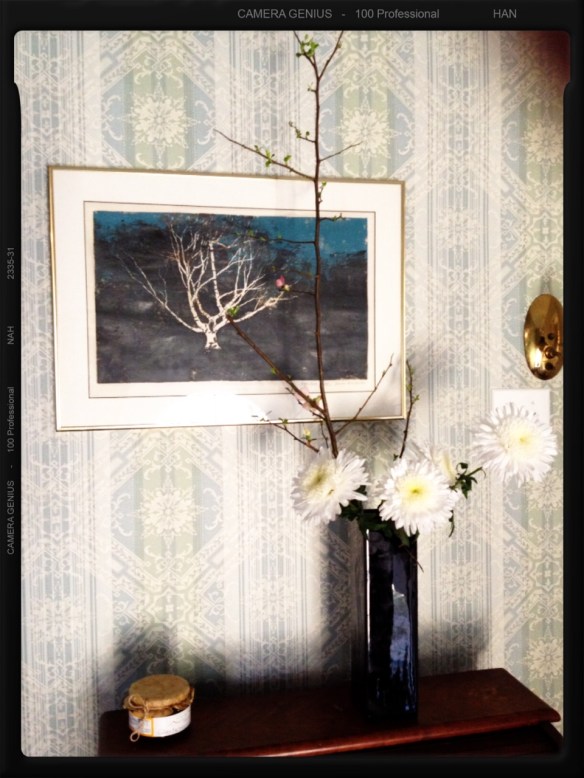
I recreated my Nageire when I got home, placing it in front of my sister's art called 'Night Birch'

I loved this class and I loved Midori.  She is such a special person and made all of us feel like we deserved an A+ for our designs.  I learned a lot this day, and also felt spiritually connected to what I was doing. Thanks, Midori!
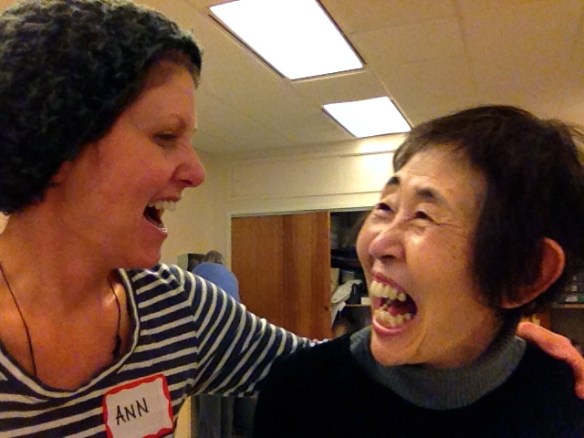
Midori and I laughing about how hard taking a picture seems to be

Photo of Midori at beginning of post courtesy of – New Castle Delaware – Arasapha May Market 2011’s Facebook page

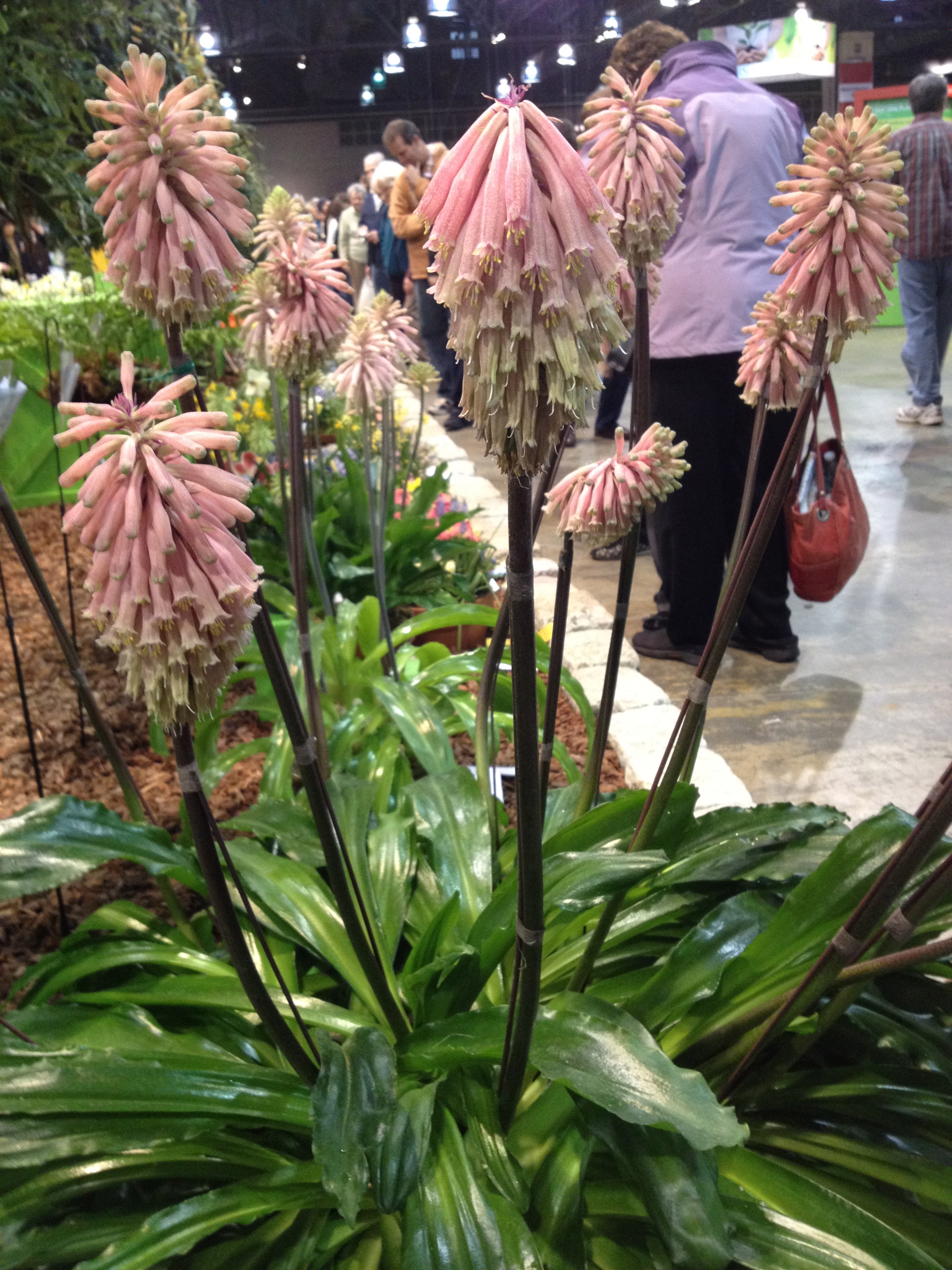
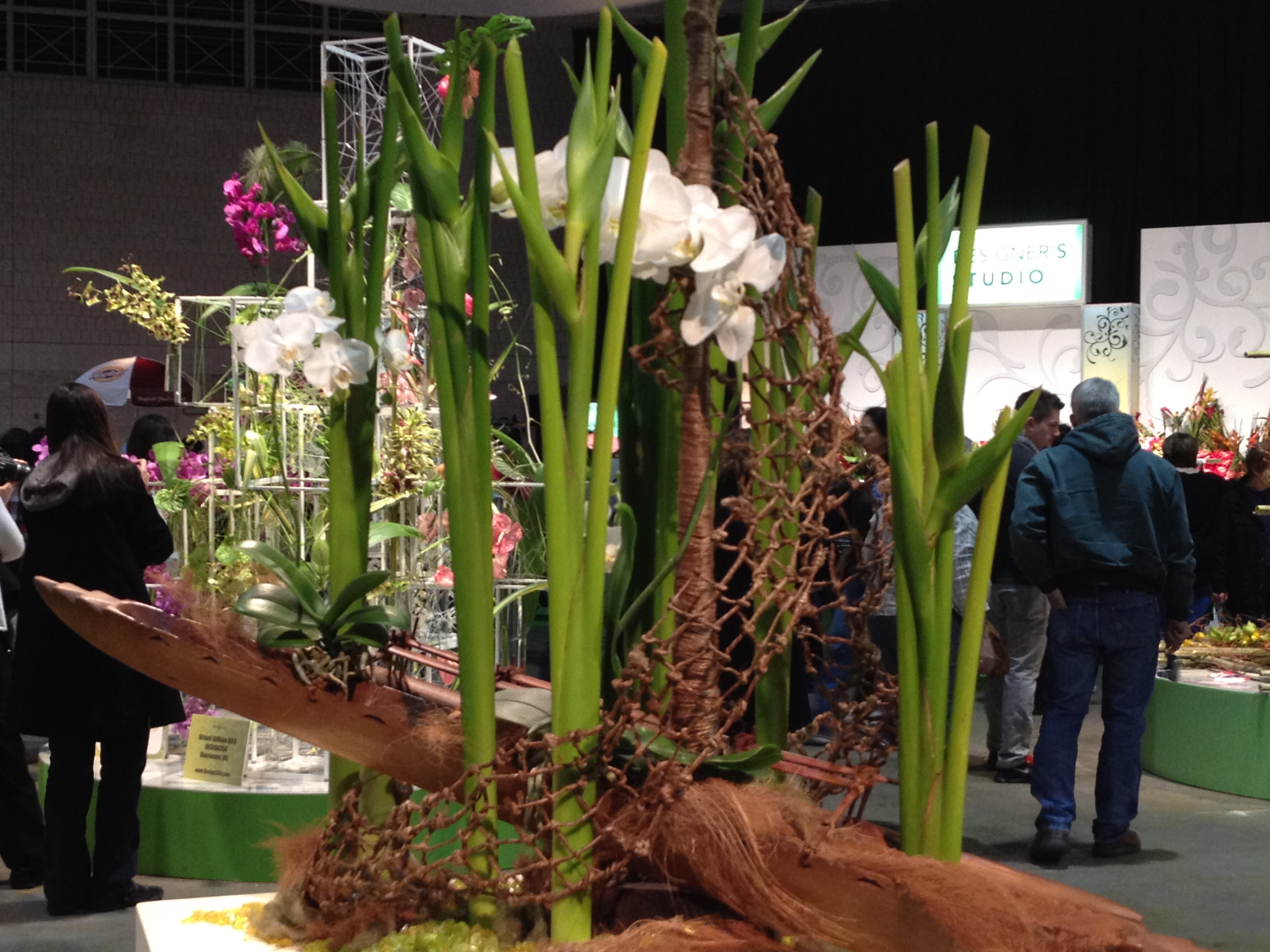
2012 philadelphia flower show inspirado!

floral wave

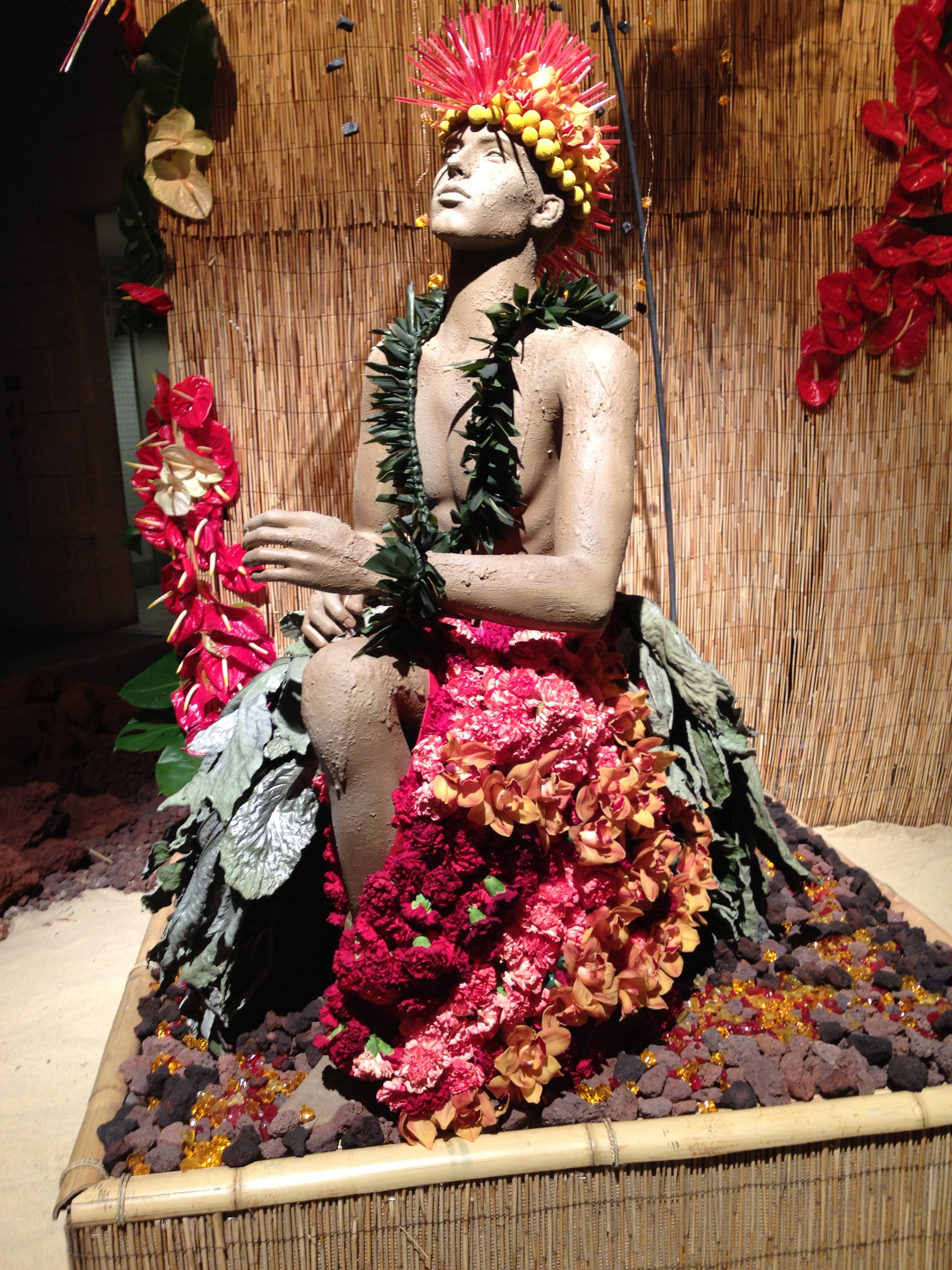
“We’re going to Hawaii!” my peeps and I kept shouting on the way there.  And it was just what the doctor ordered for our sunlight-starved, oxygen-deprived, pale winter bodies.   And I’m glad there were so many plants to compensate for all the oxygen-breathing crowds – I mean, it was SO crazy packed I could barely get over to see Longwood Instructor Jane Godshalk’s amazing Hula Man.

Hula man in AIFD's installation by Jane G. - WOW.

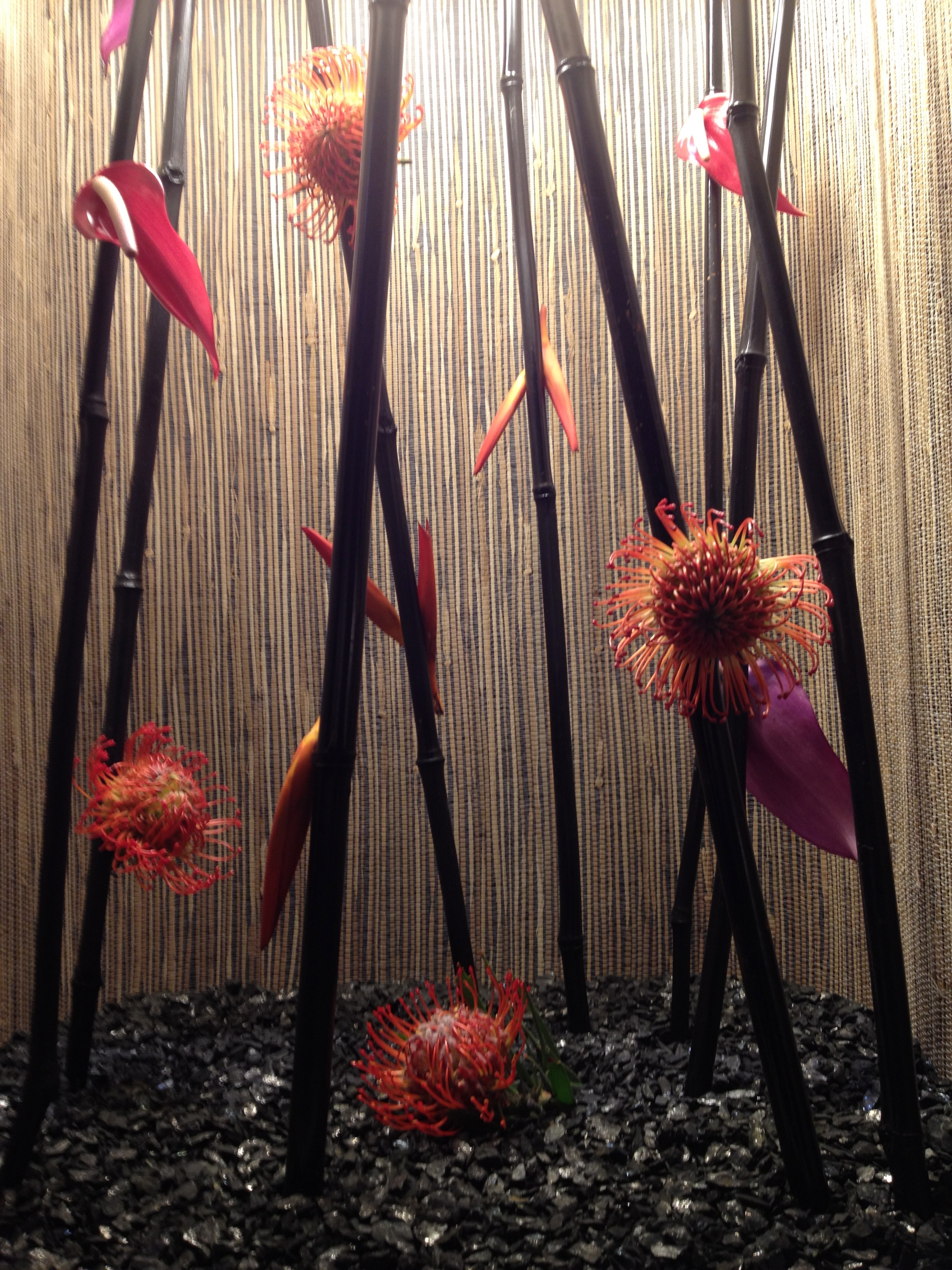
I liked how there were rows of arrangements displayed in their own little specially-lit boxes

This design evokes 'Tiki' the best according to judges - Pincushion Protea

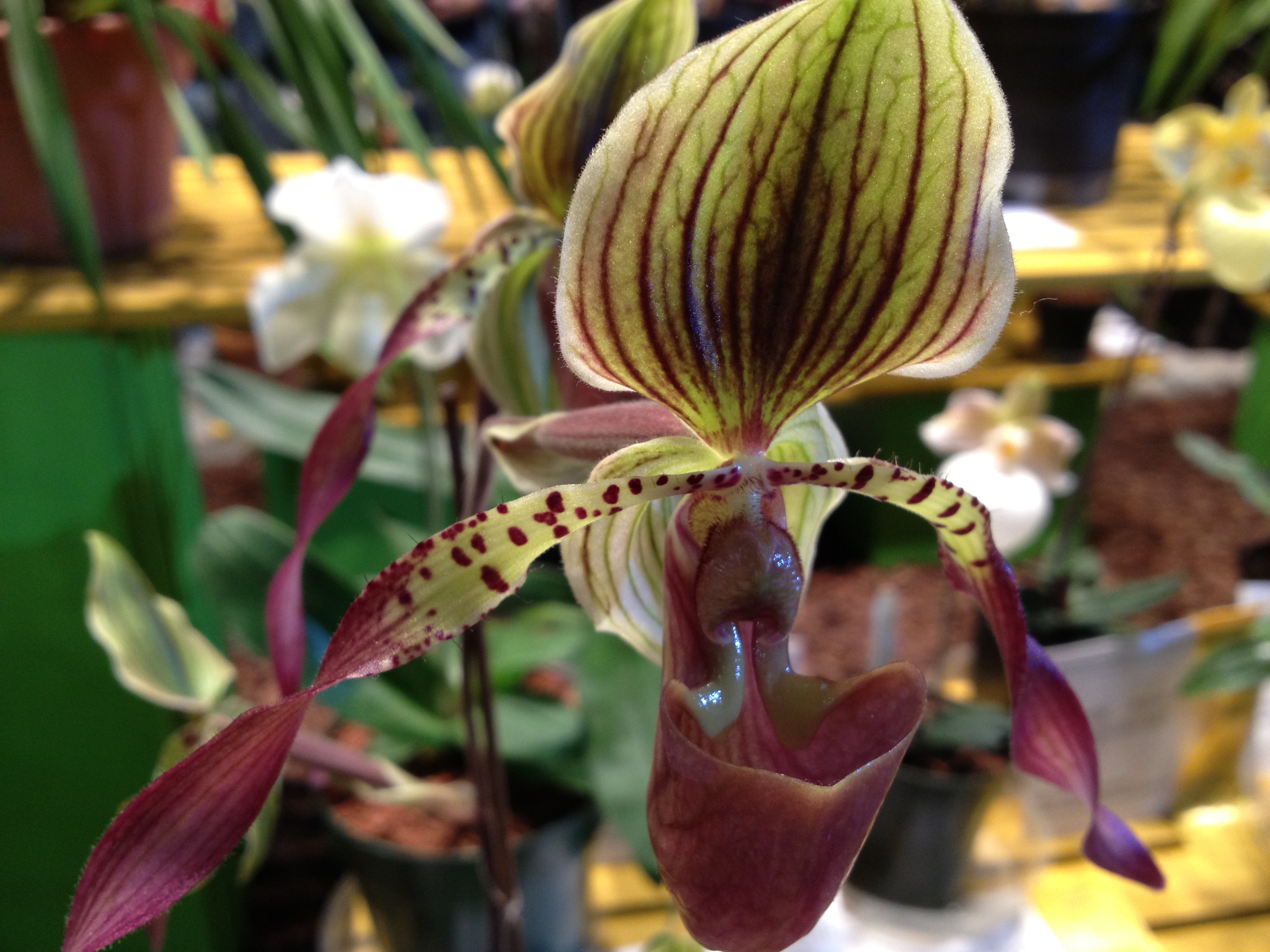
Paphiopedilum Orchid

someone please tell me what this is

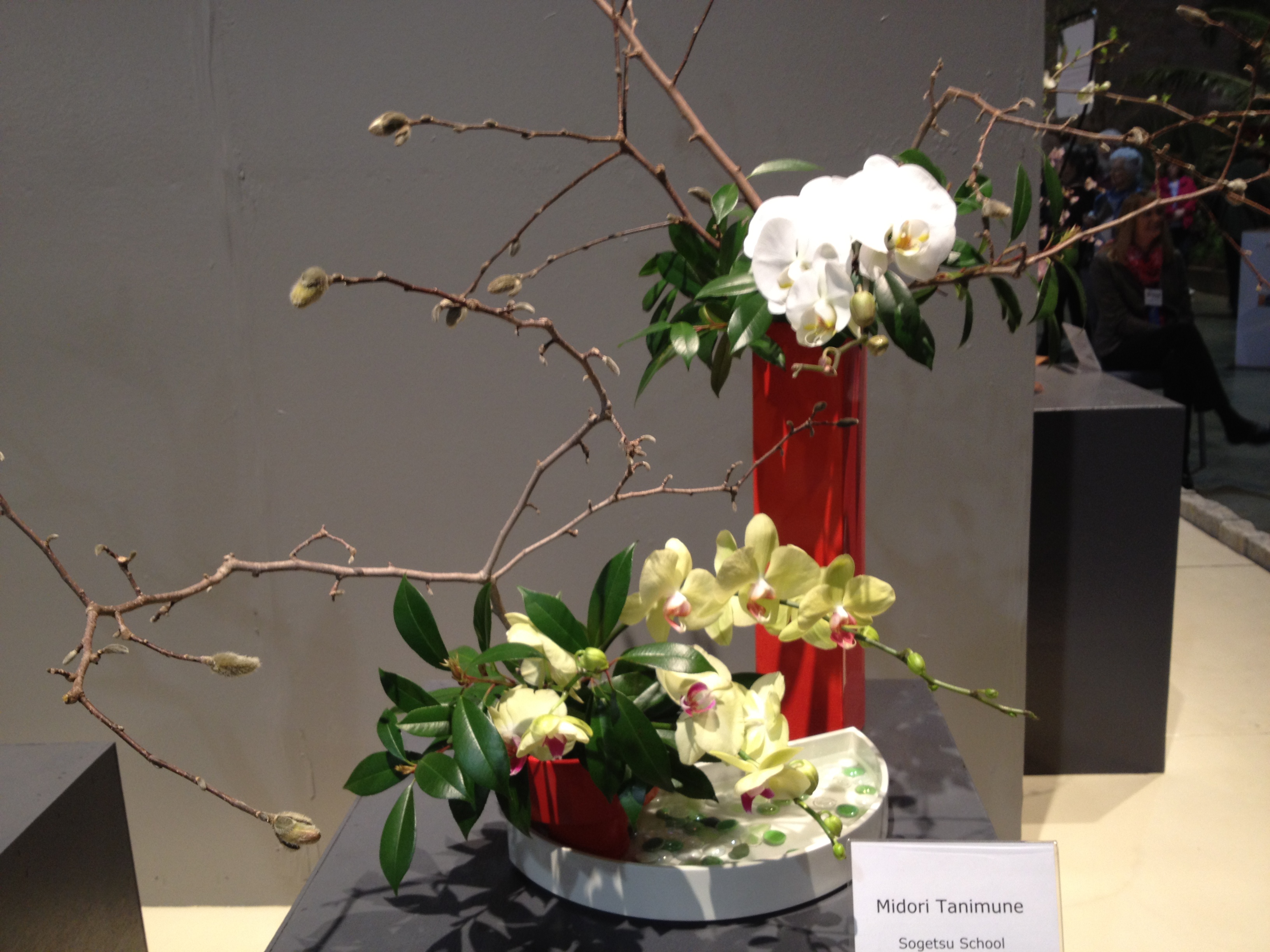
Ikebana by Midori Tanimune, one of my Ikebana Longwood Instructors

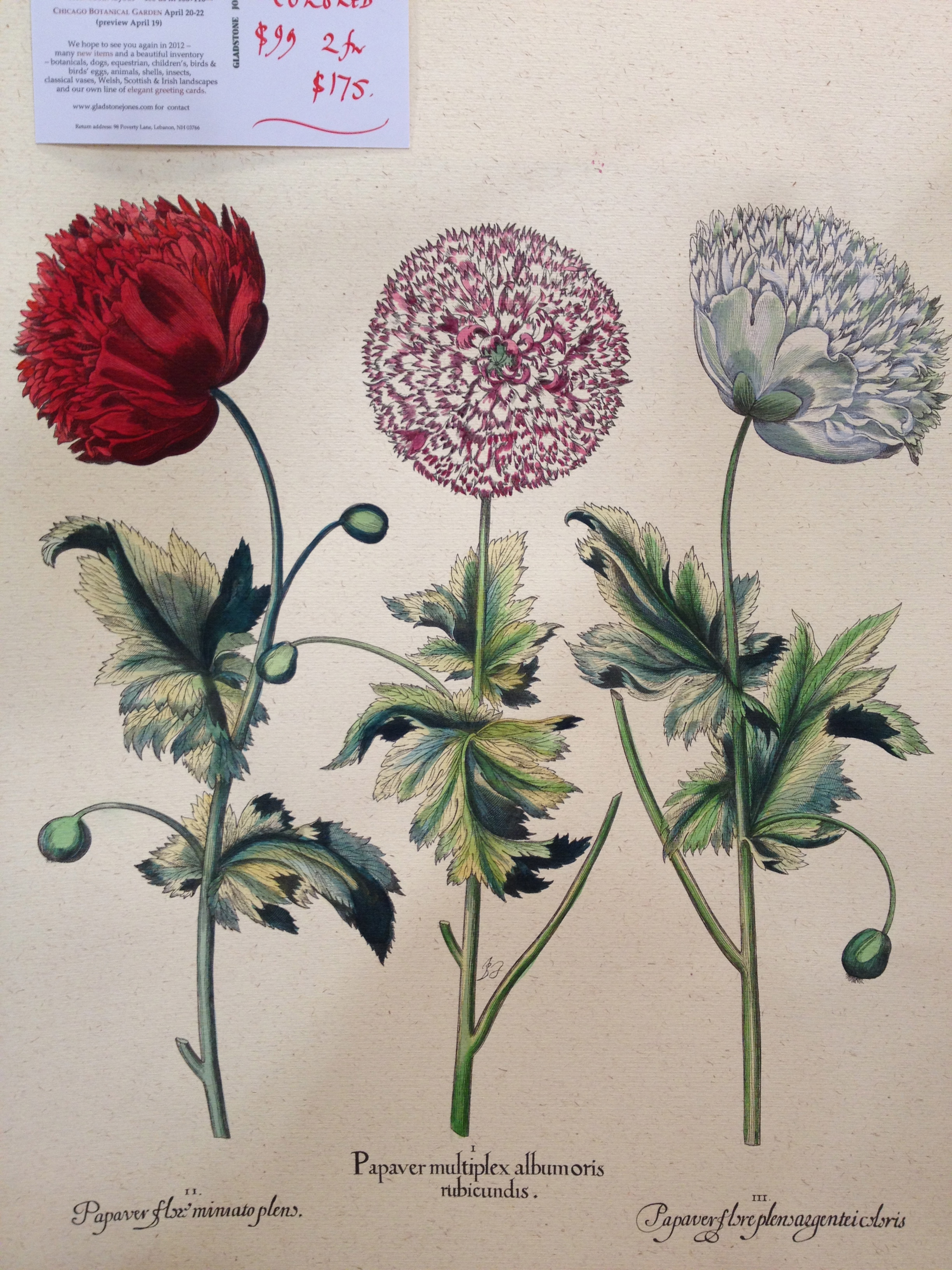
I want to fill a special room in a house I don't have with botanical prints

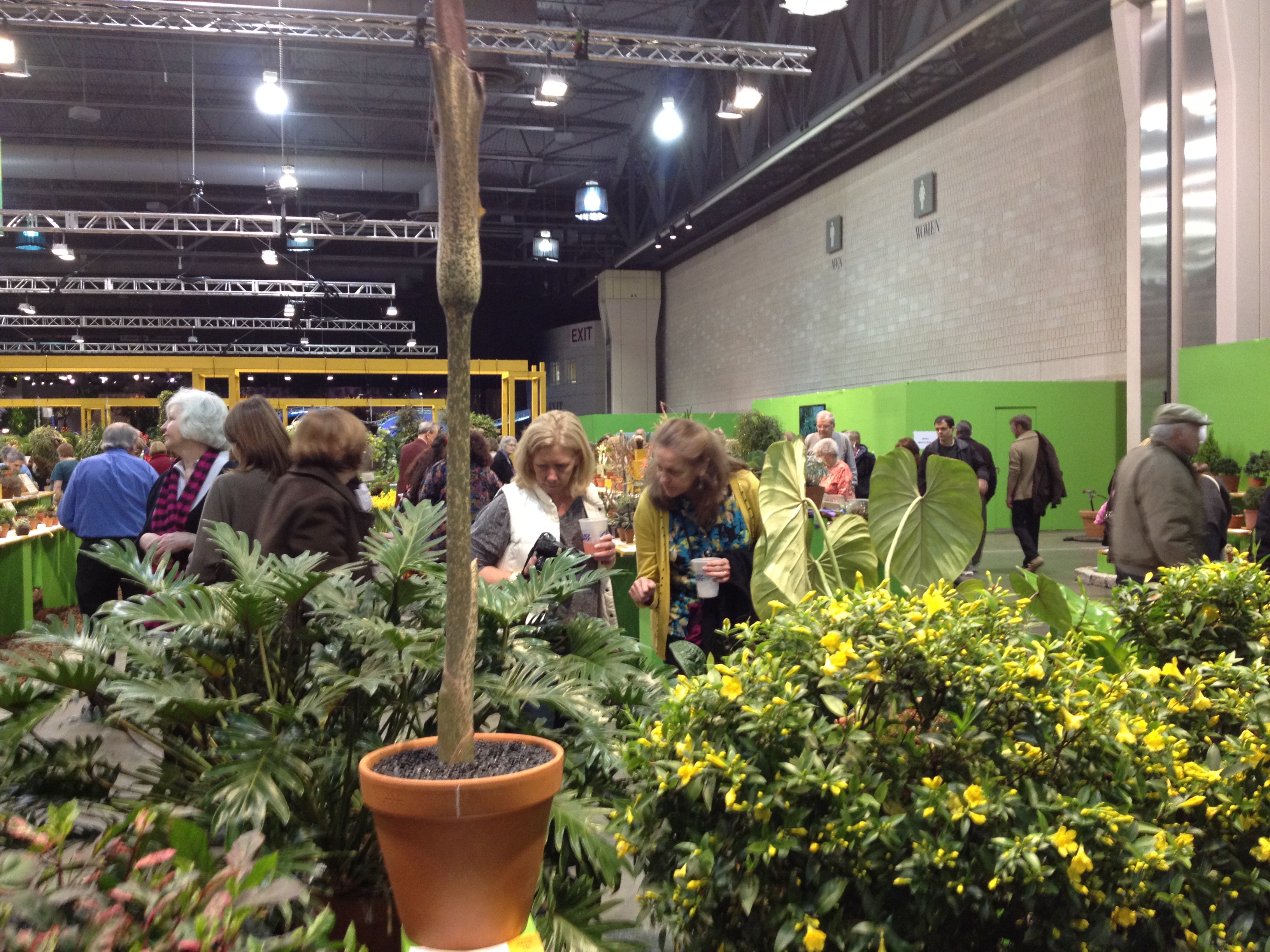
Ladies, look over here at the Amorphophallus!

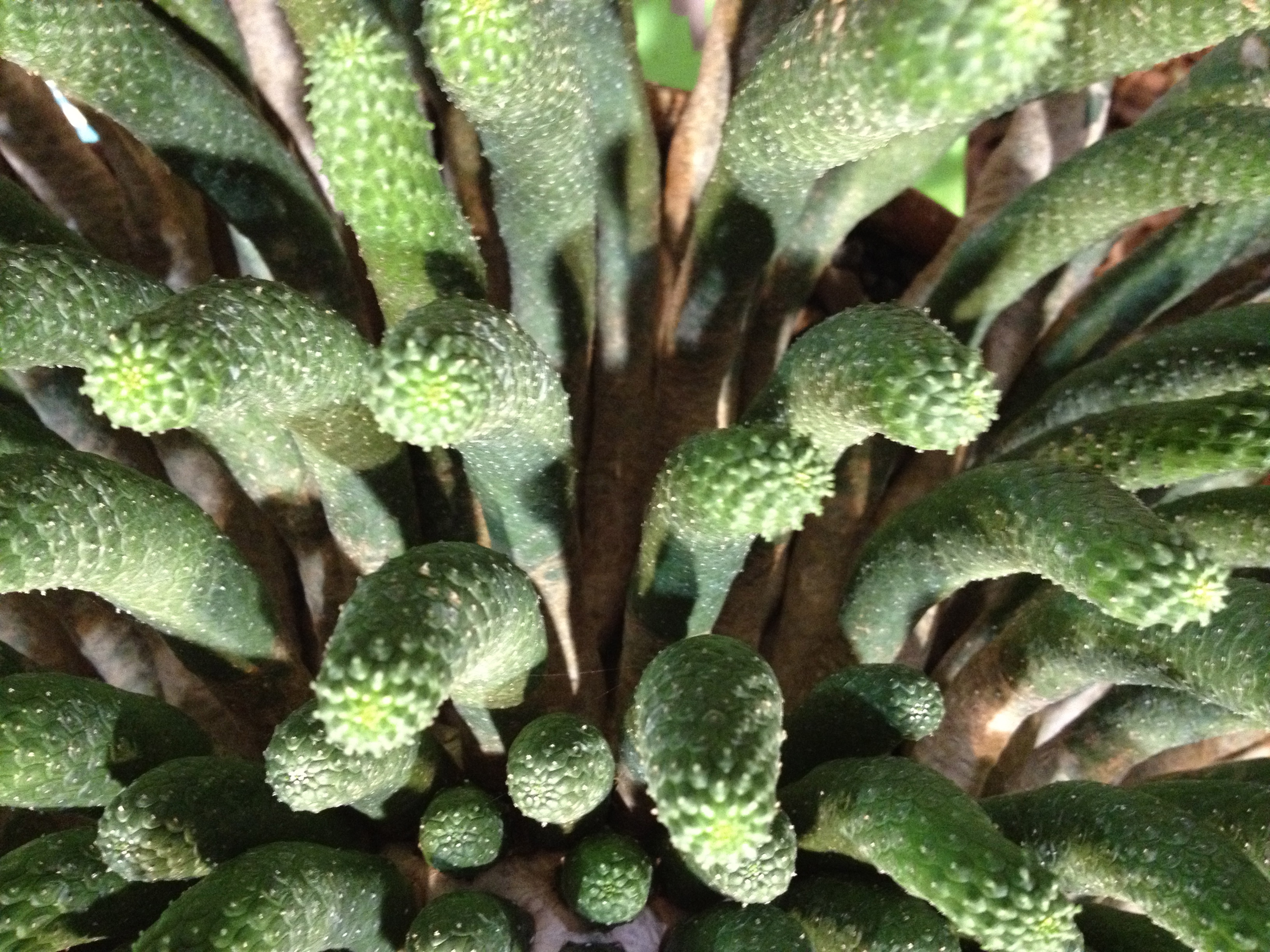
Prizewinning Euphorbia esculenta

I feel this way sometimes - it's a good thing

Don't you just hate when that happens?

'Outrigger' - Winning design by my instructor Jane Godshalk! Judges called it "brilliant"

My sister Amy took a lot of great pictures on a much better camera than mine – check them out HERE.

intro to ikebana class – longwood – day one

“Clear your mind.  Relax.  Let the plants speak to you,” says instructor Janet Solomon, during day one of Intro to Ikebana at Longwood Gardens.  Ikebana means “living flowers,” is nature focused and is a ‘do’ or way of life in Japan that’s considered a lifelong journey.  So, in other words, don’t expect to really know much after two days.  But after two days, Janet says, “your designs will be affected.  Number one, you’ll stop picking large bouquets and start using space differently.”  The biggest lesson here: less is more.  In Western arranging, we’re taught to use mass – building tightly packed, dense designs – and our emphasis is on color.  In Ikebana, the emphasis is on the line (and sometimes you must trim your plant material a lot to attain the lines you’re seeking.)  The asymmetry creates open spaces which invite the eye to explore.  The beauty is in the form and growth of a plant rather than the color.  The composition communicates the feelings of the arranger, and if you’re really doing Ikebana correctly, you might say something like: “the flowers just wanted to be arranged that way.  I listened to them, and that’s what they told me to do.”

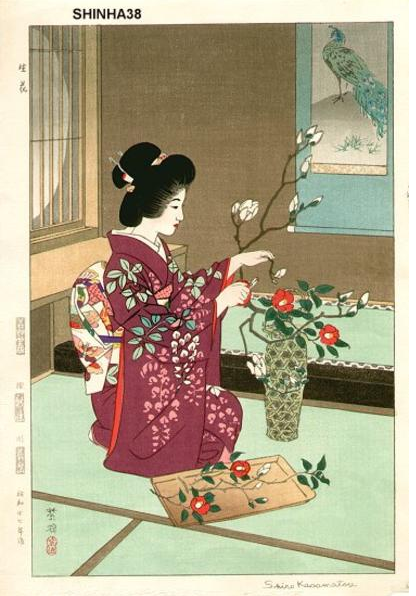
Ikebana Woodblock by Kasamatsu Shiro 1954

In Western arranging, we’re also focused on blooms rather than leaves and branches (though in our Basic class Jane uses plenty of branches and foliage.)  And not just blooms, but the perfection of blooms at their most perfectly open moment.  In Ikebana, imperfection is embraced.  A holey leaf is holy.  And the flowers are shown in different stages to represent the passage of time:  a fully open flower = the past; partially open flower =present; and a bud = the future.  Thus the choice in Western arranging of fully opened blossoms is considered “pitiable” in Ikebana, because these forms only represent Death.  “Not a pretty thing,” says Janet.  But in Ikebana, using seasonal items that are not “perfect” brings nature into the house and allows us to reflect on the concept of time.

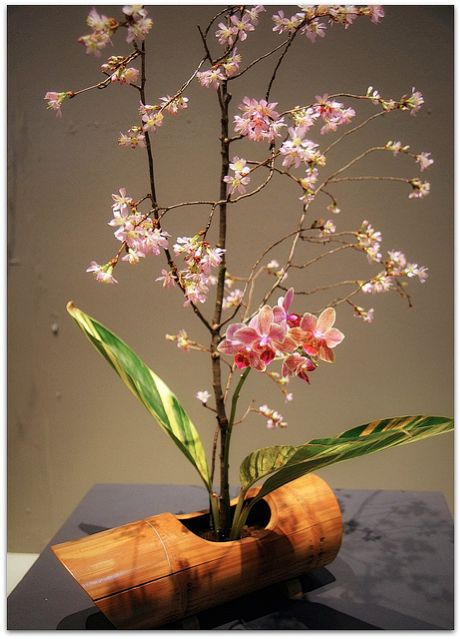
Ikebana arrangement at Philly Flower show - plenty of buds - photo by Amy Kane

As you can see, there is a lot of symbolism, and a reverence towards nature.  That’s because Ikebana’s genesis was religious, synthesizing elements of Shintoism and Buddhism.  This is cool stuff:  in Shintoism, the indigenous religion of Japan, nature is sacred, and contact with nature is a way of being close to the gods.  The monks would offer entire plants – root and all – to the gods. This is the basis of arranging at its most primitive.  In the 6th century, Buddhist monks gathered flowers and branches left after storms and arranged them at the foot of Buddha statues.  And that was where Ikebana sprang from.  I love these ideas because they express some of my own feelings about nature/plants.  I’m not religious, but I do hold nature sacred.  Gathering plant material from the outside, and putting it in a container in a design that enables me to connect with the material is an offering of sorts.  To Mother Nature, as I call her.

another Ikebana from Philly Flower show - photo by Amy Kane

Then Ikebana took off, and evolved into many styles.  These many styles include  (short-hand of my notes from class not meant to be exhaustive by any means): Rikka – 10-20′ high, these designs were microcosms representing mini landscapes complete with hills rivers and towns. Chabana – 17th century, these accompanied the tea ceremony (cha = “tea”) and held one branch and small flower.  Shoka – late 17th century, Shoka answered the need for something between Chabana and Rikka that could be ‘for everyone.’  These designs are asymmetrical triangles with open spaces.  Stems are tightly bundled at base to resemble single growing plant.  More on this, we made one!  Nageire – chabana “on steroids.” Tall narrow container.  More on this later, we made one!  Moribana – “piled up flowers” from the late 19th century.  Low rectangular container. More on this later, we made one!  Free style – these designs use the same design principles as Western arranging but still represent nature.

Ikebana arrangements at Philly flower show by Midori Tanimune, Sogetsu School

And just to make things more confusing, there are a bunch of different ‘schools’ of Ikebana that all have different rules about how to create these various styles.  Janet studied at the Ikenobo school, the oldest school with the most traditional styles. But there is no competitive spirit in Ikebana – unlike Western flower arranging where a blue ribbon won at the Flower show is the ultimate.  “Japanese flower arrangements are for pure enjoyment and never judged,” says the Ikebana International brochure.  But honestly I do detect a tiny hint of condescension from Janet that her way is the better way of doing things, that us poor Western saps are lost in our notions of perfectly rounded radial designs when we could be communing with nature and really doing something of spiritual weight.  I’m trying, okay?  That’s the point of all of this floral design stuff for me, actually: to find something that fulfills me, and balances me.  Where I use my head, heart and hands.  So far, so good.

Shoka rules - straight line, center of kenzan, fanned out, clean above water line

Okay, now we are to make a Shoka Shimputai.  That’s a straight line arrangement.  The Shoka rules: all the stems must be placed vertically and in a straight line centered in the kenzan (the spiky frog or “sword mountain” that holds stems in place – watch out, very sharp!) and the materials must be free of leaves measured in a fist height above the container (the mizugiwa – edge of water.) Then the materials are fanned out to “let the materials breathe.”  The Shoka will be viewed from the front, so if you’re using any big leaves, be sure to angle them so that they’re not too overwhelming and to create more depth.  Depth is a big thing in Ikebana.

Shoka Demos by Instructor Janet Solomon - from the side to show fanning out

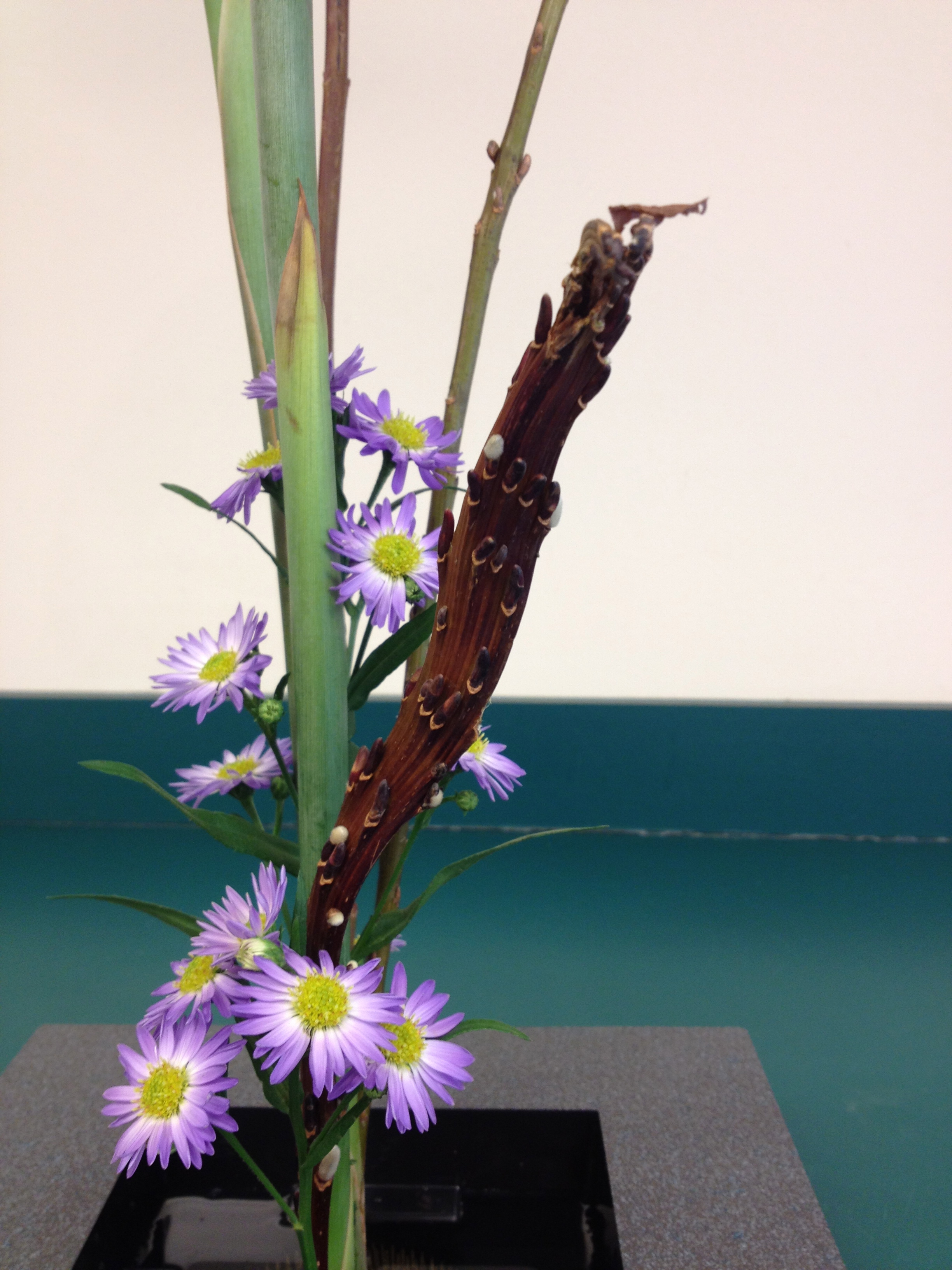
There are only 3 types of materials being used in the Shoka Shimputai.  We are using Bird of Paradise, Aster, and Willow (some of us have fasciated willow – oh baby!)   First you must choose your Shu, or the main actor in the play, the dominant force.  Obviously the Bird of Paradise here.  Janet shows us how to coax the flowers out of the triangular buds by digging our thumbs in and gently pulling the blooms out (there are up to 3 ‘birds’ inside.)

emerging bird - you can gently dig out the blooms with your thumb!

Then the Yo or supporting actor, which is meant to contrast with the Shu but be subservient.  This is the Willow for me.

Fasciated willow - Yo; purple aster - Ashirai

After that, the Ashirai goes in, which is the helper that fills in if seasonal materials are needed (there always must be something seasonal.)  The Ashirai balances things, can supply color, and ties things together.  The Aster.  I found this arrangement pretty easy, but this was my first time working with a kenzan, so I had to master that.  Once a big branch of willow goes in, it’s pretty hard to get out, so it’s a good idea to hold things in place where you intend to put them before sinking the stems in.

my completed Shoka shimputai (should be sitting on a 'base' - protects from drips)

So you see how the Bird of Paradise is dominant, the willow supporting, and the aster a touch of helping color.  And though she has stressed the fact that Ikebana is not competitive, there is a right and wrong way of addressing the basic rules, so she goes around and modifies some of our arrangements – to get a better line, to keep the stems straighter, or more fanned out.  Wrestling with the stems being straight is definitely difficult.

Janet modifies Julie's arrangement, whose feeling towards this first stab at Ikebana was "survival" which she more than achieved

In this Shoka, the Aster is the Yo and the leaf is the Ashirai..I think

Pat's Shoka uses Bird of Paradise foliage, which still counts as the Shu. She clipped off the stems, wanting her design to be simple and clean to help offset the complexity of her life. Beautiful.

All in all I really enjoyed Day 1 of this class, though I did feel like despite it being emphasized that Ikebana is supposed to be non-judgmental, the instructor was actually very judgmental towards all of our designs and was not effective at communicating her thoughts in a gentle constructive way.   Day 2 was different in this regard…so stay tuned, there’s more Ikebana to come!

day three – basic floral design I at longwood

In this class, we started by watching a video from the ’80s on Conditioning.  Jane had some stuff to add that I’ve worked into the tips I took away from it:

  1. Recut stems on an angle / Strip lower leaves to avoid decay under water.
  2. Put flowers into water in a cool dark place for several hours.  This video said to use warm water (100-110 degrees F) because it has less oxygen and can freely absorb water and nutrients better because warmth dissolves trapped air.  Jane says warm water can also speed up the flowering process, so using cool water can help flowers last longer.  So if you wanted something to open up right away, warm water would be the way to go.  And let the water cool before you put it into a fridge, if that’s what you’re using for the cool dark place.
  3. pH level of water should be 3.5-4.5 – water flows through vascular system better at this level.
  4. Use only NON-METAL containers.   Cleanliness is next to godliness.  Wash all buckets, containers, and cutting tools with bleach solution.
  5. Use a floral preservative like Floralife to reduce flower senescence.  Preservatives contain Sugar (carbs for nourishment,) Acidifier (to lower pH level,) and Biocide (inhibits growth of bacteria.)
  6. Daffodils should be stored in a separate container because it’s sap is toxic to other flowers.  Once you cut them, and put them into water for a while, the stem will harden off and not seep the toxin anymore.
  7. Tulips are funny ones.  To get them ‘straightened out,’ wrap them in wet paper and place them in a deep container to keep them from bending.   Also bear in mind tulips keep growing after they’re cut.
  8. Woody stems – slit the stem across the center for maximum water uptake.  DON’T mash the stems!
  9. Lilies – pollen can stain so pull off the anthers. This also adds to their vase life.
  10. Euphorbia and Poppies ooze a milky sap when cut.  Singe them with a flame or super hot water to prevent the ooze factor.
  11. Iris – to get them to partially open you can peel them open a bit and blow on them!  This was the best part of the video, because it was just funny watching a guy from the ’80s blowing on Irises.
  12. Orchids – tropical – keep in warm temps not below 45 degrees F and out of sunlight.
  13. Gerbera need head support and are prone to stem blockage.
  14. Jane says the best time to cut Garden Flowers is the morning or evening.  Ideally, water them at night and pick them first thing in the morning. Give them a shot of hot water, then put them in cooler water and let them rest for 4-6 hours in a cool dark place.   THANKS JANE!

botanical design using tulips at every stage from bulb to fully open flower

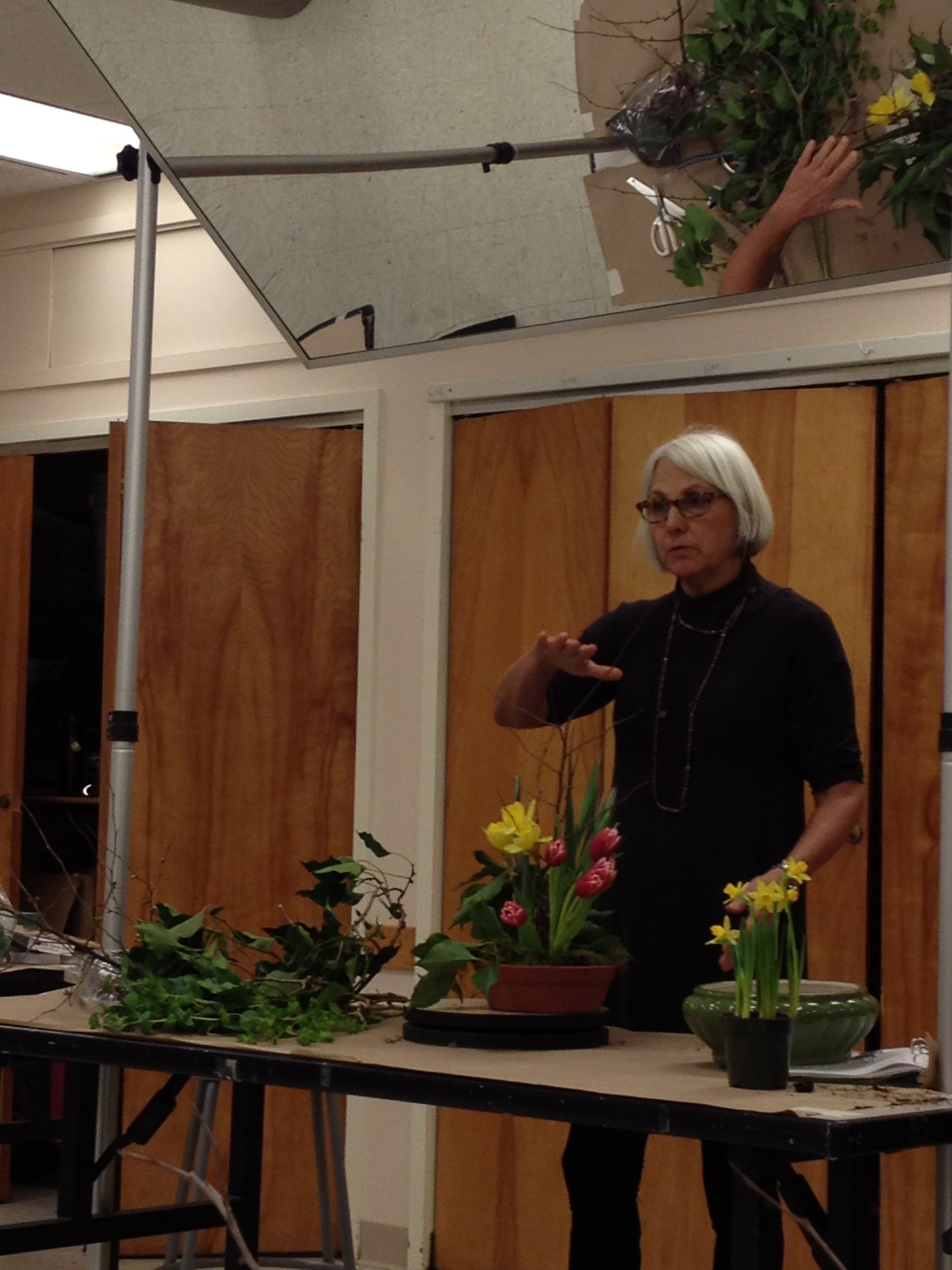
Jane then walked us through a few different arrangements before we did ours.  I really loved the Botanical design, which represents nature through the life cycle or study of a plant.  The design uses one kind of bulb flower in all of its phases, and the bulb on it’s own is included.  Cute!

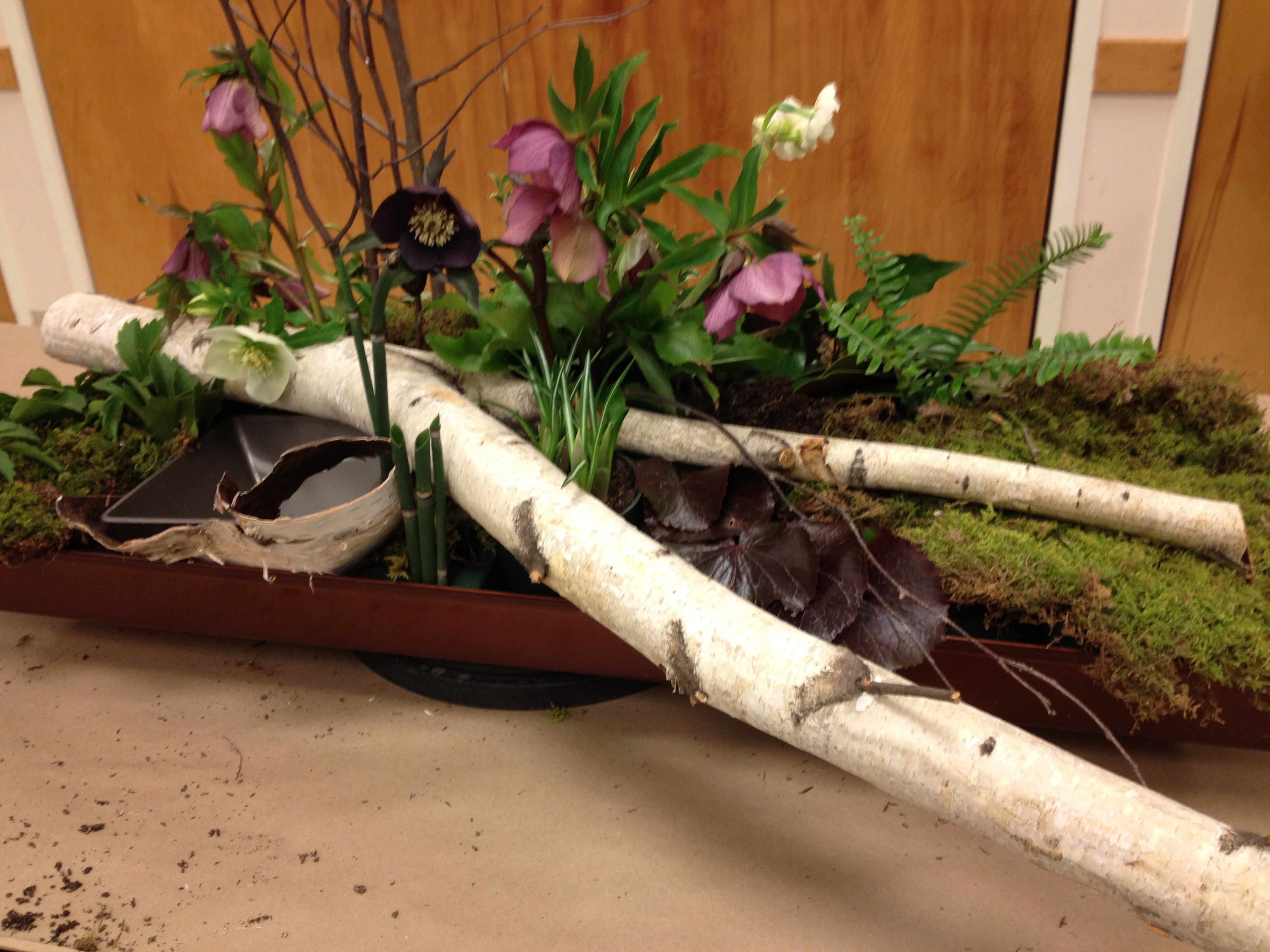
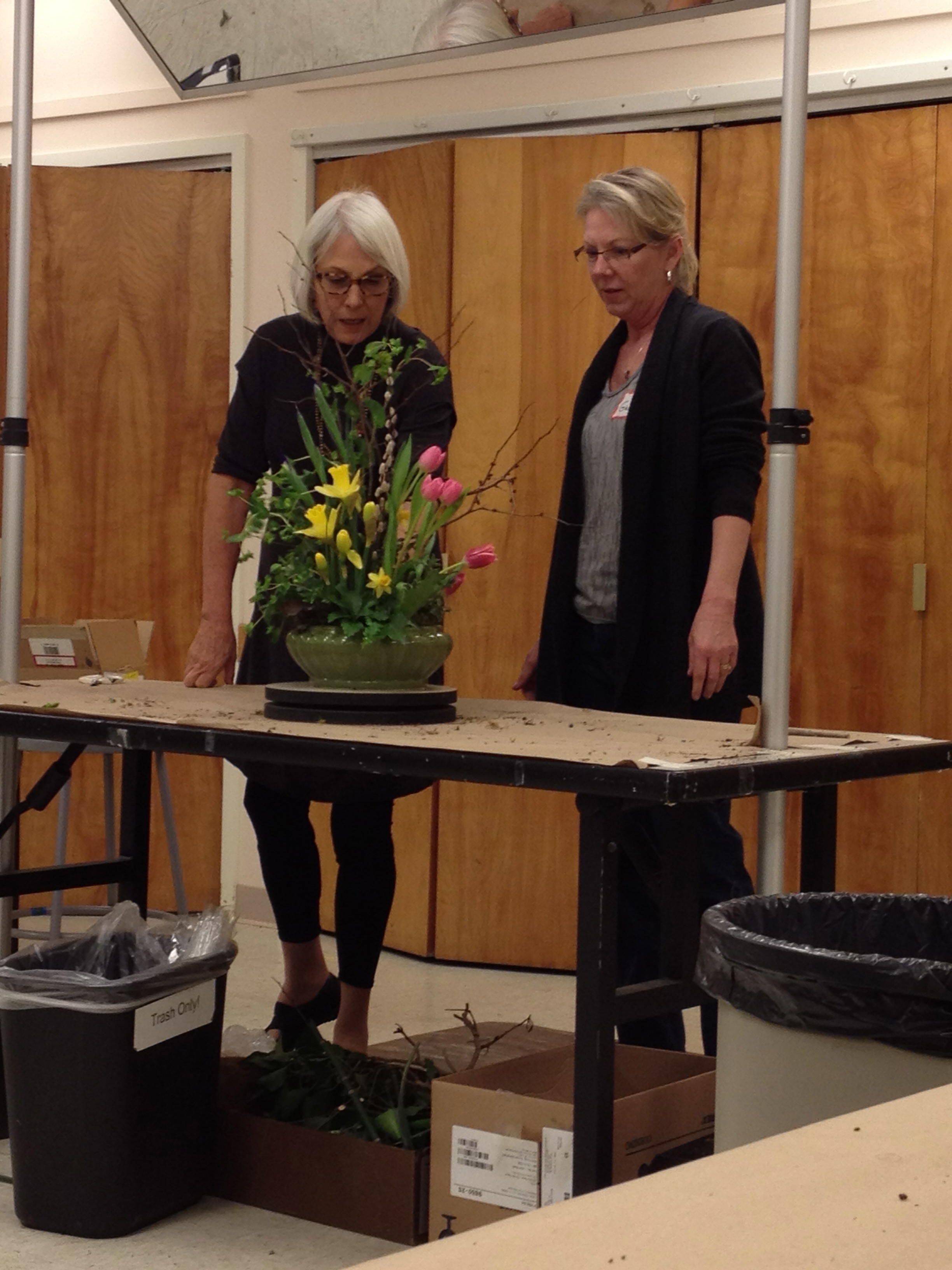
Jane doing the landscape design using birch, moss, hellebores, tulips and more

Then the Landscape Design, which is a panoramic view of a man made garden area.  It’s a larger design and includes trees, bushes, flowers and ground cover.  Also you can use a little water element if you want!  This “would be perfect if you were having a bunch of gardeners over for a dinner party,” says Jane.

Landscape design - Jane did this in about 10 minutes

Today’s lesson was a Vegetative Arrangement, which is meant to be a design that presents plants as they grow in nature or the garden.  Flowers and foliage are selected according to seasonal compatibility – so you wouldn’t see a sunflower in with a daffodil because they wouldn’t be blooming at the same time in the garden.  This ‘slice of garden’ should show interest from all sides and bear in mind Color, Fragrance, Texture and Pattern.

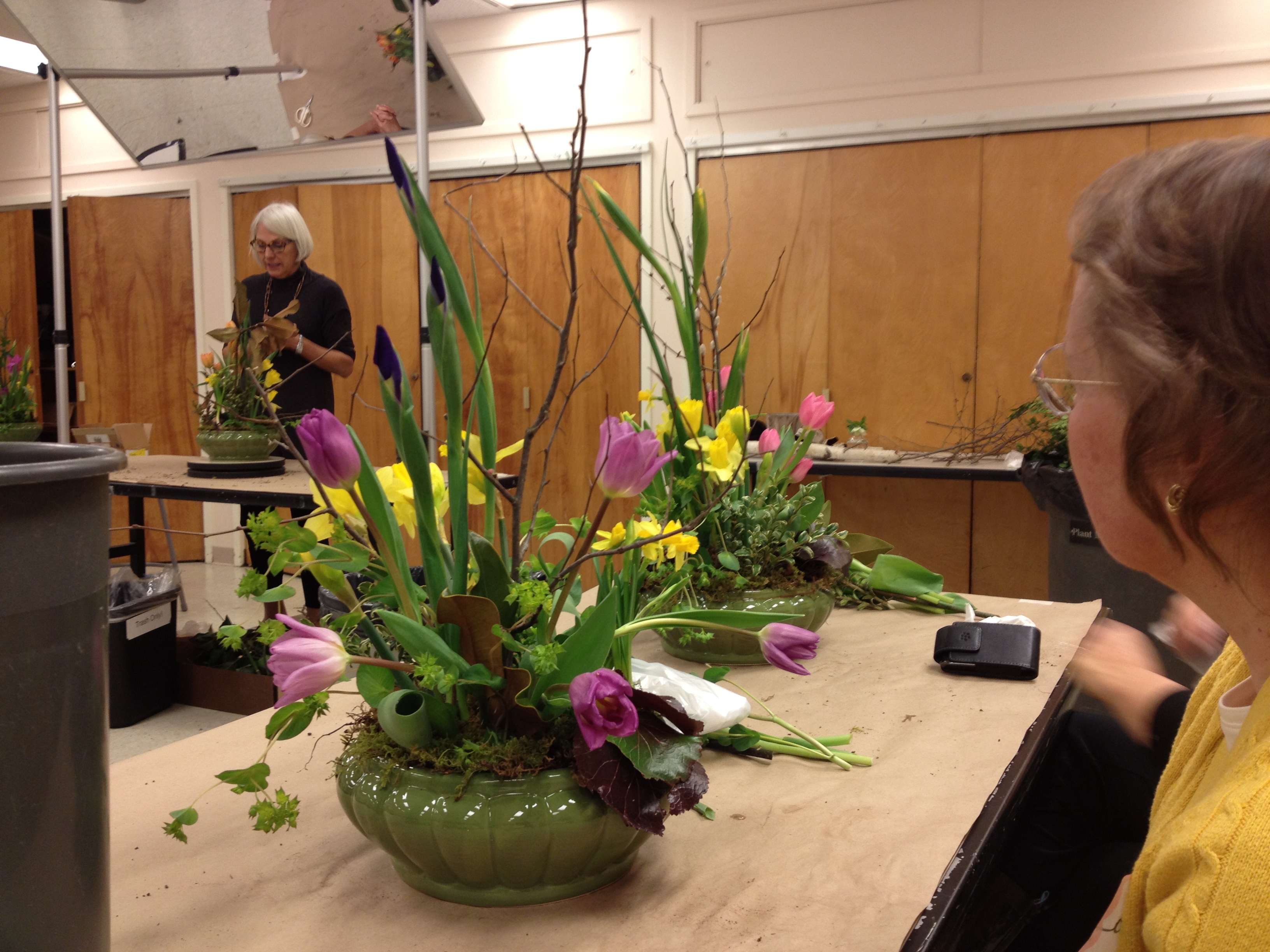
Radial Vegetative Arrangement "think about how it might be growing"

I decided to do the Radial Design rather than the Parallel Design.  We used 1 block of Oasis cut to fit the container, then pinned some moss on using greening pins but leaving the center exposed.  Our materials were 1 Quince Branch (or Red Stemmed Dogwood – limited supply,) 3 Daffodils, 5 Tulips, 3 Iris, 1 pot of Tete a Tete Daffodils, and lots of different foliage to choose from like Bupleurum, Ivy, Fern, and 3 Galax leaves.  The Galax is shiny shiny shiny and draws your eye.

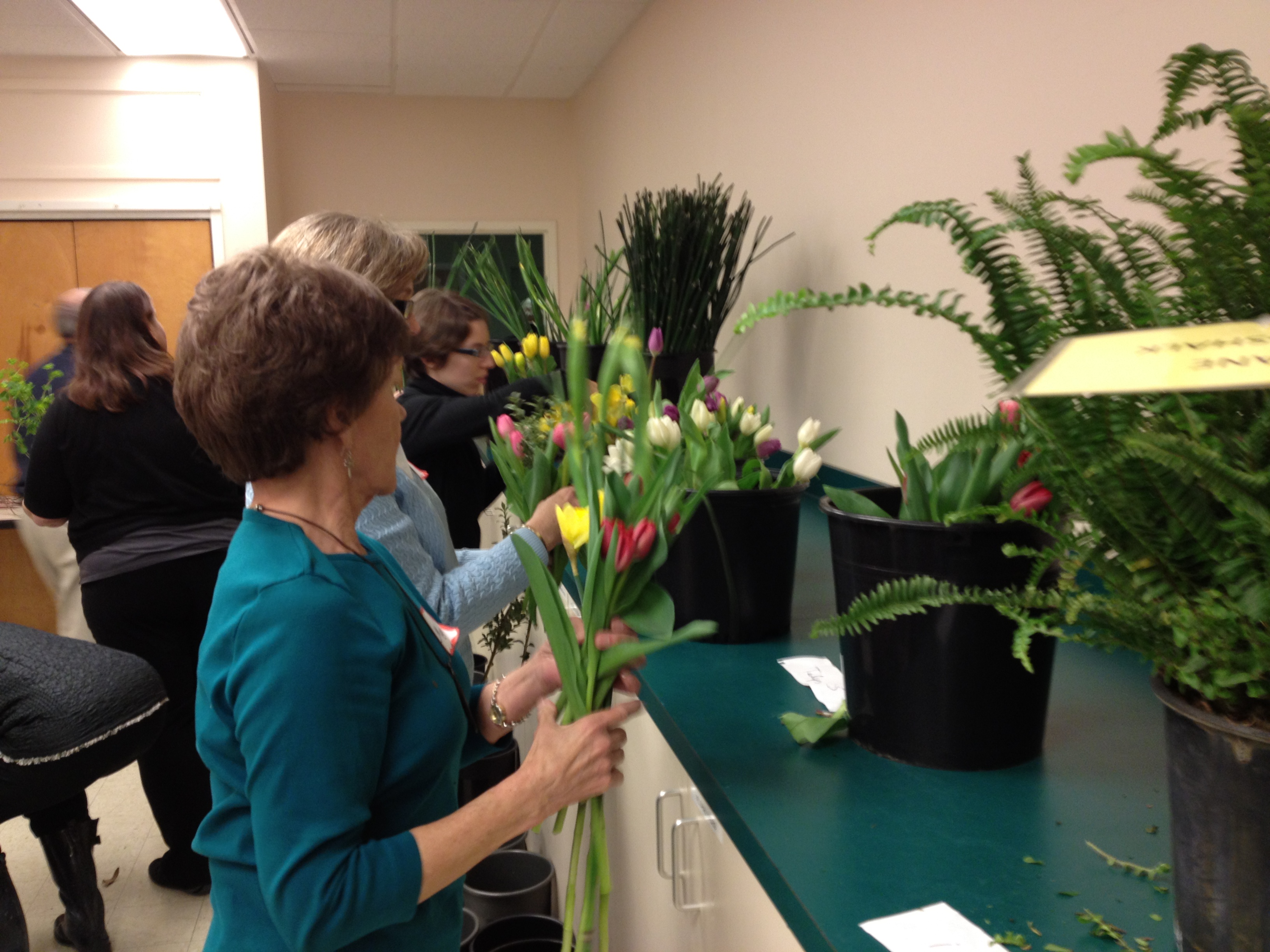
Mary Jo grabs tulips! You've got to be brutal to get what you want in this line. 🙂

after you've done the assignment, each student goes up and the class and Jane interact to discuss the design, what works and what doesn't. This one worked!

afeefa was lucky to grab some of jane's hellebores ... mmm!

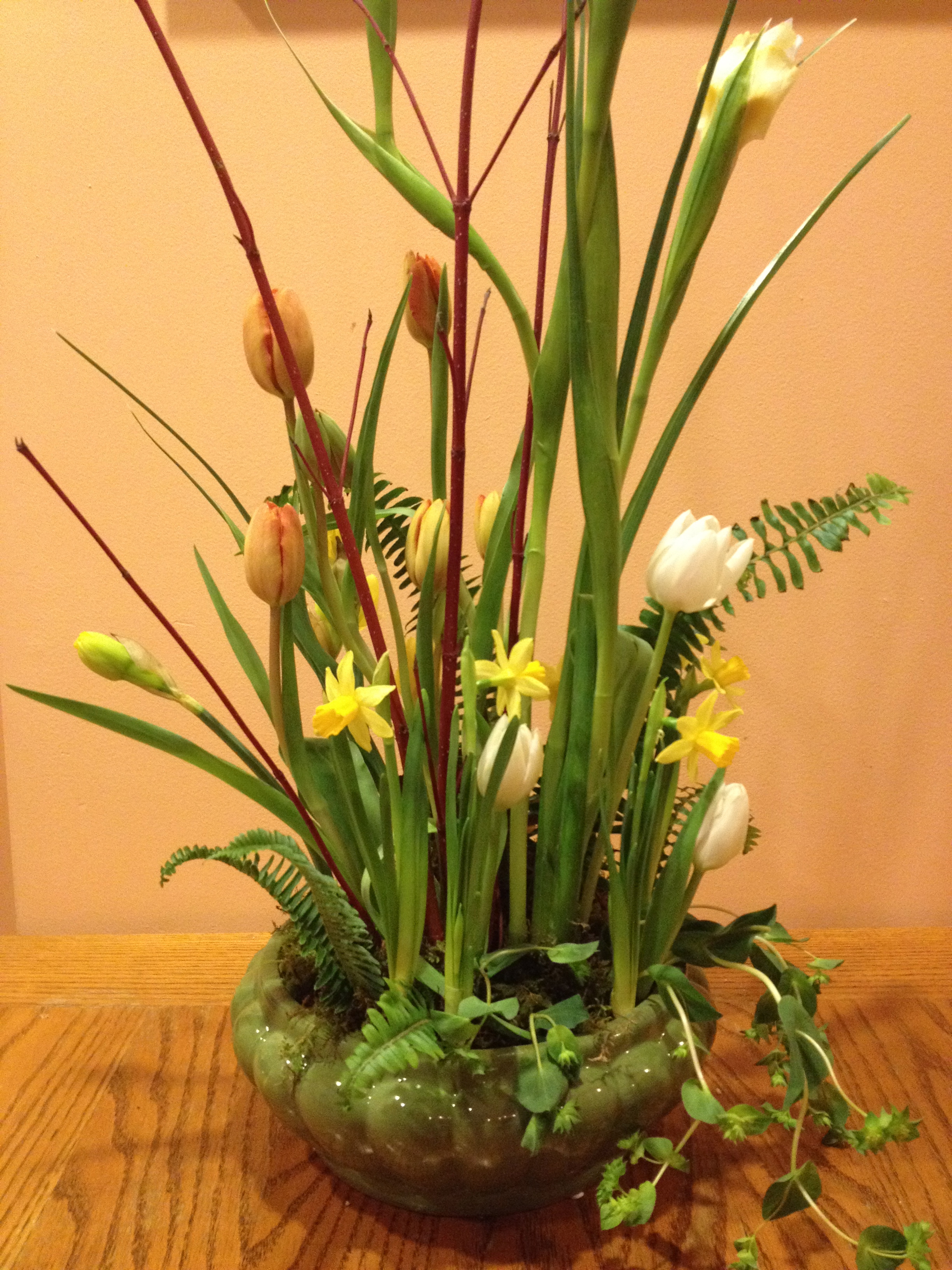
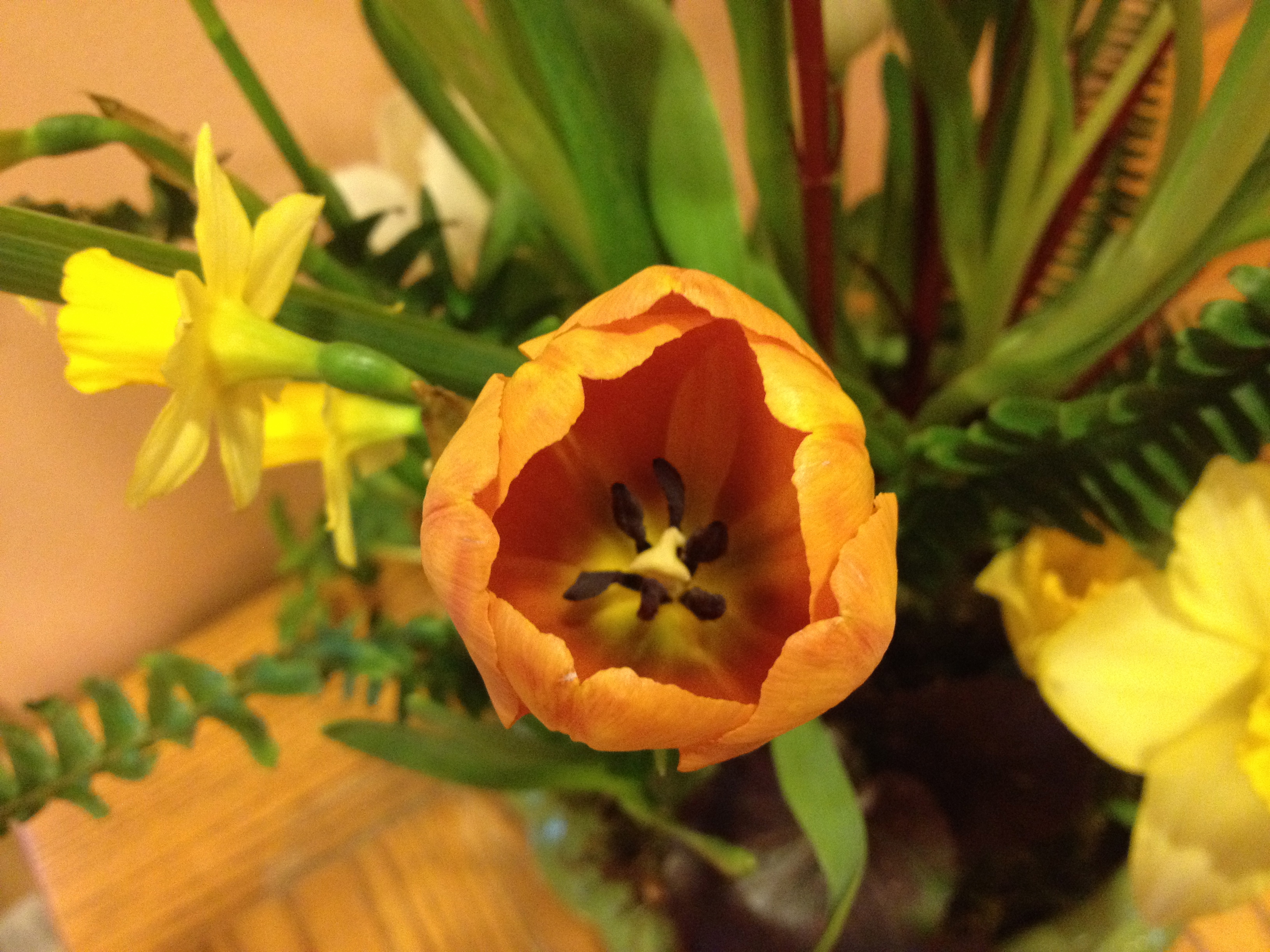
This design was definitely harder for me than the Roundy Moundy.  I struggled with the Quince Branch, was not happy with it, and then Jane came around and gave me some Red Stemmed Dogwood which worked better with my orangey tulips.  I took the following pictures once I got home:

my vegetative arrangement when it first came home

other side, i like the dripping bupleurum meant to mimic lady's mantle

about 5 days after it was made, irises blooming, tulips going nuts, and tete a tete much leggier

I just want to pinch it’s cheeks and say, “My how you’ve grown!”