a taste of the country

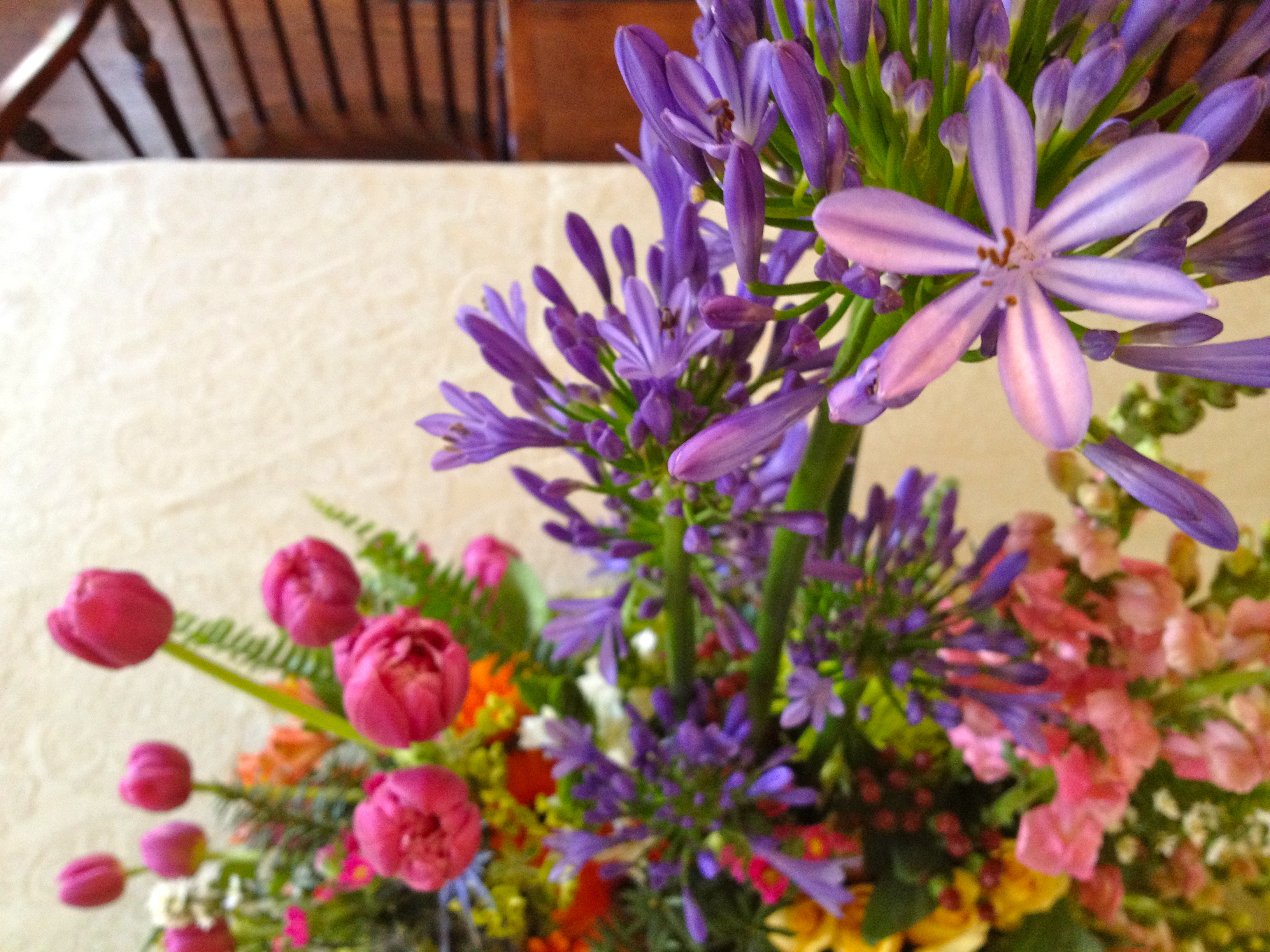
It was my mother-in-law’s birthday, so I made her two arrangements for her country house in the backwoods of New Hampshire.  This calming collection of blues and purples includes hydrangea, delphinium, monkshood and lisianthus…and white roses and white lilac, with a little bupleurum and curly willow thrown in at the end.

The second arrangement I made was more of an Easter arrangement, with yellows and pinks, including foxtail lily or eremurus, stock, sunflower, daffodil, peony, and tulip.

Rutha was also really happy to receive a garden gnome who will give her a bit of luck out in her garden beds.  (I guess I sort of believe in gnomes, since the Gnomes book was always lying around our house growing up and it’s so convincingly written and drawn.)  Here she is reading another of her presents, Cat Fancy Magazine.

While visiting, we always try to get out for some walks since the air is so clean. On this  afternoon’s constitutional, I saw this cute little yellow flower in bloom, looking a lot like a dandelion…but not quite.  I knew it was in the Aster family, but that’s about it!  Later I looked it up and found out it’s Coltsfoot, or Tussilago farfara.  It’s often found along roadsides and in ditches, and is not native to North America, brought here by settlers from Europe who used it medicinally as a cough suppressant.  (Some still do.)

But some of the real country action happened while we were sleeping.  We gave Robert, my father-in-law, a Bushnell motion-activated infrared camera (with audio!) for Christmas this year.   He strapped it to a tree a little ways into the woods near their house.  So far the camera has captured a host of wildlife including fisher cats, squirrels, chipmunks, foxes, curious crows, and even a neighborhood dog.  But a few days ago a coyote showed up, and here she is caught on camera!

I just love the way she peeks around the tree towards the end.

P.S. Check out the Soulsby Farm’s recent post on coyotes…lots of great info there.

day three part one – advanced floral design I at longwood

There is a lot of oohing and ahhing at the beginning of today’s class, for the counter is covered in a array of bright tropical flowers and lush foliage, the likes of which many of us have never seen before. These are for us! To use! In an abstract design!

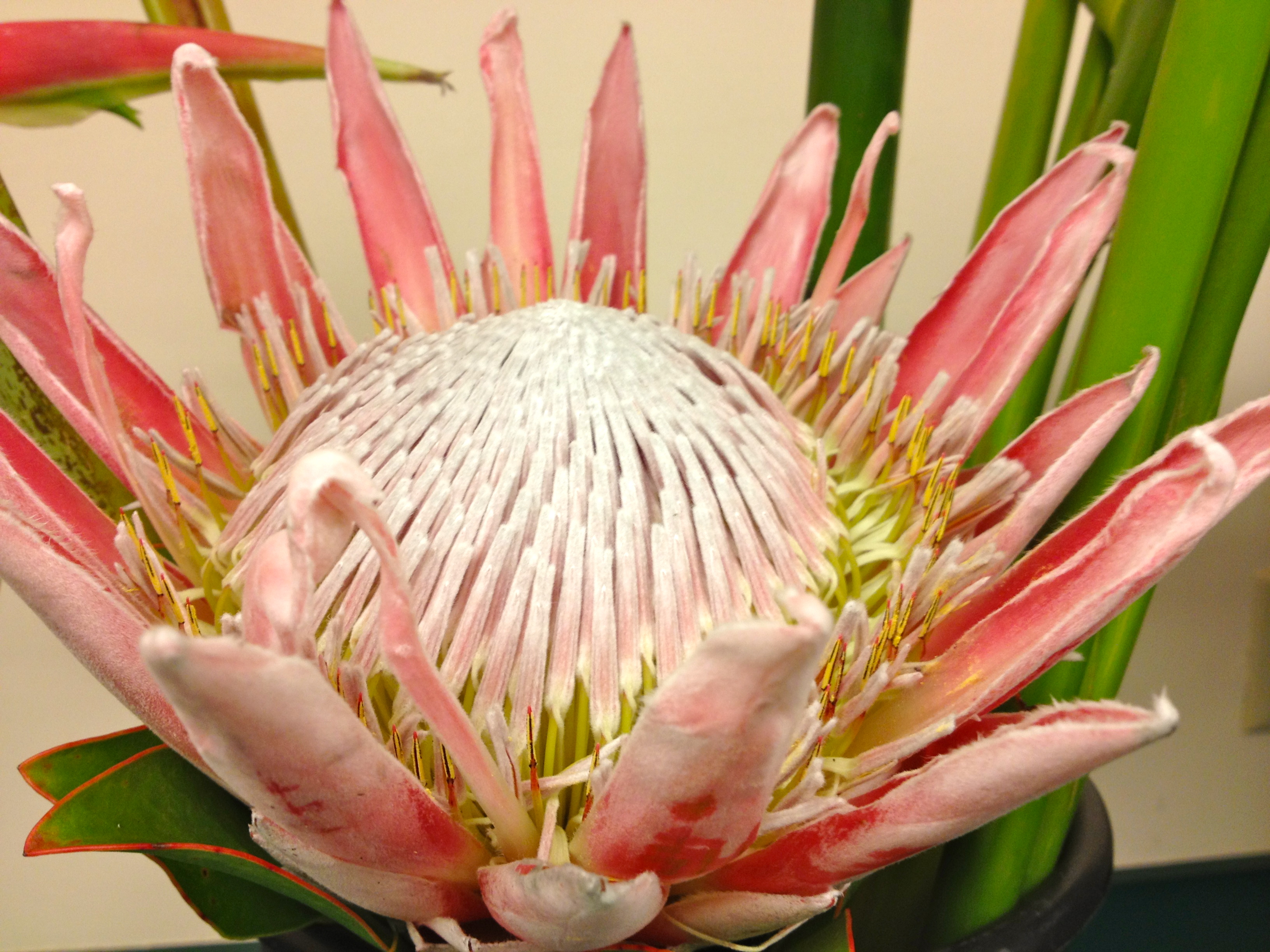
King Protea

Cibotium Kakuma Curl Fern

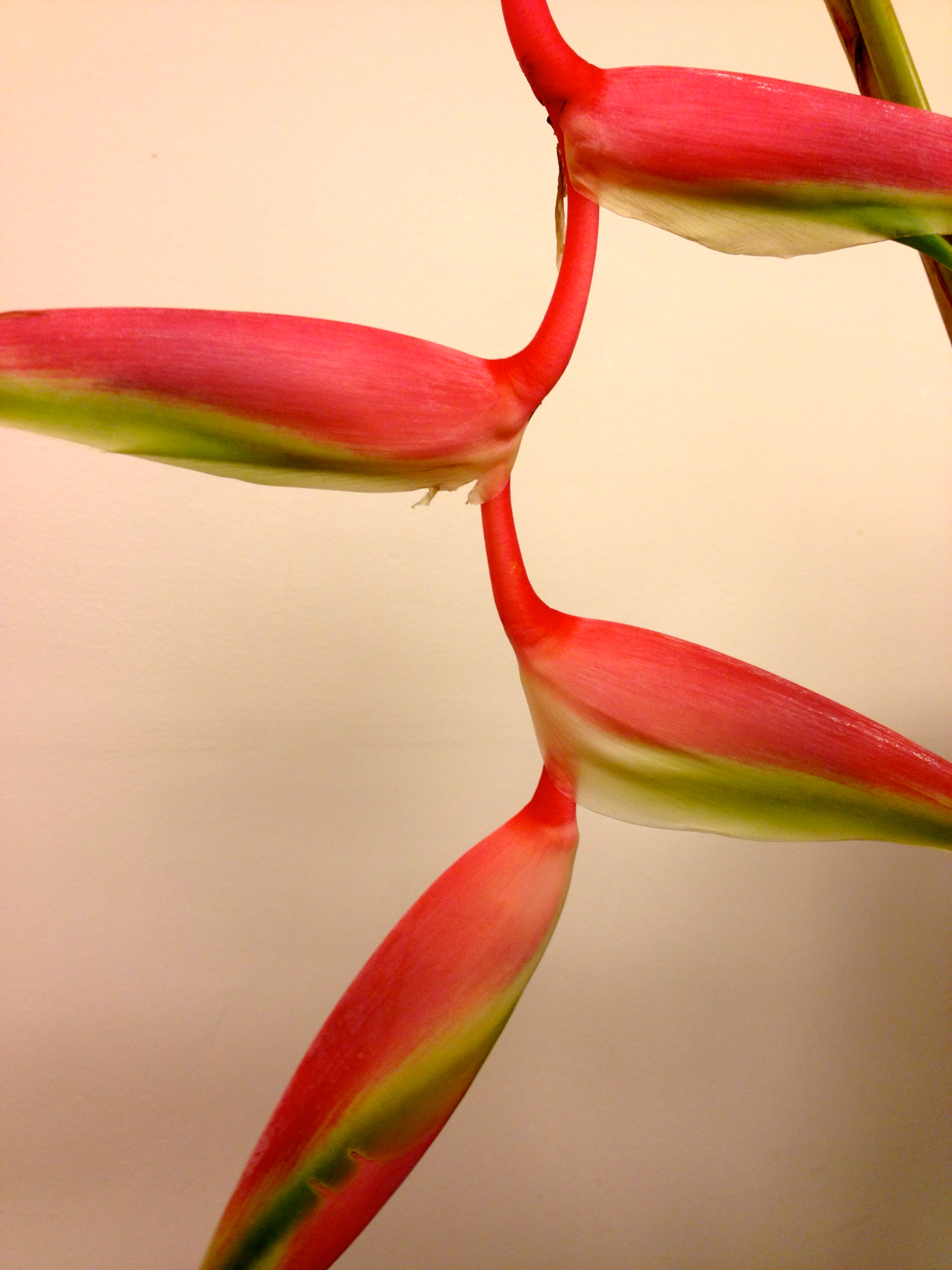
Heliconia hanging 'Sexy Pink'

Zingiber 'Chocolate Ball'

Tropical flowers work great in modern and abstract designs. But they do require special care – remember, they’re from a warmer, more humid environment and often cannot survive in a cold climate or standard floral refrigerator. Use room temperature water when working with tropicals – most love to be misted on a daily basis!

Anthurium 'Obaki,' I love you

Anthurium – called Flamingoblumen in German- come in many shades and sizes, and because they drink from that pointy thing or spadex, they should be submerged under fresh water for 10-20 minutes before using them, and misted daily in an arrangement.

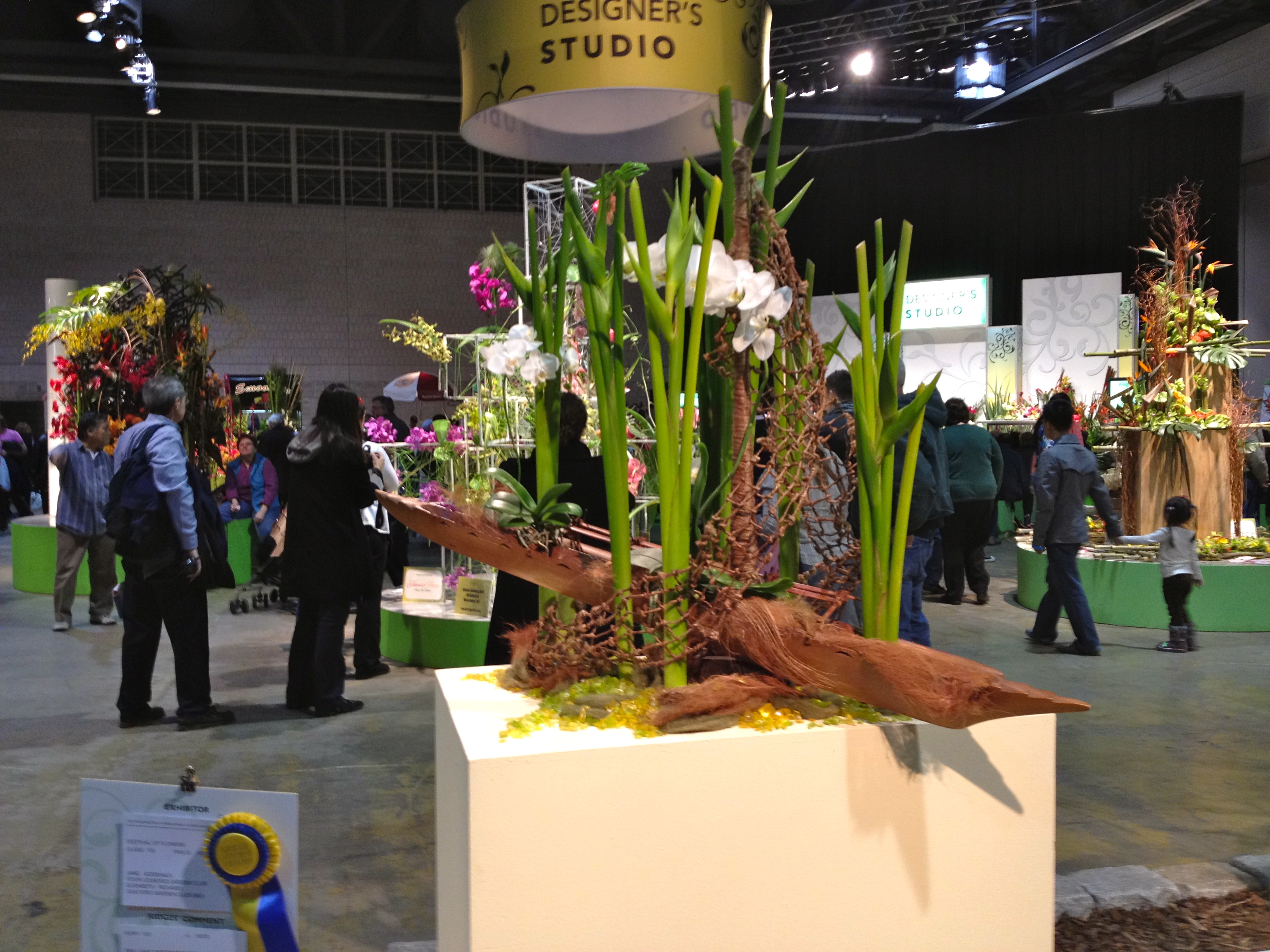
Jane's winning design using Heliconia Torch 'Emerald Forest'

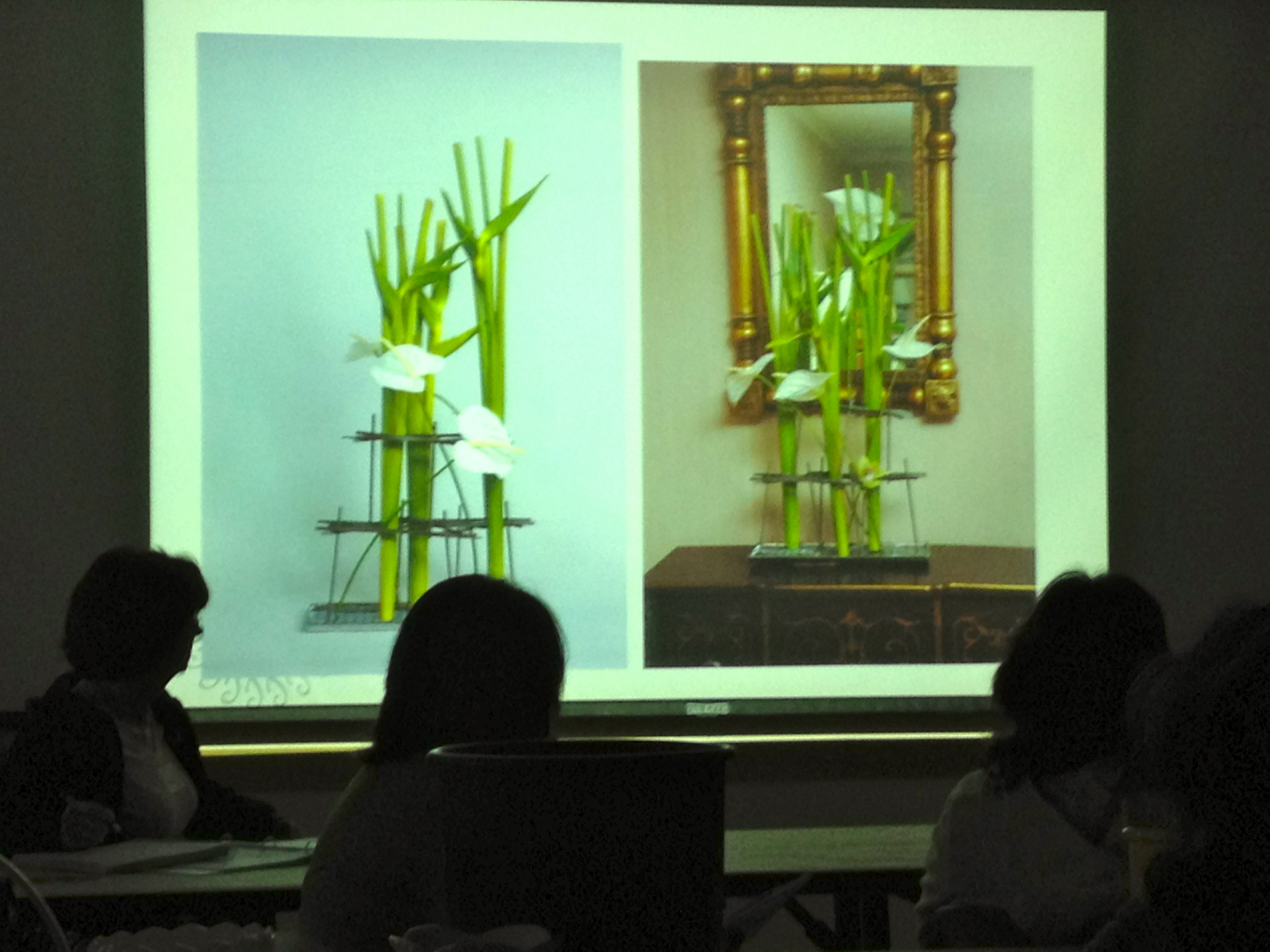
The Philly flower show this year was full of tropicals (obviously, with the theme being Hawaii!) Our teacher Jane loves using Heliconia Torch ‘Emerald Forest’ and won a blue and gold ribbon with them in her design at the flower show this year. Here they are in another Jane design that shows you that modern/abstract design can look good in a home setting:

Jane's design - the tops are not chopped, off that's how Heliconia really are!

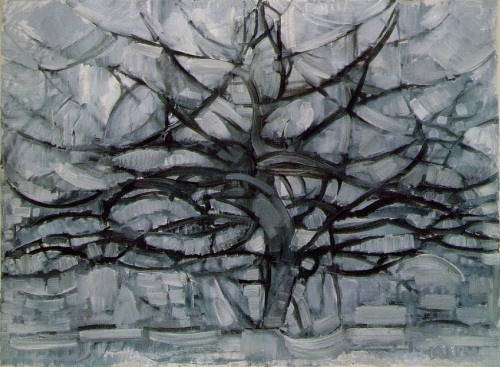
Then we talked about Abstraction, which in the art world indicates a departure from reality. This departure from accurate representation can be only slight, or it can be partial, or it can be complete. Jane brought up the Tree series by Piet Mondrian as an example of varying degrees of abstraction.

Piet Mondrian, Avond (Evening), Red Tree, 1908. Collection of Gemeentemuseum, The Hague.

Piet Mondrian, Gray Tree, 1911. Collection of Gemeentemuseum, The Hague.

Piet Mondrian, Flowering Apple Tree, 1912. Collection of Gemeentemuseum, The Hague.

The essence of the last Mondrian tree is distilled into lines, forms, color, space. In abstract floral design, some of the same principles apply. “Abstract floral design: A contemporary design style in which plant material and other components are used for their intrinsic qualities of line, form, color, and texture.”

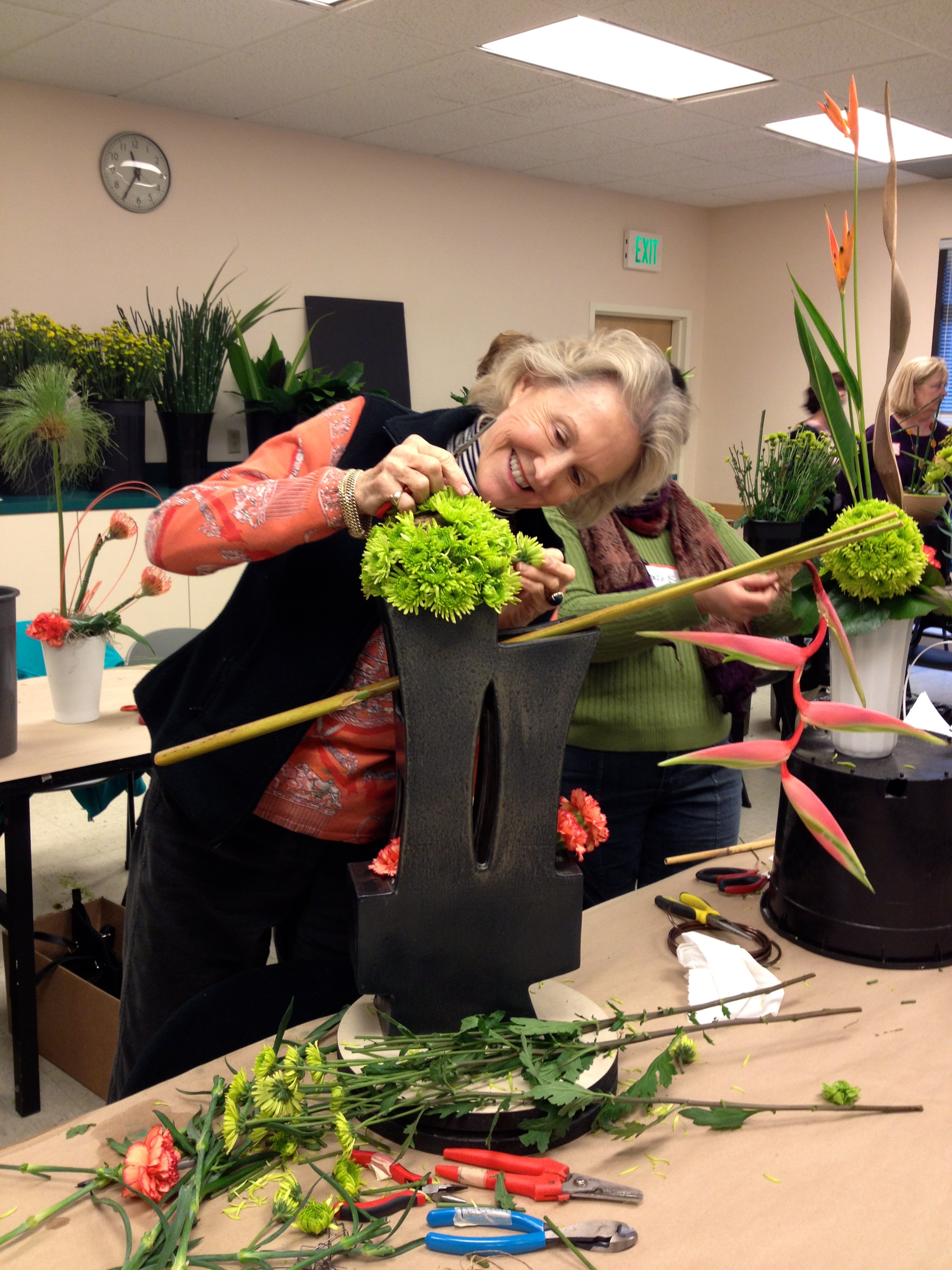
Eleanor creates an abstract design - sphere of mums, heliconia hanging 'sexy pink' - container is part of design

So how does one go about creating an abstract floral design? These qualities are important to consider:

  1. Bold, high impact
  2. An emphasis on space
  3. Dynamic tension
  4. RESTRAINT! in use of plant material, often no transitional material
  5. Interest distributed throughout the design
  6. MORE THAN ONE POINT OF EMERGENCE for plant material, often unconventional placements
  7. Container (if used) is part of the design
  8. Non-naturalistic use of plant material
  9. MINIMALISM

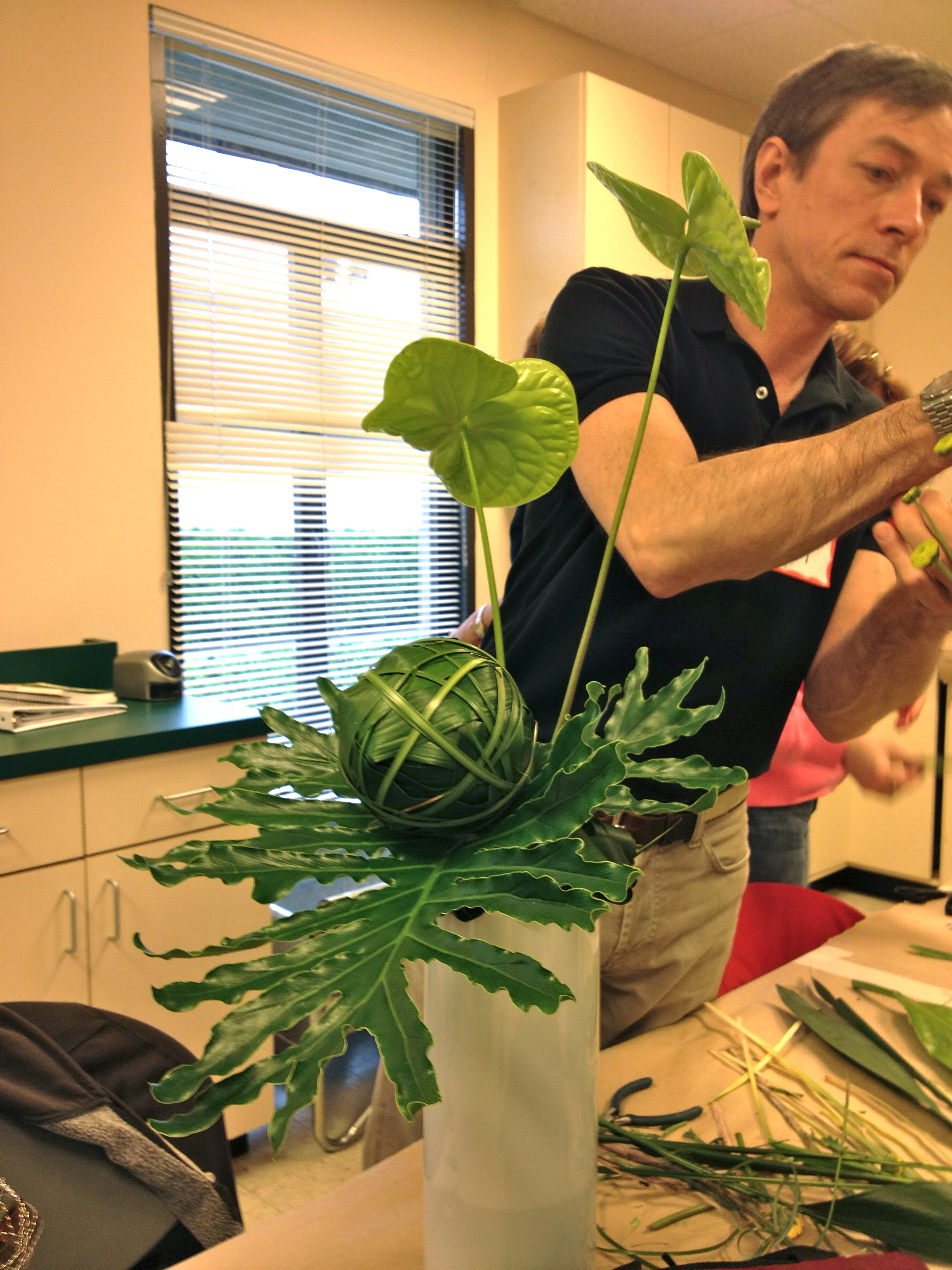
Jim uses all green tones. His grassy sphere creates TENSION by looking like it might roll away

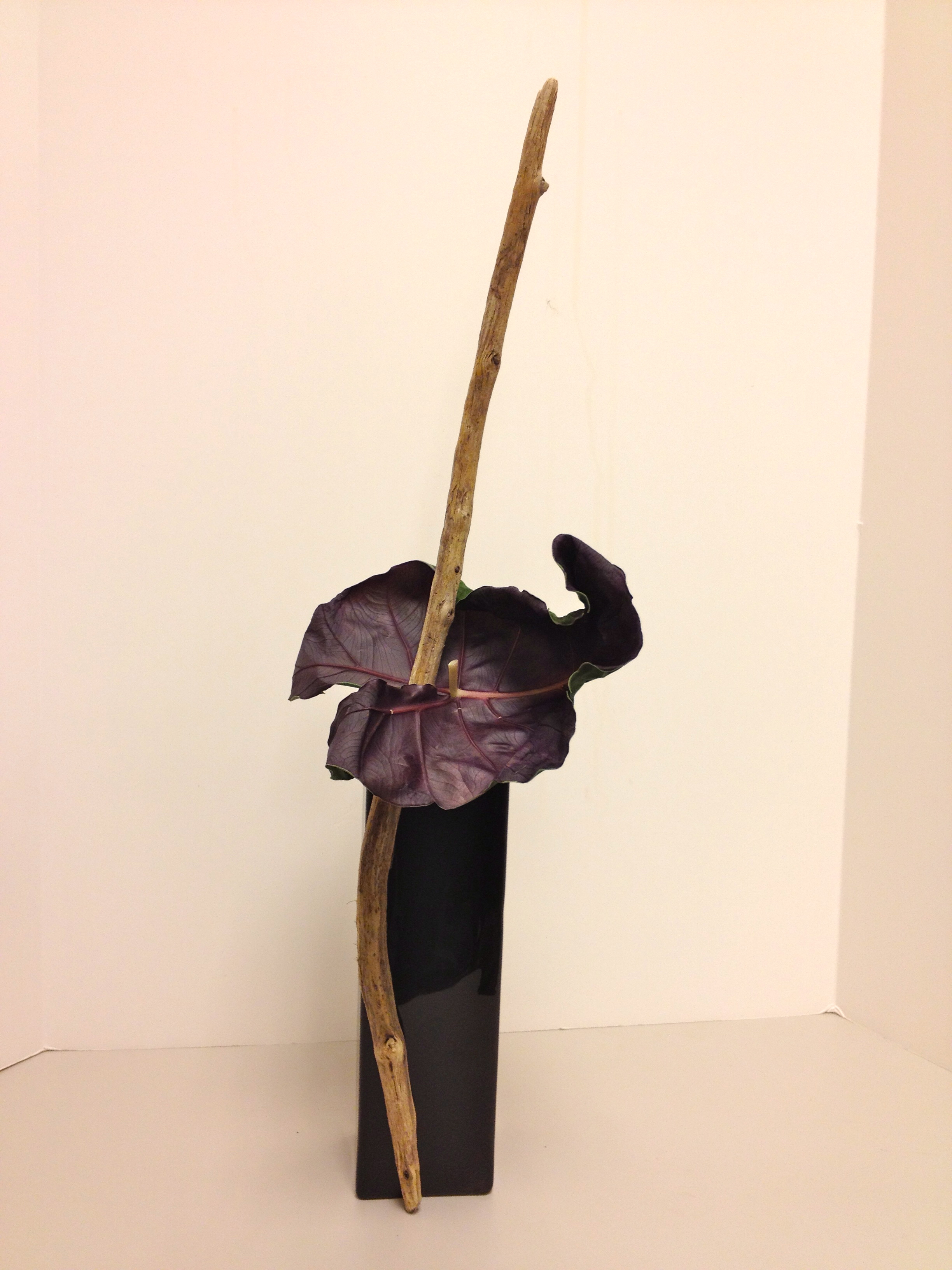
And the RESTRAINT award goes to....Jenny! This design was probably one of my favorites today. One colocasia leaf, one driftwood stick, one black container. Some glue. Gorgeous.

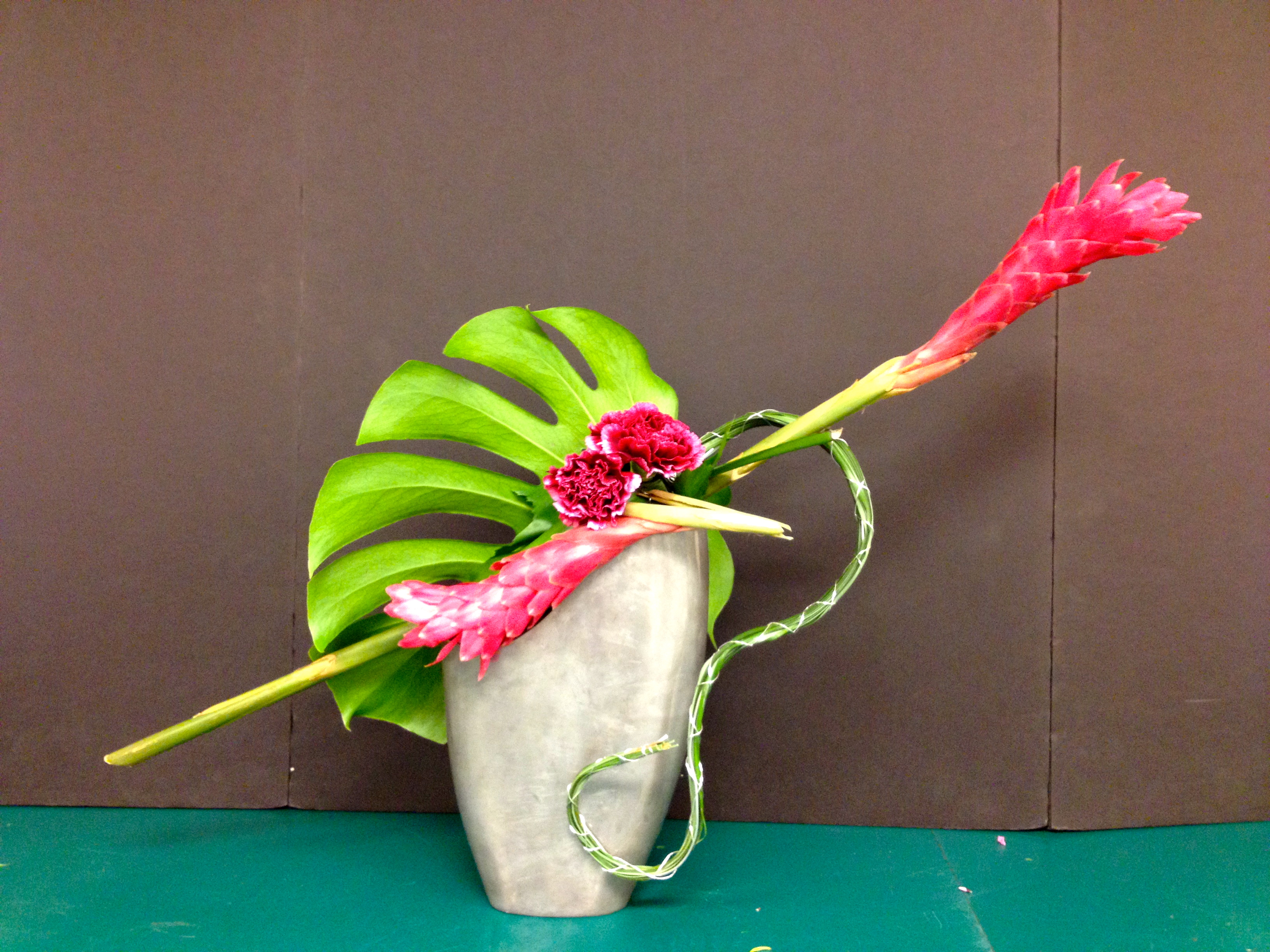
I'm breathless. Jean's design uses heliconia, carnation, and monstera leaf, plus bear grass bundled together with silver wire. It's like that CONTAINER would be lost without exactly what's inside it.

Weren't you wondering what someone would do with the 'Chocolate Balls?' Here Parul schools us in abstract design! Talk about NON NATURALISTIC use of plant material!

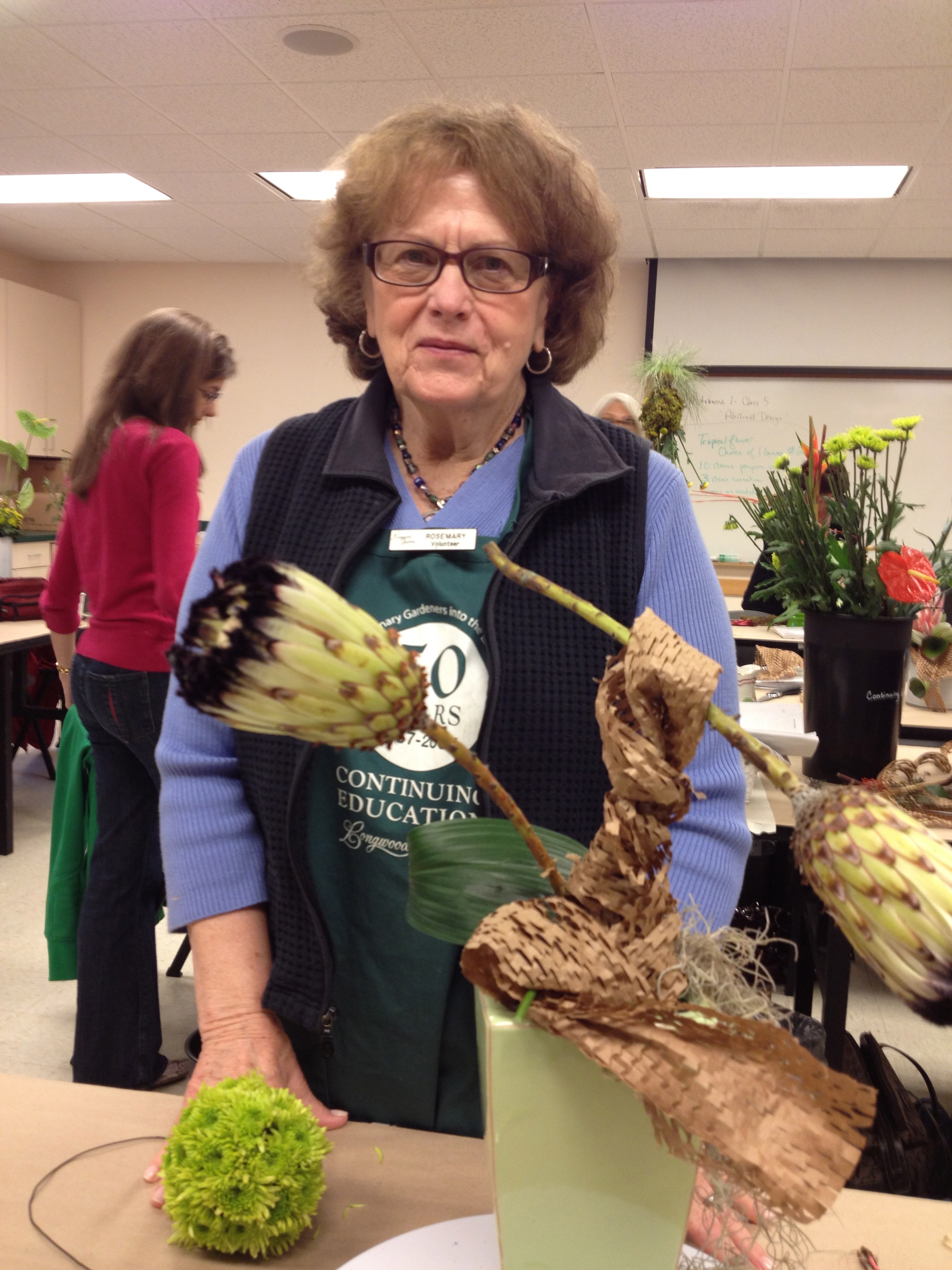
Rosemary the volunteer helps out with some words of encouragement.

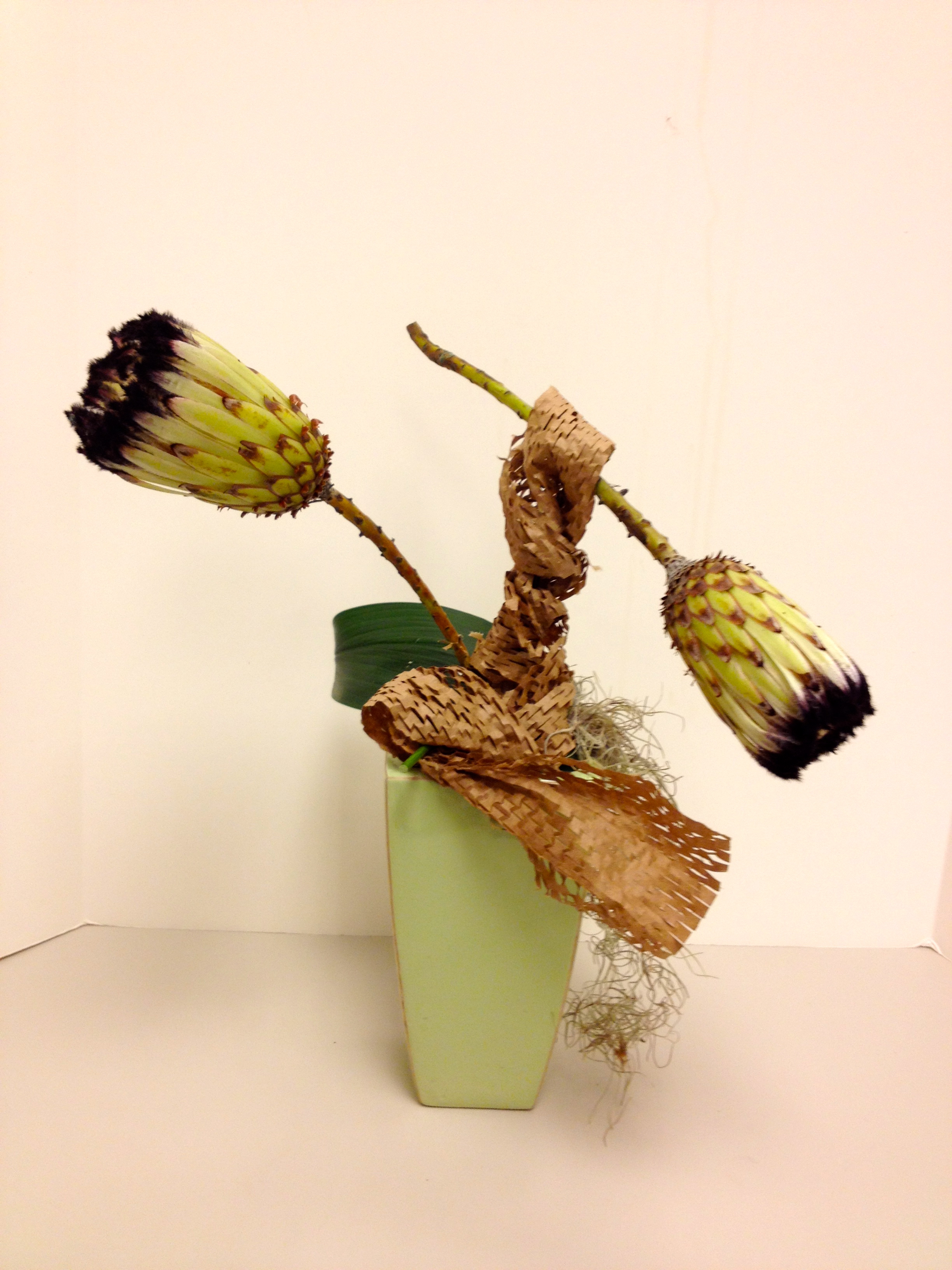
For my design, I used the two Protea ‘Van Rooys White’ which I had been eyeing from the beginning of class since they matched the container I brought so perfectly. In these Advanced classes, it’s BYOC! There are many many Protea species, South African flowering plants that I would love to see growing in the wild. In fact, Protea was named for the god Proteus, who could change his form at will – because Proteas have such variety of form. Tim Snyder, a graduate of the Professional Gardener program at Longwood, now gainfully employed at Chanticleer, recently visited South Africa with a group of students. Here’s a really cute video with great music that Tim and his wife made of his trip — keep your eyes peeled for Pincushion Protea growing in the wild!

my abstract design uses two protea 'van rooys white,' one hanging in mid-air

I wanted to do something playful with one of them hanging in space unrealistically. You have to think long and hard about how to have more than one point of emergence, and this seemed like an easy way to achieve that. I wired the stem using fairly heavy wire, sticking it into the floral foam inside the container. Then I covered the wiring mechanic with brown paper packing material. The apidistra leaf stem pokes right through and with the remaining space I poked in a few yellow pom pom mums to peek out.

other side of my abstract design, pom pom mums peeking out

This class was totally mind-bending. It really makes you throw away a lot of the rules to see that anything’s possible in the world of floral design!

day 2a – advanced floral design I – longwood at home

A nasty stomach bug prevented me from attending a day of classes, so I attempted to do the first design we learned this day at home, following directions from the book The Art of Floral Design by Norah Hunter (with Jane’s blessing, of course.) My teacher was very understanding about me missing the class, and I’ll be able to attend at least the lecture portions during the class held this fall.

First stop - PRODUCE JUNCTION - I wanted it all!

Here’s what I’m making: the New Convention design, which is a structured, linear-style design. It’s like the parallel design on steroids – with the addition of horizontal materials. Vertical lines are reflected at sharp right angles forward, backward and to the side using identical materials. Contrasting textures are used at the design’s base where all the lines converge. The book gives you a pretty good how-to diagram.

new convention diagram from book

To begin, select a low rectangular container. Cut floral foam to extend above the rim of the container (to allow the horizontal placement of materials) and secure with tape. Plan your design by placing stakes in areas where flowers will be grouped. I wanted my end geometric form to be triangular, with the top point in the center.

foam, in retrospect, perhaps a little too high above edge.

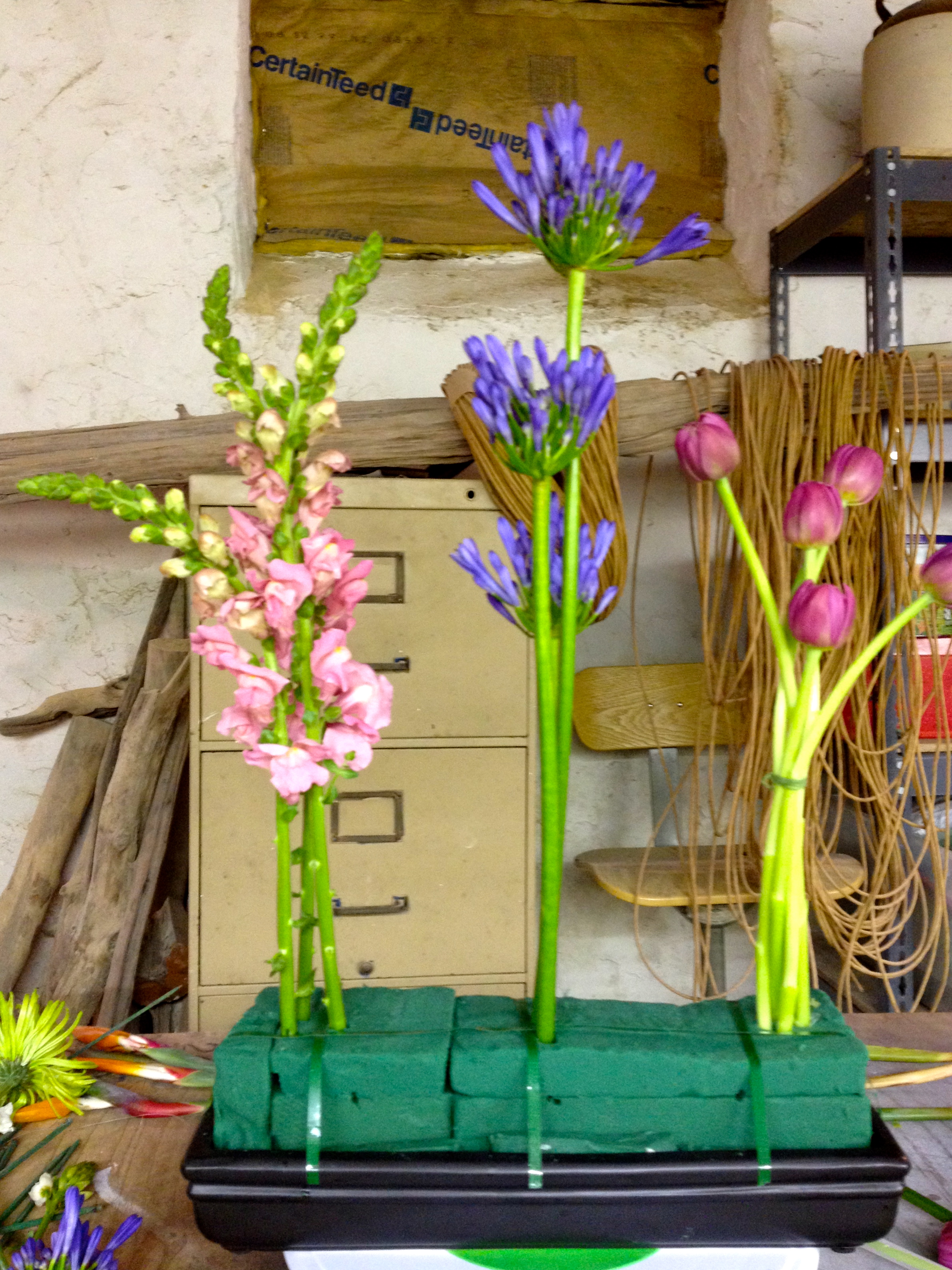
What’s really exciting is that I bought a cake decorating spinny thing which makes floral design so much easier.! (Purchased on Amazon for $18) Maybe that’s only exciting to me. Anyway – next, add your vertical materials. I chose snapdragons, agapanthus, and tulips which I bound together with a little wire. I thought it might be neat to see how the tulips keep growing while confined in a bunch.

add vertical materials

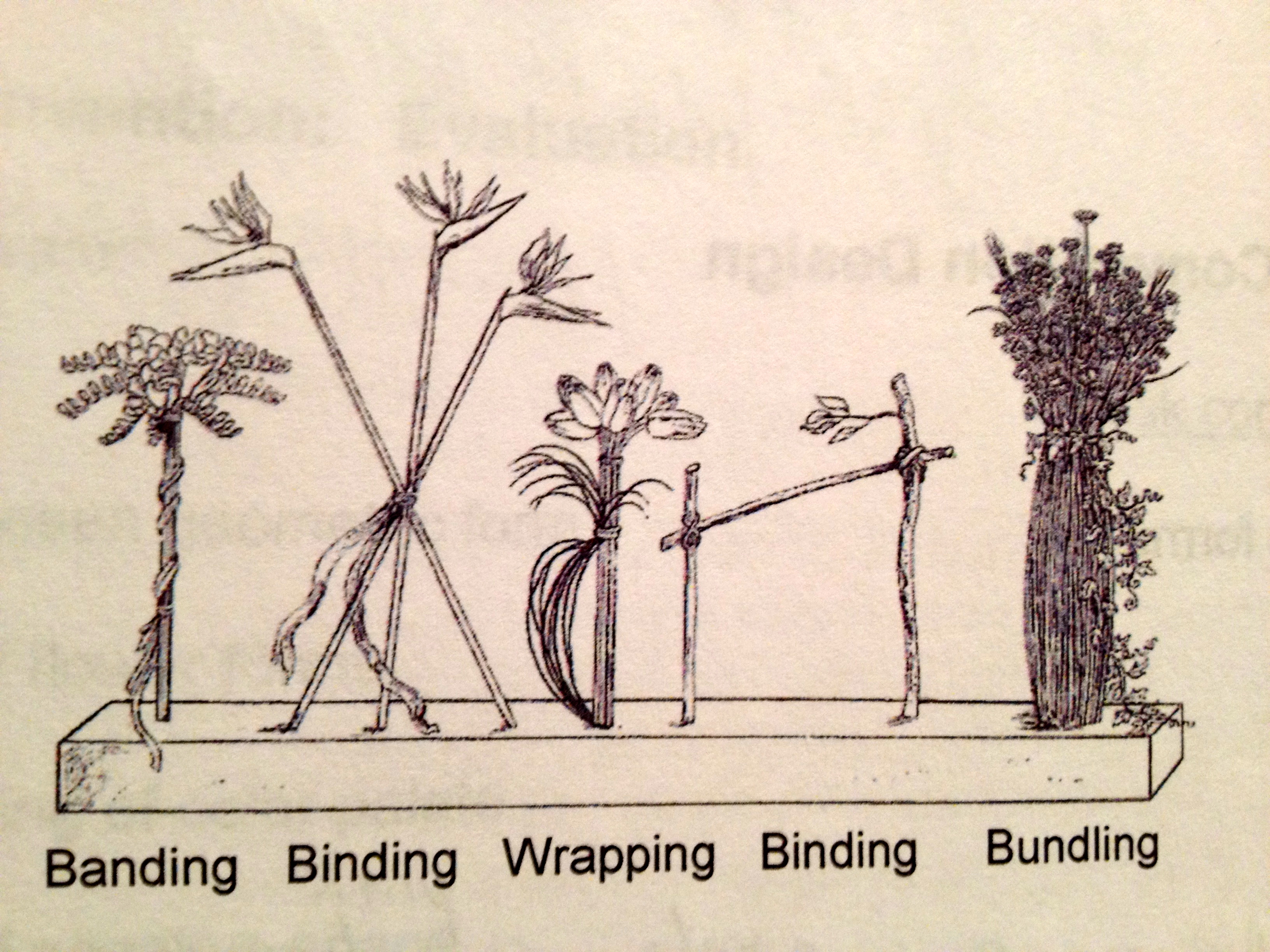
Part of this assignment was learning to unite materials, something our class handout talked about. But the book didn’t really mention these techniques as part of the New Convention design, so I didn’t go overboard on it. However, I think I probably should have done a little more of the following:

methods for uniting materials

Banding: Tying materials for purely decorative purposes.

Binding: Tying materials for functional purposes, physically joining the materials together.

Bundling: Tying or wrapping similar materials together into one unit, such as sheaves of wheat or a bundle of sticks. The bundle may then be placed in the floral design.

Wrapping: A technique in which fabric, ribbon, raffia, cord or wire are used to cover, coil, or twine a single stem or group of stems to achieve a decorative look.

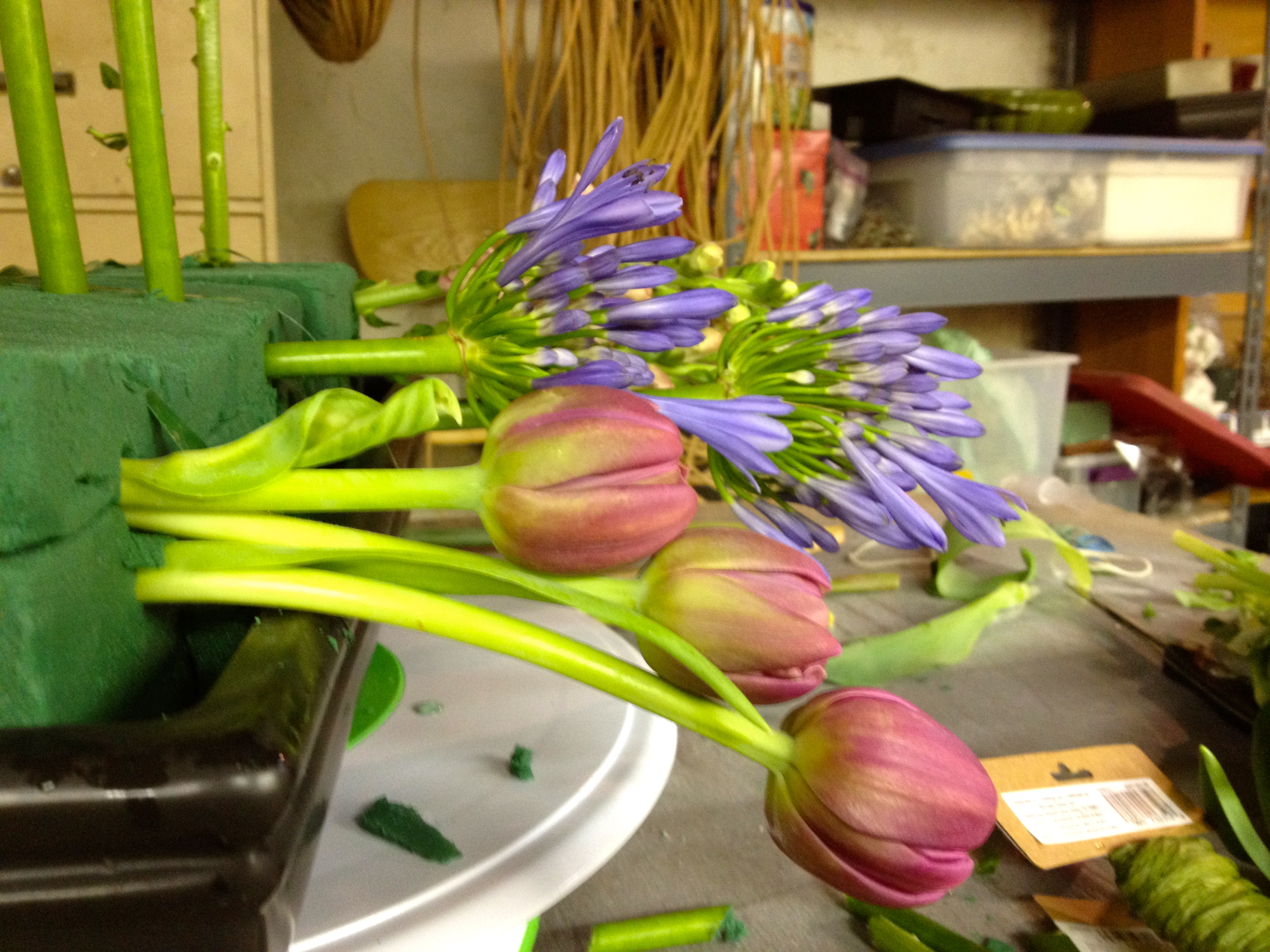
Add horizontal groupings that reflect vertical ones

Next, insert stems into sides of foam at right angles to the vertical groups. Horizontal lines are shorter than vertical groups. I used the exact same material to reflect the vertical groupings. Then, complete the base of the design with short flower heads, mosses and leaves using basing techniques (remember pave, clustering, tufting, terracing, etc from the parallel design?) I went totally crazy here, but I wanted it to look full and I had tons of material to work with. I wasn’t sure about ‘point of emergence’ for this one, so I just did my best. I think my foam was too high and we have a lot of competing elements here because I needed to fill up the space…

after basing added - in basement - hours have transpired - i'm in trance

from a carpet of gerber daisies springs white ornithogalum, eryngium, and some euphorbia x martinii 'ascot rainbow' (euphorbia from my cutting garden, yew foliage from parent's yard)

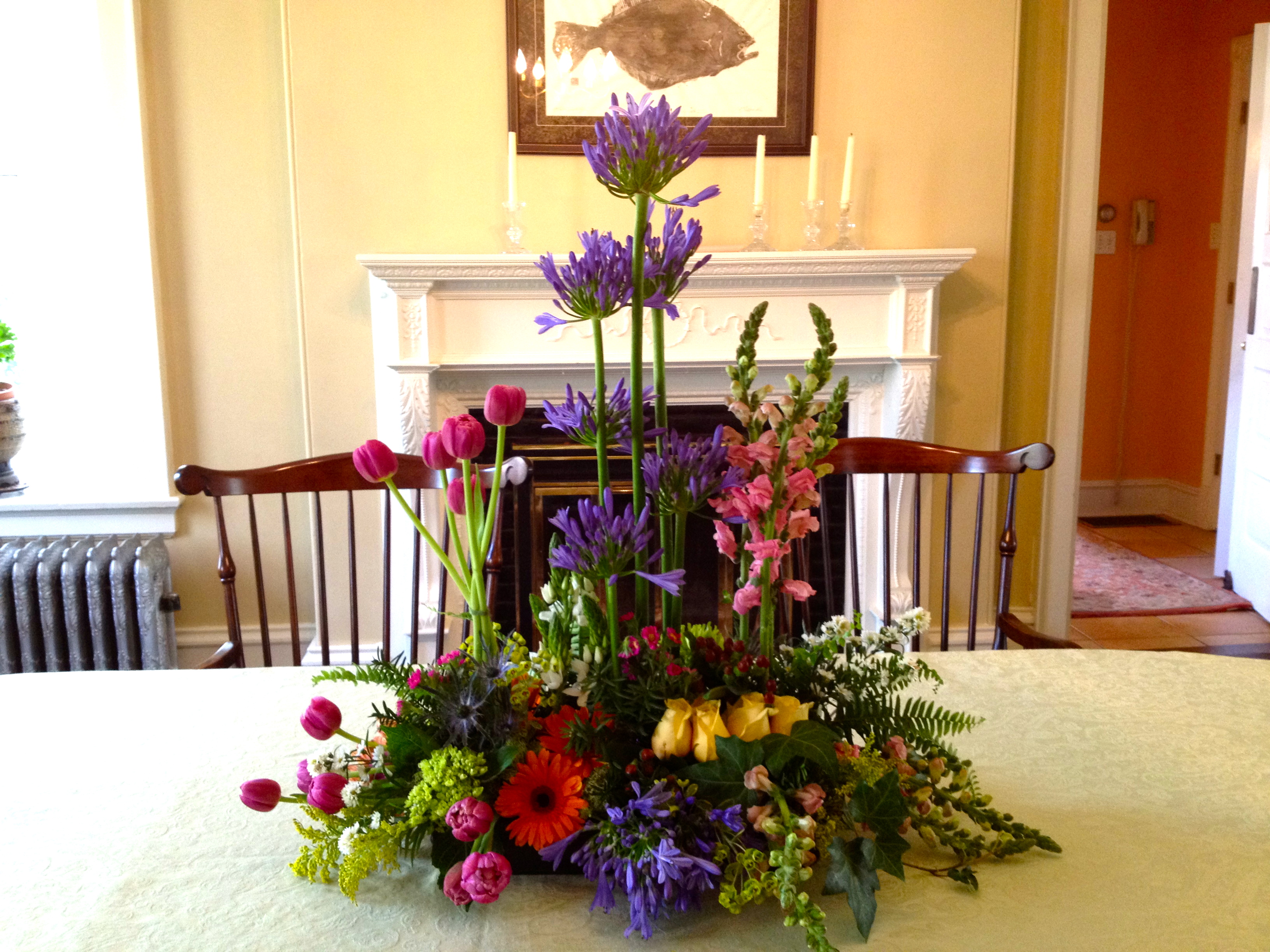
new convention design in a diningroom

Our handout talked about dominance – which is the greater effect of an element – it must be clear in a design and imply subordination.

Linear Dominance – a certain type of lines take the role of importance by either quantity or size (for my design, I think the agapanthus wins because of size and rhythm of lines)

Color Dominance – one hue or strong colors (the purple of the agapanthus draws your eye, but the orange gerber daisy is a dominant focal point I think)

Form Dominance – clearly developed

Textural Dominance – one type of texture (my design has lots of textures and I don’t think one dominates – do you?)

Space dominance – either very full or very open space (it’s pretty full eh?)

And as far as the focal area goes – the dominant place within a design which has the strongest visual impact – I think there are multiple focal areas in this one.

why is this one so hard to photograph?

other side - roses are pave-d

An accent is a subordinate element that contrasts or complements the dominant element – the accent is often connected to the focal area of a design. Here, the ivy is the accent to the roses.

from above

I sent some pics to my teacher Jane and I’m waiting to hear back on whether I’m anywhere in the ballpark here. (Maybe she’ll comment right here on my blog! Wouldn’t that be something?) I welcome any comments and criticism on this design – advanced Longwood students, I would really like to know what you thought of this assignment.

Stay tuned for more adventures in floral design!

ADDENDUM: I talked to Jane over the phone and she gave me a thumbs up on my design. We got to talking about all the foam used for this particular bad boy, and she’s thinking the New Convention won’t be taught in next year’s Advanced I class in order to conserve the use of Oasis to a minimum. I really enjoyed making this design, but I can see how 24 students x 2 blocks of foam starts to add up!

day six – basic floral design I at longwood – last day of basic!

There was overlap with Advanced and Basic this past week.  But this was the last Basic class, boo hoo! I never wanted it to end.   In today’s class we reviewed the principles and elements of design, and then did 2 arrangements.  The first was a simple market bouquet in glass, taken apart and re-designed with added greens and a few extra flowers.  I think we’ve all had experience with this- you bring home a bouquet from the grocery store and you can’t just stick it into a vase “as-is.” You need to break all the stems into groups and analyze what you have.  Often the bouquet from the market has the different flowers placed in a very regular pattern all around – but maybe you’d like it better and there would be more impact if some of the flowers were grouped together.  This was quick and easy but important as it was our first design in glass with water – no Oasis!  So how will the stems stay in place? We had a few options for the mechanics – the first was to create a grid out of clear tape, creating 1″ holes on a dry vase and running tape all around the rim once finished.

clear tape grid method for designing in glass

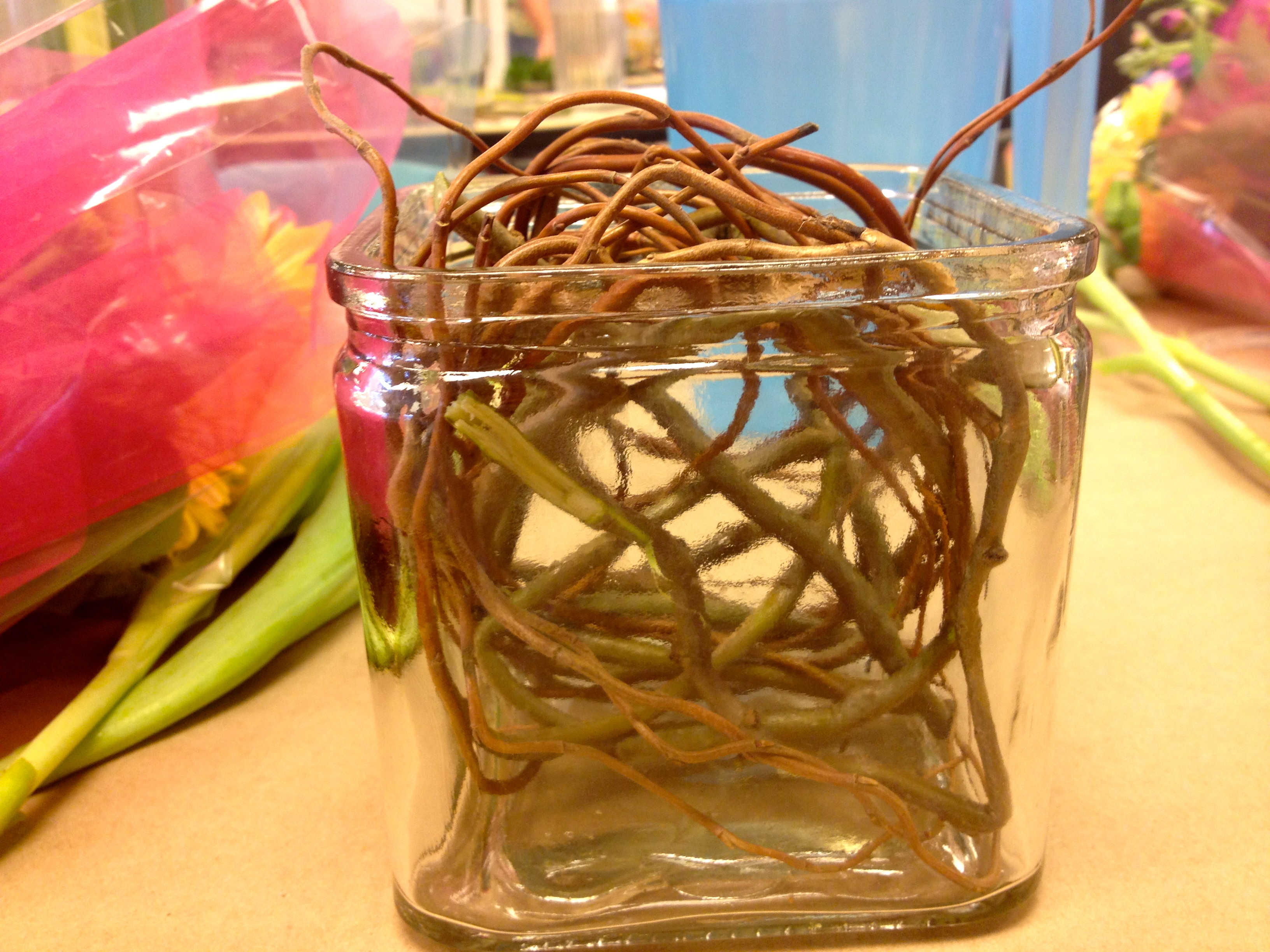
The second, and the one I went for as it would create interest in the lower half of the arrangement, was the branch structure with willow.  Wrap a stem of curly willow around your hand and smush it into the glass, adding a few big stems in a criss cross pattern for more support, and 2-4 more wrapped stems as needed. You could use any other flexible stems for this, like red stemmed dogwood for example.  Just make sure they’re pretty bendy.

using natural stems to create supporting mechanic for arrangement

Personally I know I will use this method again, it was really easy to work with – the stems stayed put – and I really liked the way it looked especially after you put water into the design.  Of course there are many other ways to support stems in water – by using kenzans/frogs/pin holders, or using foliage or large flowers at the base to keep other flowers stable.

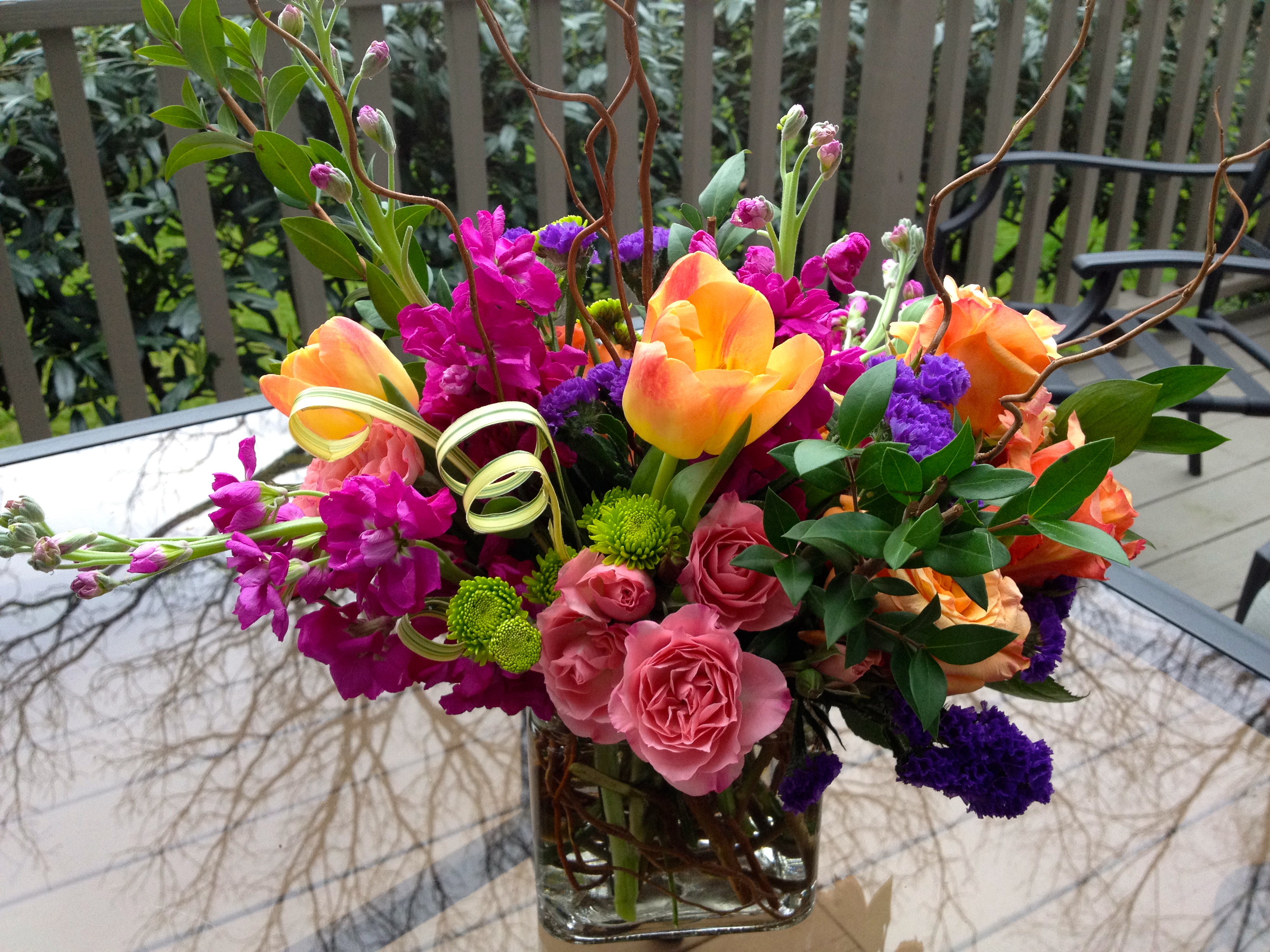
my market bouquet in glass - curly willow added last to reflect the basing stems

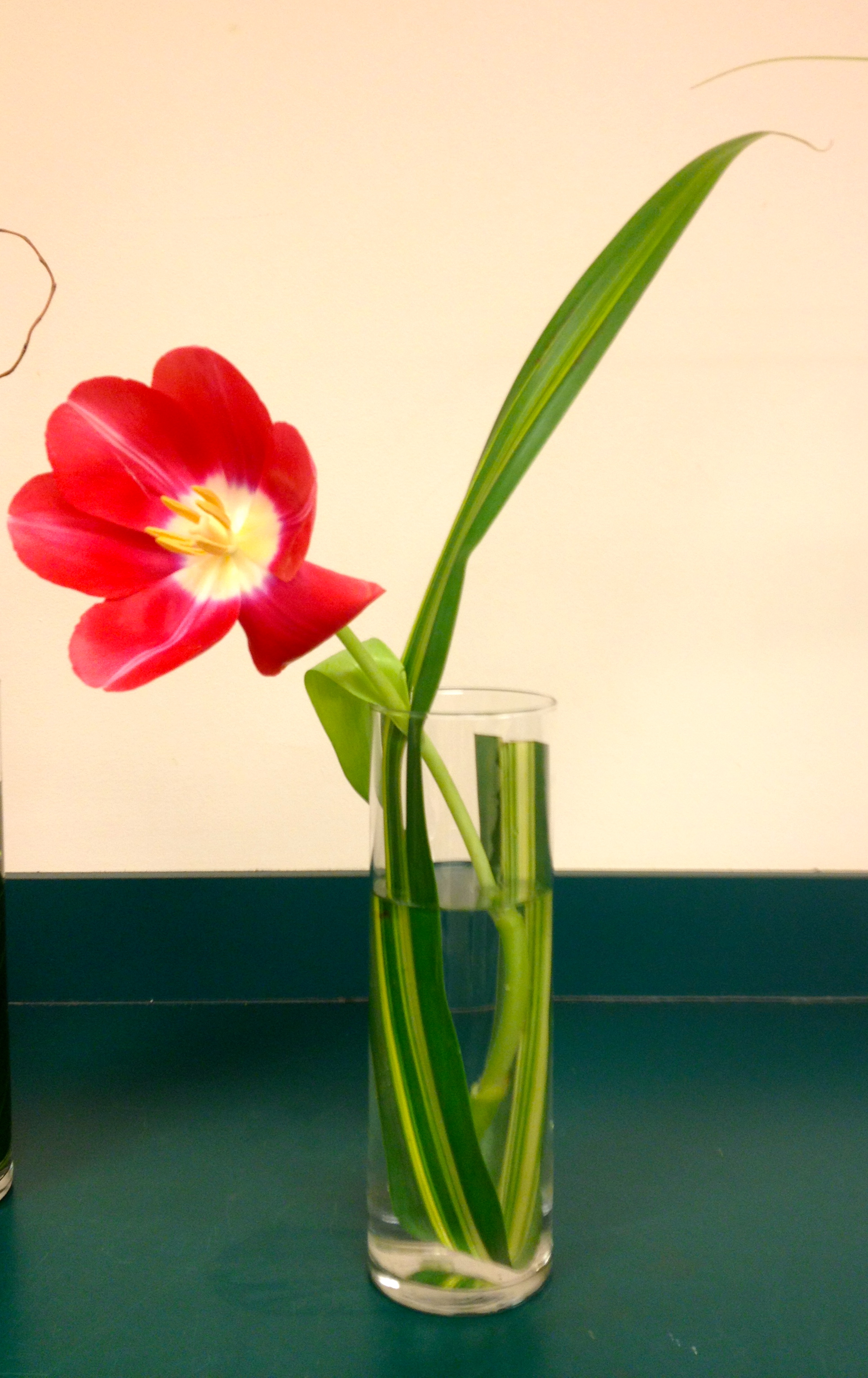
isn't this tulip delicious?

branch structure looks even cooler when you add water!

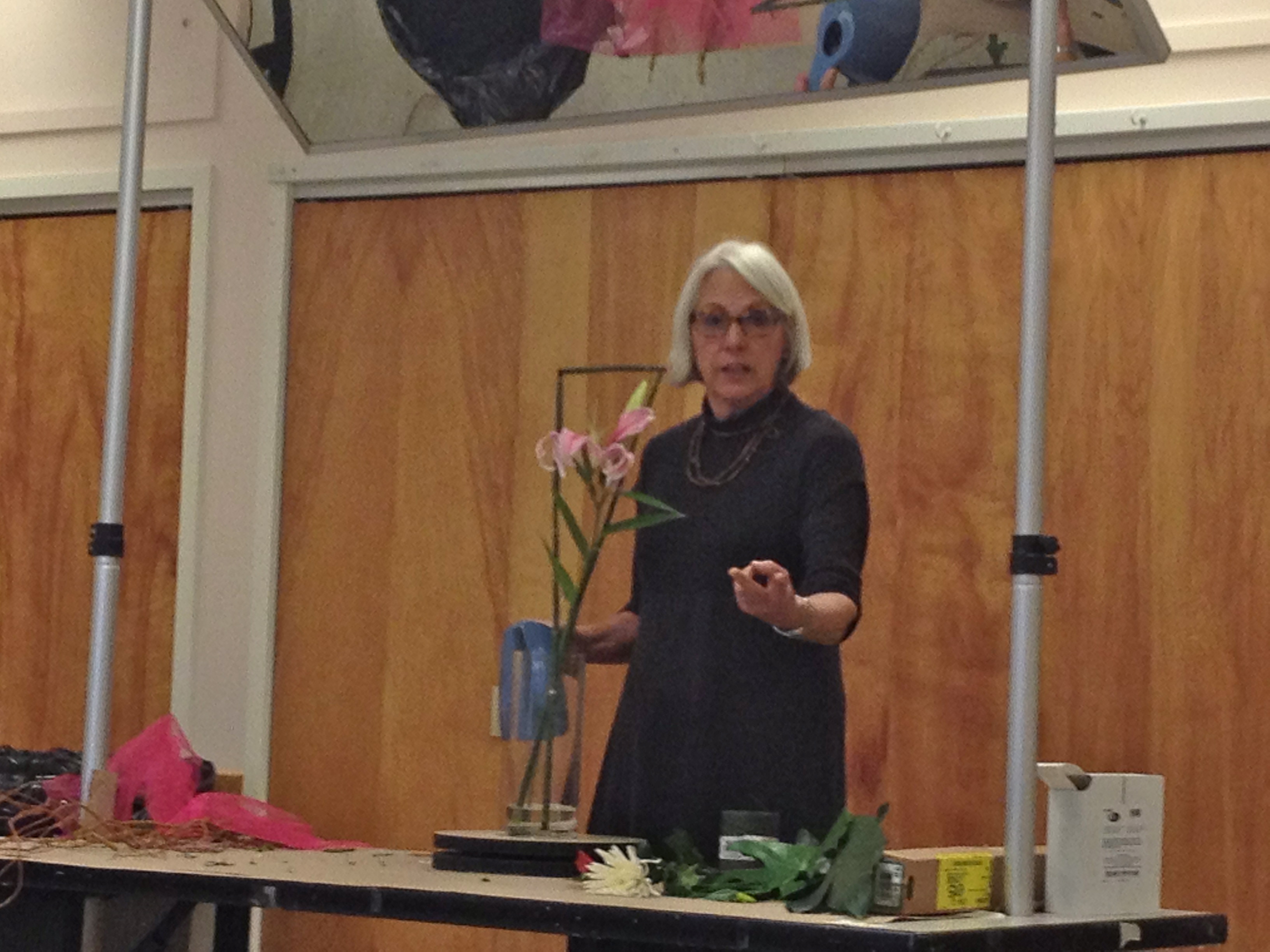
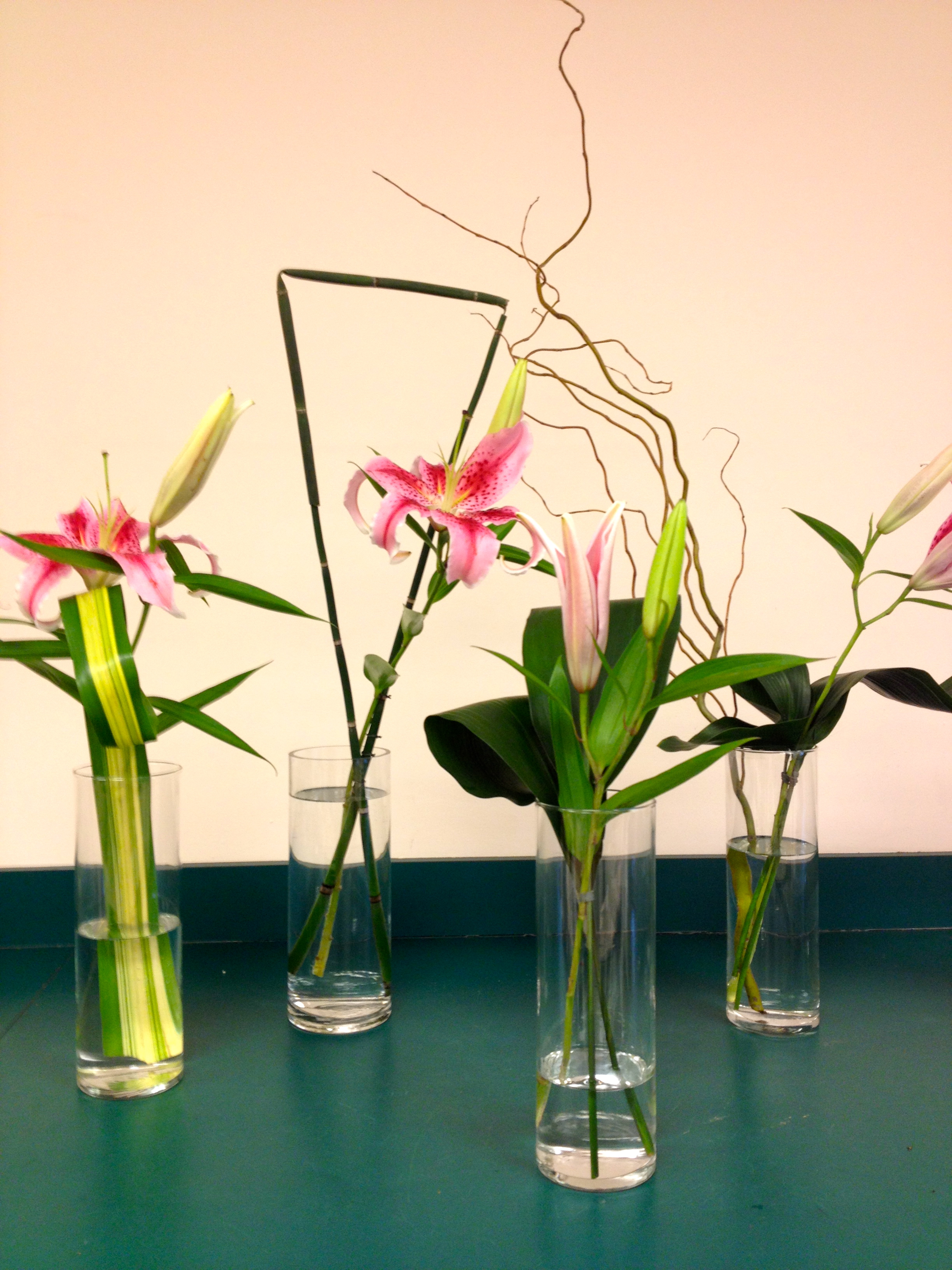
Next up, the one flower/one foliage stem design in glass.  We were given a glass cylinder vase and a quick demo from instructor Jane on some unique things you can do to various foliage stems to create drama.  Here she’s wired Equisetum to get it to conform to the shape she wants – a long rectangle – that will contain the single lily flower like a frame.   She’s also revealed a very important trick of the trade – called U-Glu dashes which are tiny dots of clear tacky glue that can help stems stay put and so much more.

Jane explaining that the level of the water is part of the design

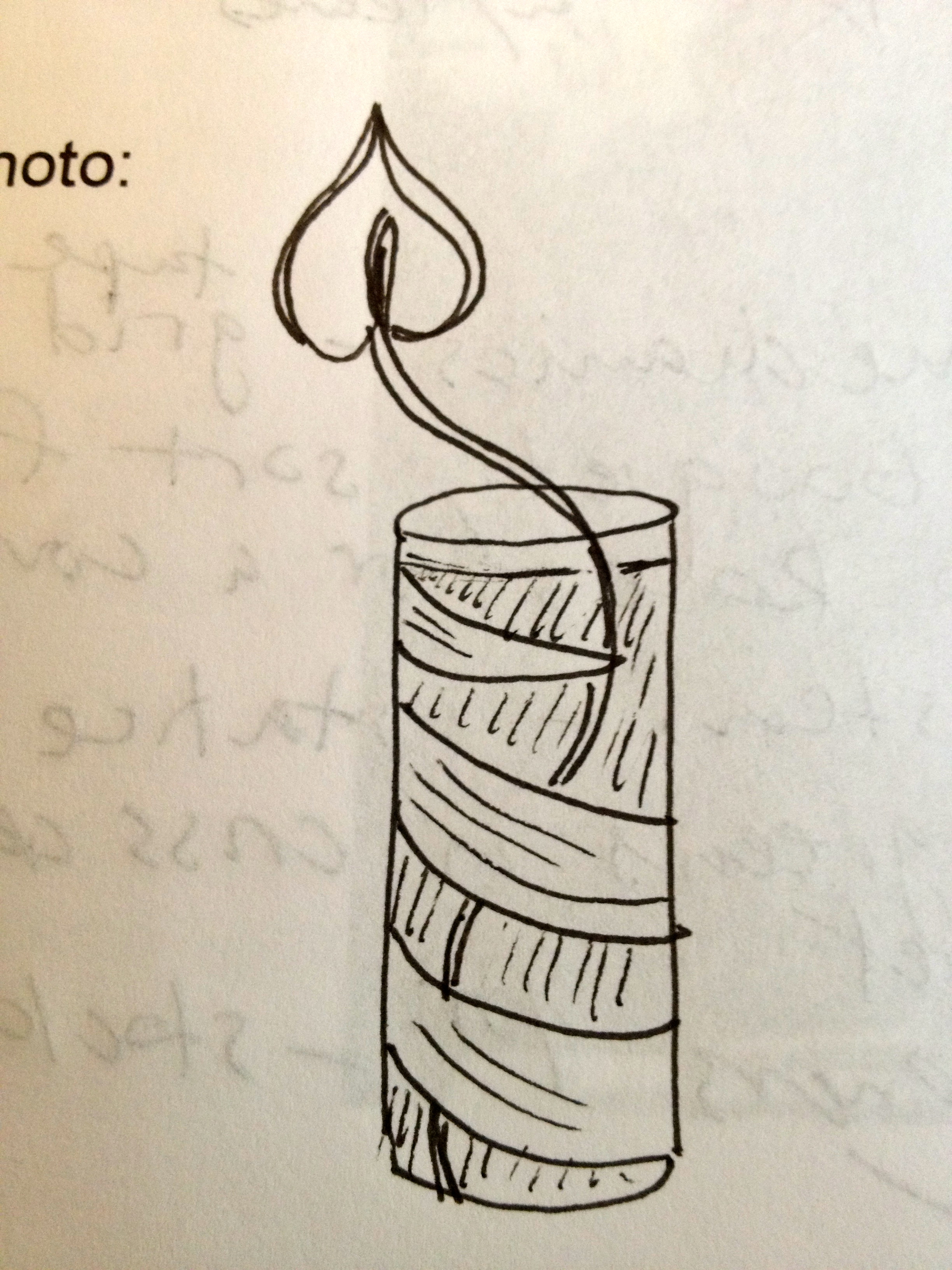
In a flower show competition, none of the mechanics should be visible unless they are purposefully part of the design, like using bind wire repetitively around a wrapped stem.  As she’s doing her demo, I already have an idea for what I want to do, using Phormium or Flax, and one single Anthurium.   And because the practice of sketching has been pressed into my brain from the Advanced class, I do a quick sketch of a possible arrangement.

my sketch idea for the one flower/one leaf design

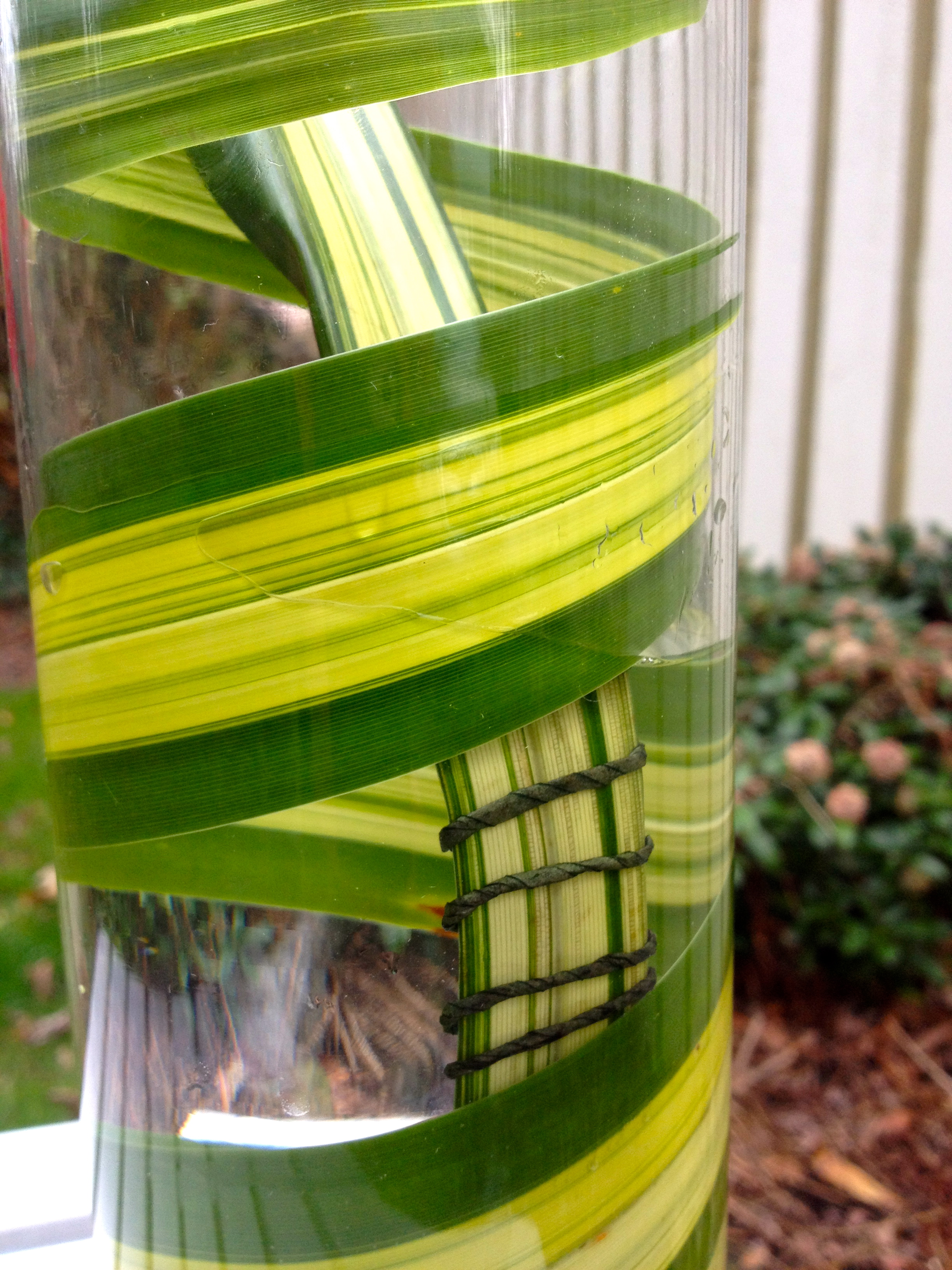
Of course, once you start working with the plant material, it might tell you it wants to do something else, which it did in my design.  First I wound the phormium leaf in a spiral around my hand, and sunk it into the container.  I fussed with the spacing and at the top used a bit of U-Glu to adhere it to the vase.  Then, I tried wiring the anthurium because I wanted to to be taller and I wanted to play with it’s form, but that was harder than it looked and I couldn’t get the wire all the way up the stem, so to disguise the wire sticking out at the bottom, I wrapped another phormium leaf around the stem and then bound the whole thing with bind wire in a hopefully decorative way.

bind wire holds the anthurium stem inside the phormium leaf

my one flower/one leaf design after i got it home - had to rejigger things a bit

What was so amazing about this class was again the hugely varied results given that we all had similar material to work with, and all the same vase.  Jane gave us big kudos and we all felt very good about ourselves!

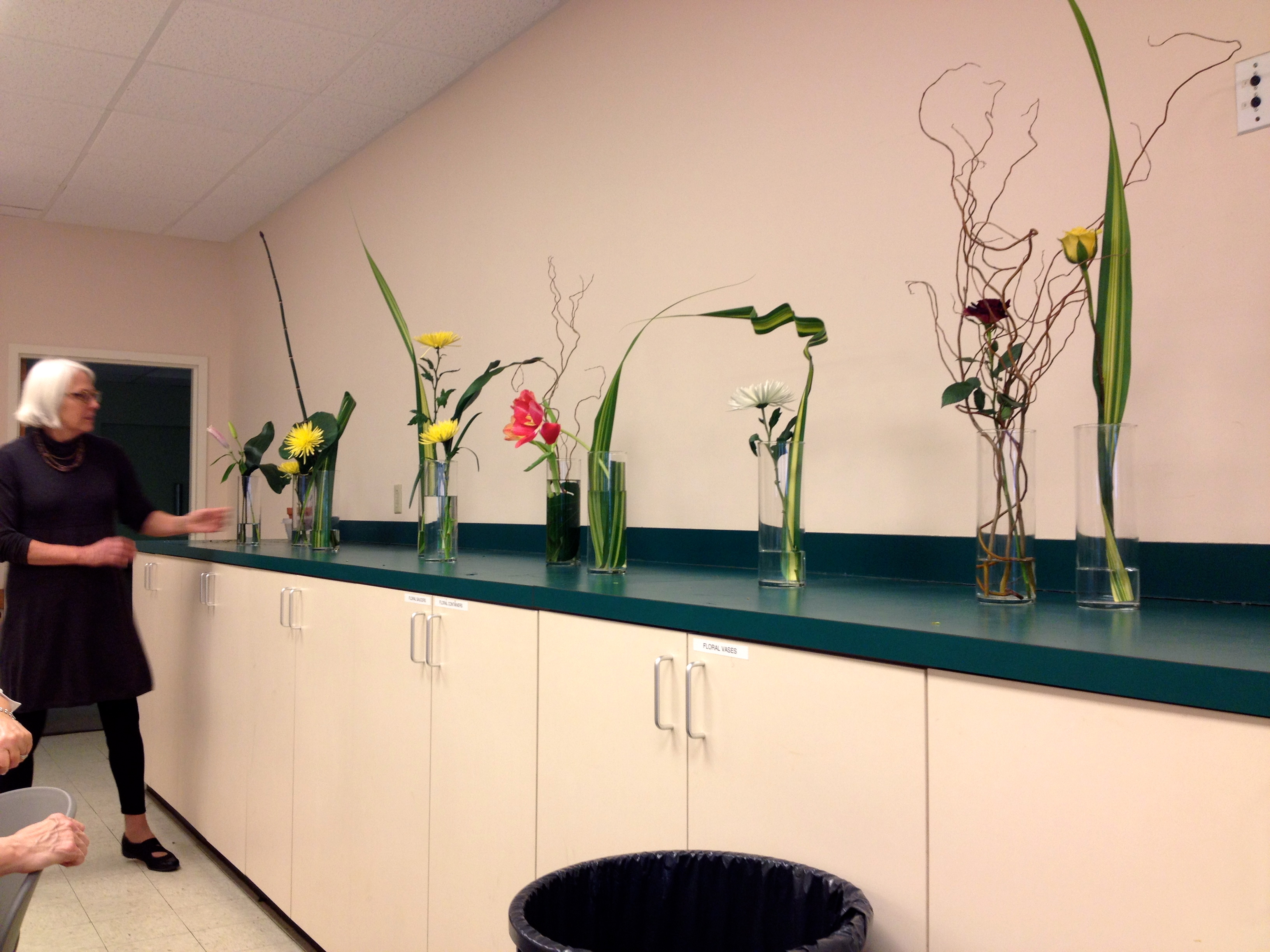
Jane lined up all our designs and had fun playing flower show judge

here all the lily designs are grouped together, giving us the idea that you could create sets of these designs for an event - getting a lot of 'bang for your buck'

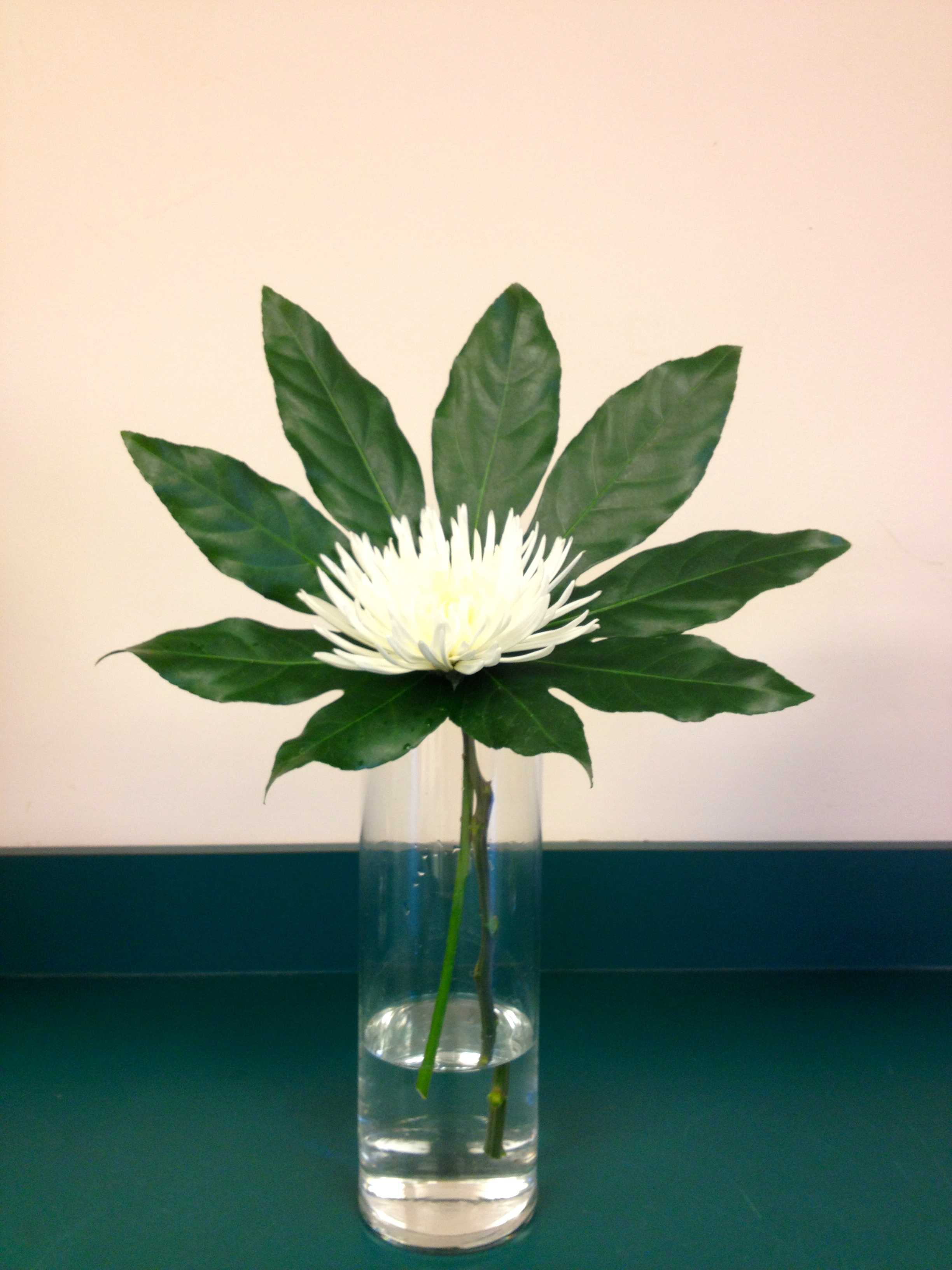
this very simple design using a mum and an aralia leaf reminds me of a lotus

one tulip, poked through a flax leaf. i also loved jenny's design using willow and a tulip but didn't get a good pic. sorry!

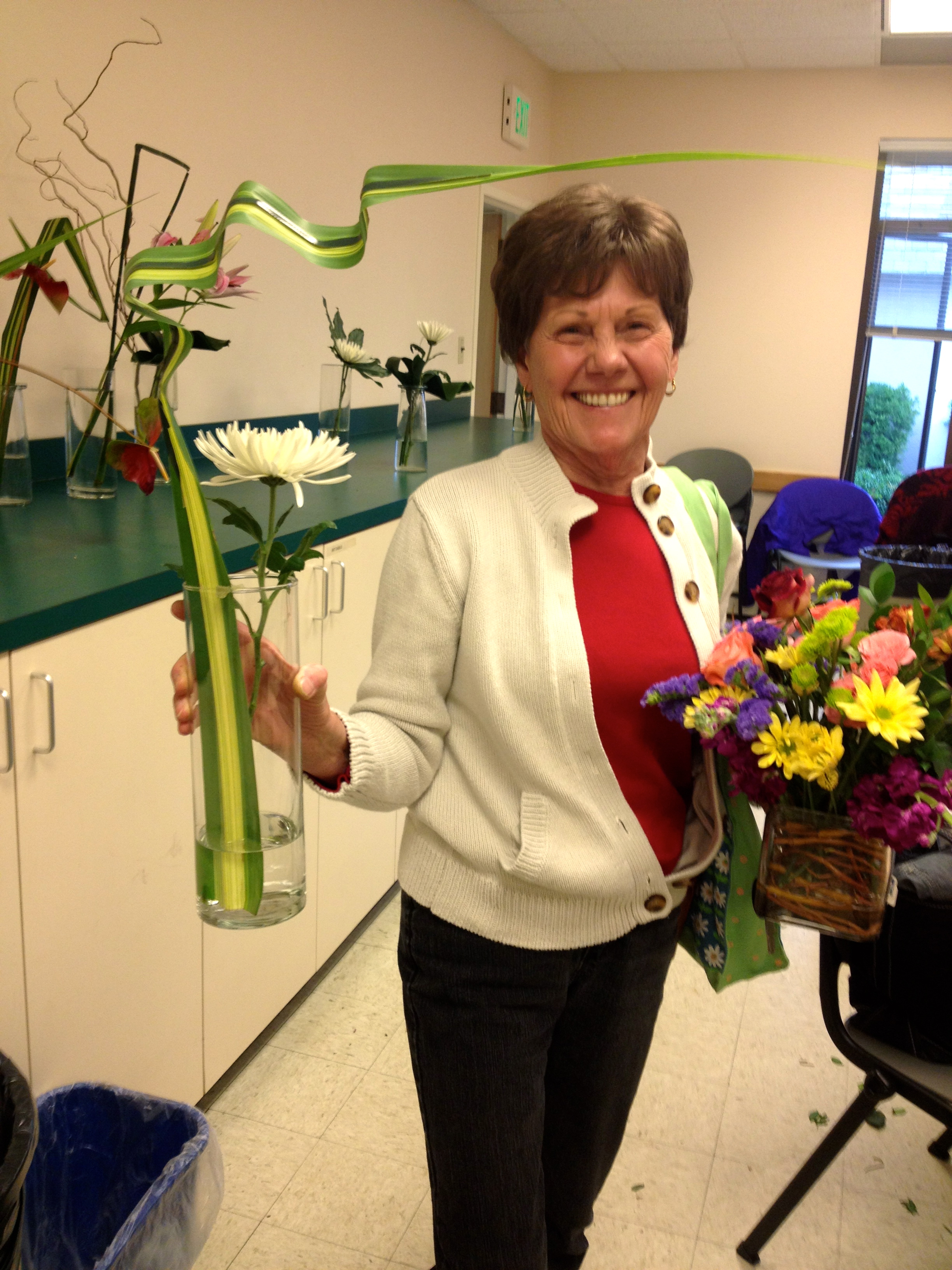
Mary Jo always has a smile! Love what she did with her flax leaf.

I will miss all the great students of this class! Hope to see you in Basic II in the fall. And thanks, Jane, for getting me hooked on Floral Design.

day five – basic floral design I at longwood

Roman fresco with garland of laurel leaves, pomegranates, sheaths of wheat, and pine cones - photo courtesy of metmuseum.org

In today’s class we talked about garlands, which were popularized during the Greek and Roman Periods.   “Garland:  a wreath or festoon of flowers, leaves, or other material, worn for ornament as an honor or hung on something as a decoration.”  Personally, I like the idea of festooning long garlands all around the house and wearing a head garland at the same time.  In ancient Greece, head garlands (also called chaplets) were made of predominately foliage, and were awarded to honor athletes and heroes as symbols of allegiance and dedication.

Apollo crowned with a laurel wreath / photo courtesy of http://www.theoi.com

During the Roman period, garlands and wreaths were heavy and elaborate with fragrant and colorful blooms.  An abundance of lavish flowers was seen as a sign of opulence and wealth.  According to our teacher Jane Godshalk, there’s a story of one rich Roman Emperor who had a dinner party with a fragrant surprise: ceiling panels full of roses and other flowers. The idea was to let the canvases fall deliciously over the heads of his guests.  But it didn’t go like that –  a few of his guests were in fact smothered by his fabulous flowers.

party gone wrong at Elagabalus the Roman Emperor's place

There are a few ways of going about making a garland, and though we weren’t able to cover actually doing them all in this class, we were given a quick demo on how to make a wire garland, using pre-soaked Oasis blocks wrapped in plastic wrap and enclosed in chicken wire.  You just stick the materials into that, careful of the dripping.  A rope or twine based garland seems easy enough – just wire bundles of flowers/foliage around a stretch of rope or twine, making a loop with the twine on either end to hang it easily.  Work from one end to the middle, and then the other end to the middle. These are good for wrapping around pillars or poles, hanging swags on a table, or framing a window or door.

small garland of purple limonium, seeded eucalyptus, and bupleurum made by Jenny in class

And then there’s the table garland – essentially a wreath formed out of Oasis that you poke your plant materials into. Start with a basing of greens – in this case we used Ruscus, Myrtle, Galax and Seeded Eucalyptus.  Place them inside and out of the ring at varying angles.

my table garland/wreath in action - dinner courtesy of Dad and Julie with the wonderful company of Meg

Then add your main flowers – in this case spray roses and carnations.  Group them evenly throughout.  I used the seeded Eucalyptus as a filler flower really, but Limonium or I hate to say it Gypsophila also work well as a filler.  All of these items except the carnations (these were left over from another class) will dry pretty well and therefore this table garland borders on everlasting.

my first table garland/wreath - put a candle in the center and call it a day

All of these garlands are quite labor intensive and therefore should be done the day before an event.  That goes for head garlands too. In fact, I had just enough time in class to squeeze out a quickie for my niece June.

Niece June modeling the head garland I made

This was super fun to make and not too hard at all.  I measured out a piece of honeysuckle wire (just a wire with a brown wrapping, also comes in green,) making one end into a loop.  Then I made small bunches of daisy mums, Bupleurum, and Gypsophila or Baby’s Breath in my hand, which I then wired onto the main wire using bind wire.  Many mini bundles later the garland was filled, and I added some white ribbon on.

Head garland of Bupleurum, daisy mums and gypsophila on June

I really, really liked making the head garland.  I love the idea of wearable flowers – this might be a niche for me.  And when you put them on you feel like a total princess! (Or Greek goddess!)

Despite it's small size, I couldn't resist putting on the garland myself. photo courtesy of Juliet

wrist corsages

At falls flowers this week, I got a lesson in making wrist corsages.  There are a few different styles and ways of doing it, but as the request was for almost 40 simple white roses for a sorority gathering, we went with the simplest and fastest method – GLUE.  Gluing saves time when you have a bulk order, because the alternative is wiring and taping – a lesson I hope to get one day, too.  And this glue is like no other I’ve worked with – Oasis Florist Adhesive.  It’s a “fast-drying and waterproof liquid adhesive formulated for use with fresh flowers.” It won’t brown fresh flower petals, and it will hold up in cold storage. In other words, it’s a must-have for all you budding floral designers out there!

In making the wrist corsages, Peicha and I start by using well-hydrated roses, removing their sepals (the small spiky leaves at the base) and then trimming the stem down to near nothingness.  Shave the stem down with a knife so it’s as flat as possible.  Add a tiny blob of glue to both the bottom of the rose and the Elastic Wrist Corsage Band, making sure to spread the glue evenly.  Let the glue set for about 30 seconds and then carefully press the rose onto the band’s flat metal plate.  Earlier, we removed the little metal prongs that would normally fold over and enclose a bunch of wired flowers.  As with any glue, it’s better not to touch it with your fingers or you’ll be trying to get it off all day – this is especially true with this glue, though scrubbing with Lava soap does get it off pretty well.  Also – when working with this glue PLEASE choose a well-ventilated spot and take breaks to venture out into the fresh air or you will get silly like I did.

As far as wrist corsages go, I think there are a lot of possibilities out there on what you could do, and I think they are a great alternative for prom season.  Remember your date awkwardly trying to pin a corsage on your chest? This is so much easier.  And a wrist corsage doesn’t get in the way during the slow dance!  I really think we should all wear flowers a little more often, don’t you?

day four – basic floral design I at longwood

My parallel design (photo courtesy of hugh and juliet)

Today’s lesson was to create a Parallel Design, a design that’s meant to have a calming effect.  In a regular decorative design, like the Roundy Moundy, the overall shape is dominant. But in a formal linear design, the forms and lines are dominant.  The lines in this design are created by grouped plant material set in a vertical pattern with negative space between each section.  The negative or empty spaces allow the eye to travel through the arrangements.  We talked about parallel designs with Landscape Designs, but this one is different because we are not mimicking how you’d see plants in nature, and we’re not necessarily combining plants that are seasonally compatible.  In other words, let her rip!

Oasis fit to edge of container, covered by Apidistra leaf and "terracing" with Galax leaves

We started by filling a low container with Oasis floral foam, shaved to the lip of the container (important for a clean line, clean look.)  Nothing much should be hanging over the edges in the parallel design.   Jane recommends attaching an Apidistra leaf with greening pins to cover up the foam at this stage, rather than going back and filling in with moss at the end.  (Some stems will poke right through the leaf, whereas a hole will have to be made for other, more tender ones.)  We’ll be using a lot of basing techniques at the end to conceal the mechanics, but the terracing using Galax leaves is easier to do at the beginning.  Terracing is simply placing materials on top of one another, divided by space, like a staircase.

We get our materials for class from Delaware Valley Wholesale. Doesn't Jane look nice today?

Linear plant material is a must for this design, and we had lots to choose from, like gladiola, liatris, and equisetum.  Hold the line flowers/foliage up over the design to see where it looks best, and vary the heights.  The idea is to keep the same plant material grouped together for a bigger impact and to keep the lines stronger. They should all be placed in as straight as possible!  With lilies in the mix, the only way to go was to keep them low or they took up too much of the space at the top of the design – reserved for negative space.

Design in yellows and whites - very restful

Depth is created by angling stems, overlapping materials, and the use of color (light colors pop out while darker ones recede.)  The lines create negative and positive space.

Afeefa's Design - powerful color choices

Notice how Pat trimmed her Equisetum on a diagonal cut for effect (sorry Pat I didn't get the bottom of your design!)

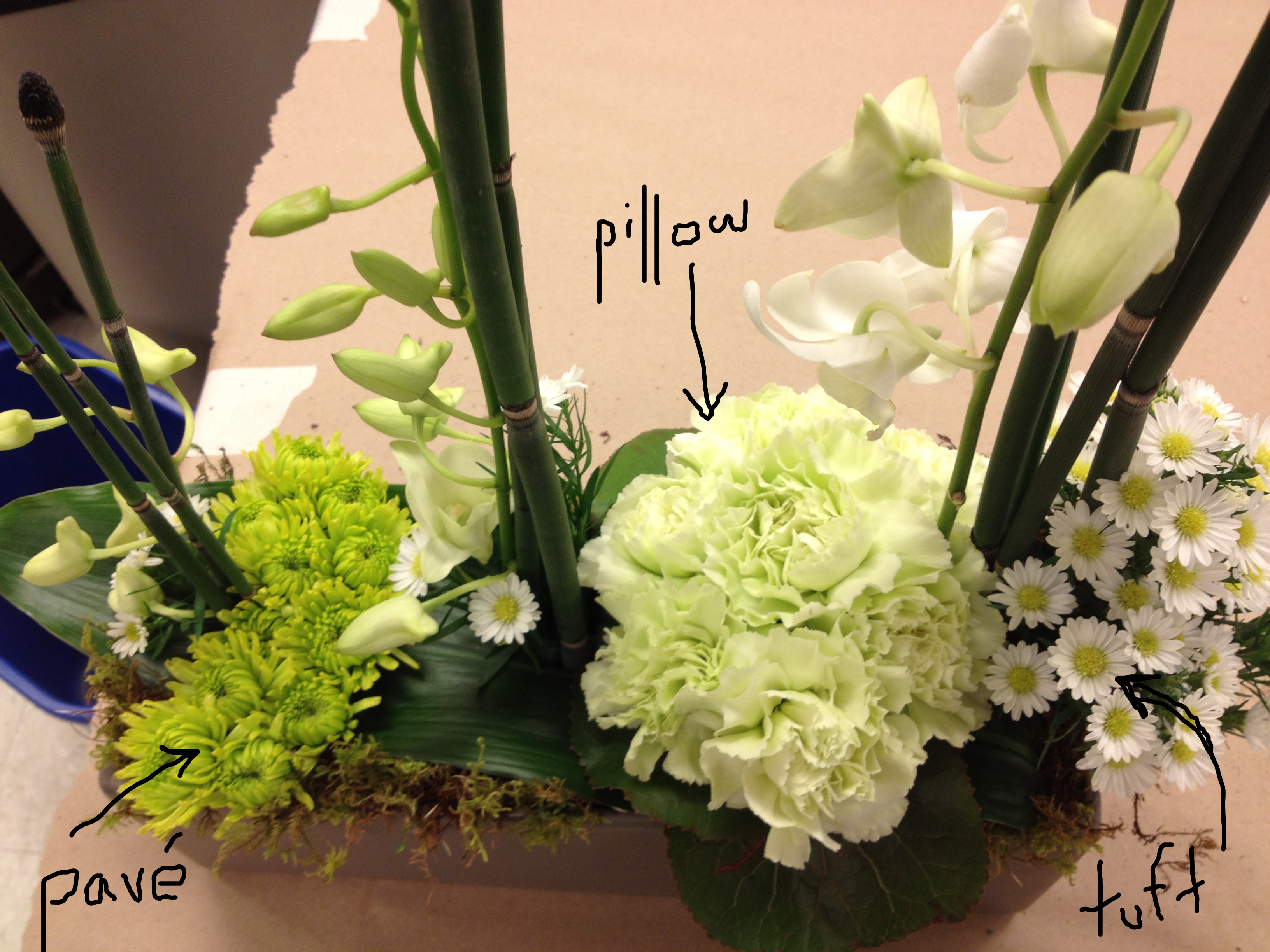
Next, we did our basing techniques to cover the mechanics and to create color and texture.   Pillowing is creating a tight, round pillow out of a few stems placed radially.  Tufting uses bunches of short stems to create an airy look.   Pavé-ing is a tight clustering technique where the surface of the bunches remains totally flat, creating a cobblestone effect. (Pavé as in the jewelry technique, too.)

Jeny's Design to show basing techniques

class critique - don't worry, we all get As here (Melissa's design up close, I think)

This design really opened my eyes to the possibilities of parallelism.  I think these would make great table centerpieces because you can see through them easily and they look good from all sides.  You create a little mini world in a box that has nothing to do with the way plants would really be growing and it’s kind of liberating.  Also, it’s been said that men prefer these vertical designs.

my design in home environment (photo courtesy of hugh and juliet)

(photo courtesy of hugh and juliet)

intro to ikebana – longwood – day two

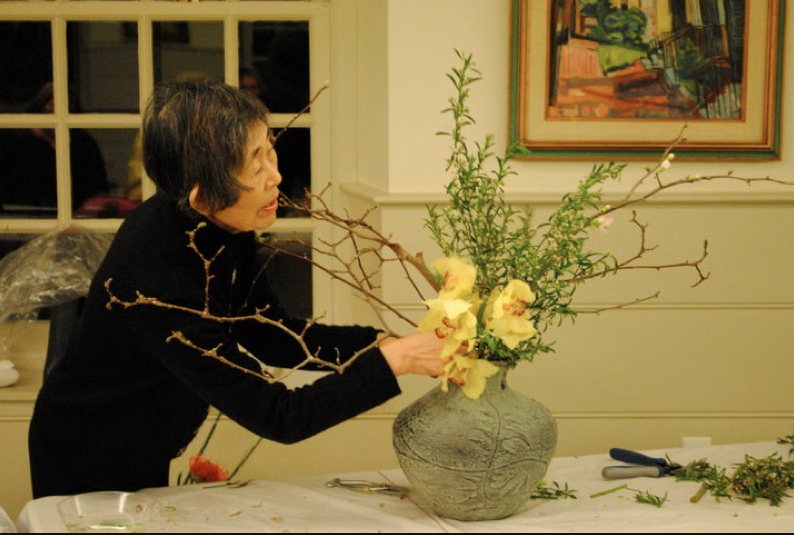
Midori Tanimune, Longwood Ikebana Instructor, Sogetsu School

Instructor Midori Tanimune, a diminutive and ageless Japanese woman with twinkling eyes, begins the class with a story about herself.  When she was 11, living in Japan with her family, her father tragically passed away.  She had spent every day talking to her father in the fields, and they were very close, so when he died she didn’t know what to do with her grief.  Her mother, having no other answers, sent her to tea ceremonies and Ikebana class once a week after school.  Midori would listen to her Ikebana teacher, and talk about herself, and as long as she came home with a flower in her hand her mother did not question her.  “Ikebana saved my life,” she whispers, but through a smile.  It will teach you to “clean up your soul” and respect nature, respect silence.  I look around at my classmates in surprise at this raw emotion I did not expect to feel at 9am in the Acer Room at Longwood.  There are some other watery eyes too.

Poem by Midori

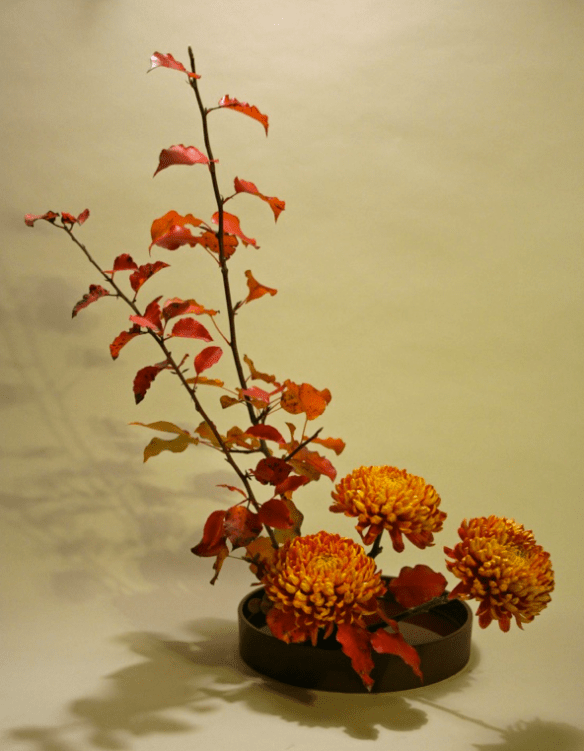
Midori is in the Sogetsu School, the newest Ikebana school founded in 1927.  In this school, they use unconventional materials alongside fresh flowers.   Their philosophy of Ikebana is that “it can be created anytime, anywhere, by anyone in any part of the world and with any kind of material.”

one of Midori's designs courtesy of epochtimes.com

Also, the teacher must make the arrangement towards the student, which I imagine might be difficult, given all the precise angles, etc.  Midori explains that if we see something we want her to do or to change, to speak up.  I know I certainly don’t feel qualified to do that at this point!   As she creates several different designs for us, none of which I got very good pictures of I’m sorry to say, certain words of wisdom pop out at me.

  • The moment you’re making it is the most important.
  • Never put the kenzan in the middle of the container in Moribana. (Kenzan is the device with points meant to hold the stems.)
  • Use a cutting bowl to cut stems underwater especially for spring flowers.
  • There are 3 main elements when creating an arrangement in Sogetsu Ikebana: Line, Color and Mass.  Line = Space.

Basic Upright Moribana photo courtesy of http://keithstanley.com - 365 days of ikebana

Our first lesson is to create a Basic Upright Moribana Arrangement. Moribana, as you may recall from Day 1, means “piled up flowers.”  And the basic upright arrangement is the most important, “because all freestyle comes from this.”  There are 3 main stems and specific rules about how long they should be and at what angle they are placed in the kenzan.  We’re using a long low container for this.

Julie's moribana design - beautiful

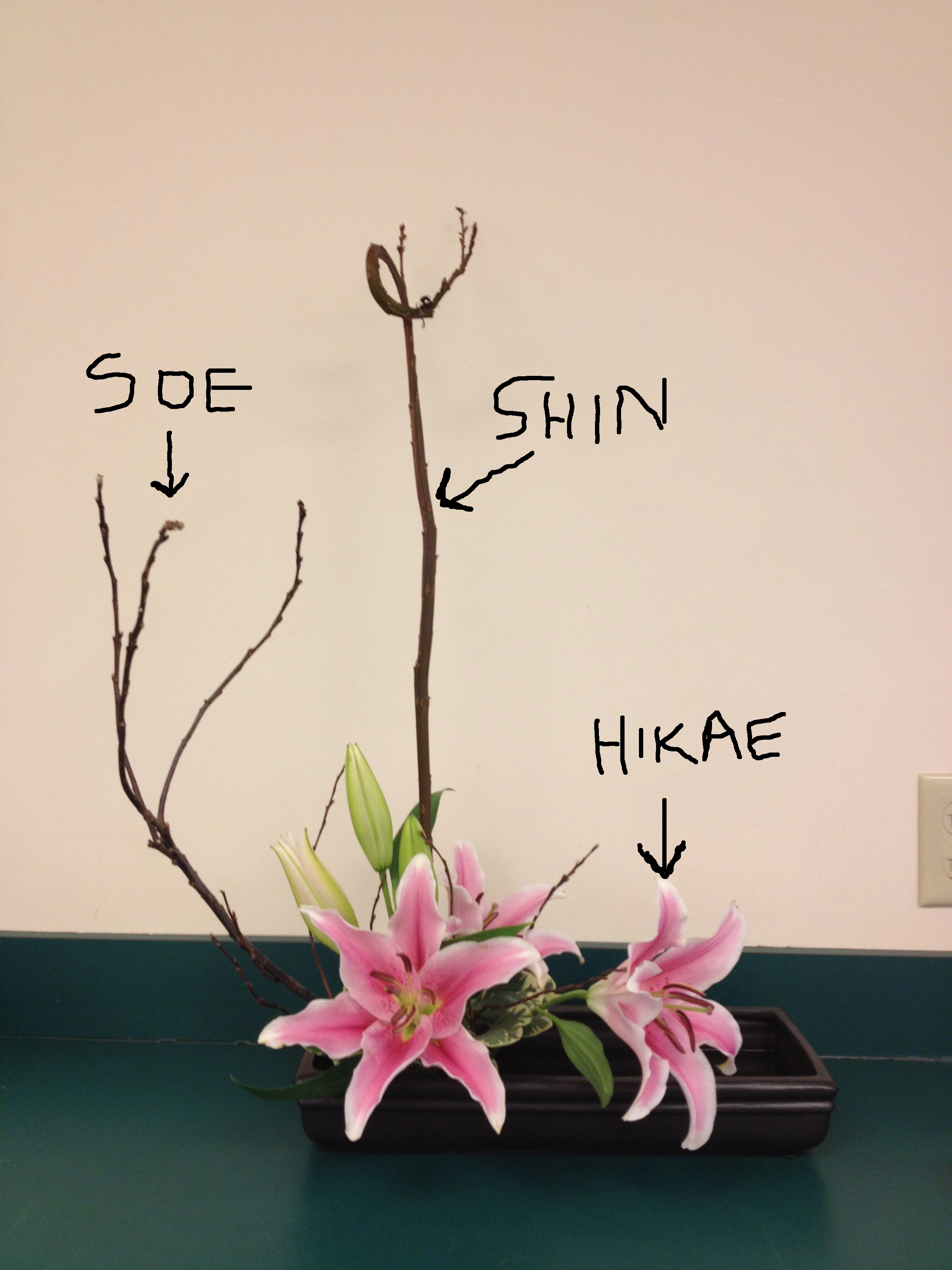
Shin is the First Main Stem, and Midori calls this stem “the husband.”  The measurement of this stem is the most important, as the other stems will be fractions of it.  The shin should be 1 1/2 times (the depth of the container + the diameter of the container.)  The Shin stem goes in first, in the back center position, placed straight into the kenzan and then turned slightly to the left, as if bowing.  In the arrangements we’re doing, the Shin is a Willow stem.  Choose a side of the stem that will create depth, and trim the stem accordingly to create the strongest line.

Soe is the Second Main Stem, and Midori calls this stem “the wife.”  The Soe is 3/4 the size of the Shin, and goes in second in the left front position.  She is placed straight into the kenzan, then pushed to a 45 degree angle towards the arranger’s left shoulder. The Soe is also a Willow stem.  In choosing how to place the stem visually, don’t think radially.  Think about the stems ‘conversing’ with themselves.  (This was not a natural thing for me to do! I’m so radially oriented!)

Hikae is the Third Main Stem, and Midori calls this stem “the child.”  The Hikae is the shortest stem, and 3/4 the size of the Soe, and goes in the right front position. She should be placed straight into the kenzan, then pushed to a 75 degree angle towards the arranger’s right shoulder and opposite from the mother or Soe. We used a Lily for this stem.

my Moribana with diagram

Next, you should “invite all your friends to the house,” by placing in other supporting stems of the same material – lilies and willow.  But these supporting stems, or Jushi, must never compete with the main stems for line or space.  Always keep the spaces between the main stems open.  And when placing the supplemental “friends” in, make sure some of them are angled towards the main action of the house, so they’re all having a conversation with each other, rather than angling them radially.  Make sure they create movement.  Also, remember that smaller blooms are placed higher in an arrangement, and larger ones LOWER.  Then, place one main flower at the center to “close the door,” and add some greens or pittosporum in our case, to hide the mechanics of the kenzan (not too much but just enough).

Midori helps us get our moribanas right

After a nice long lunch break, we’re back to create the Basic Upright Variation No 4 – Nageire Arrangement in a Tall Vase.

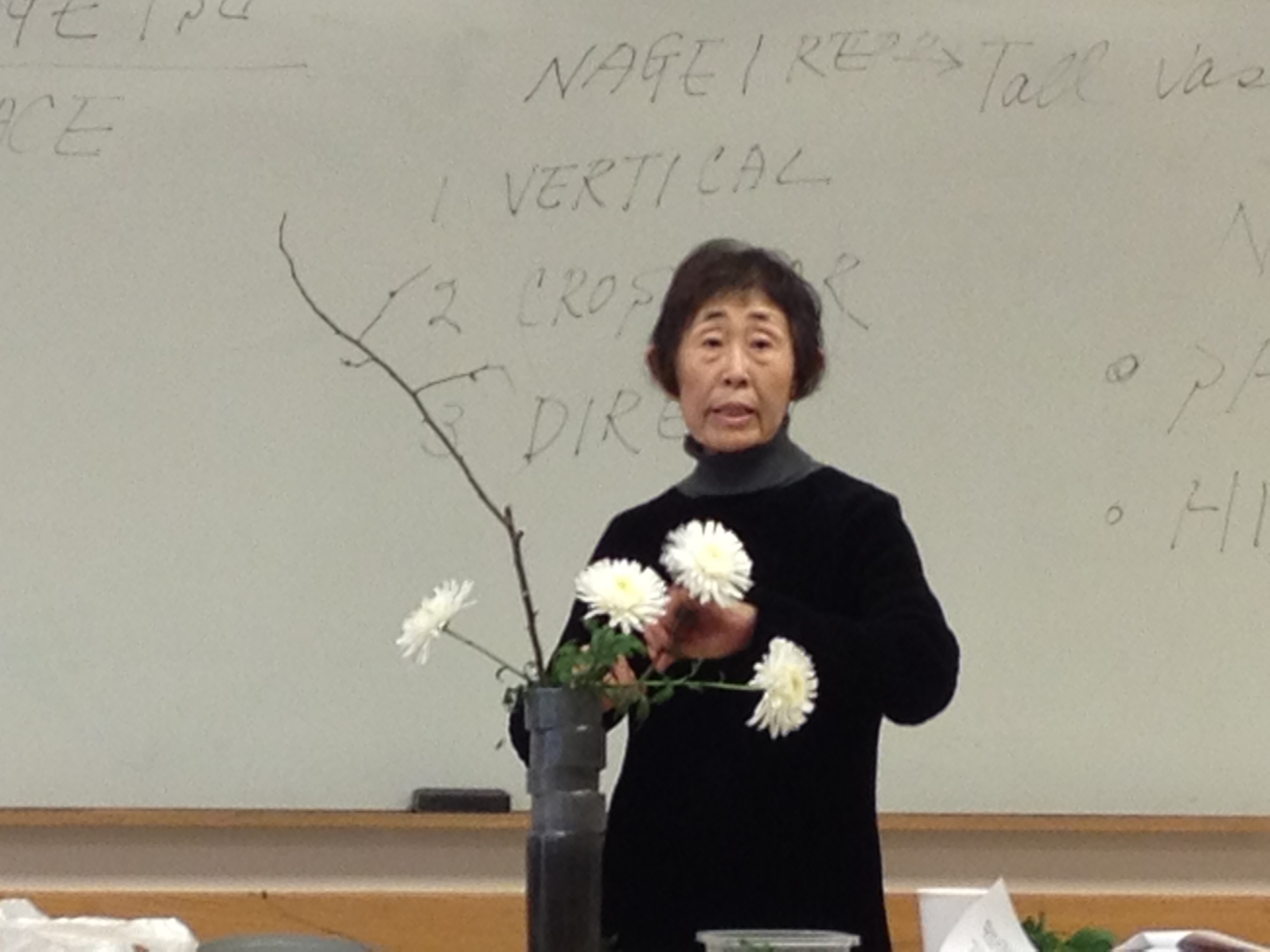
Midori with Upright Nageire Design we are to make

Nageire is Japanese for “thrown in” and usually utilizes a single long branch with shorter branches and flowers at the base arranged in a tall upright vase. And while there are only 2 main stems (the Shin and the Hikae,) there is NO KENZAN, or device to hold the stems in place, so the mechanics of this will be a little tricky.

Create a supporting branch in the shape of a Y for your Shin stem

The first order of business is to cut a supporting branch that will hold the Shin, making sure there is water in the vase first.  Once you place your stems in, that’s it, it’s really hard to move the container without displacing the stems!  So, your supporting branch will be a few inches lower than the container’s depth – and where it touches the bottom of the container, it will be cut straight, not on a slant.  Cut a slit in the top side and widen it out – this will create a Y for the Shin to sit in.  The Shin stem, a flowering Quince branch, should be as straight as the material will allow, and should be cut up the center so that it can connect strongly with the supporting branch.  The end of the Shin should be cut on a slant and touch the side of the container for support.  Actually there are some rules about the stems and where they can touch, that are basically all about how to anchor things so they stay in place best.

rules about stem placement in nageire

Getting the Shin in right is easier said than done! Midori has to help all of us with this.  We are not used to working with this mechanic but it’s SO cool once you learn it!
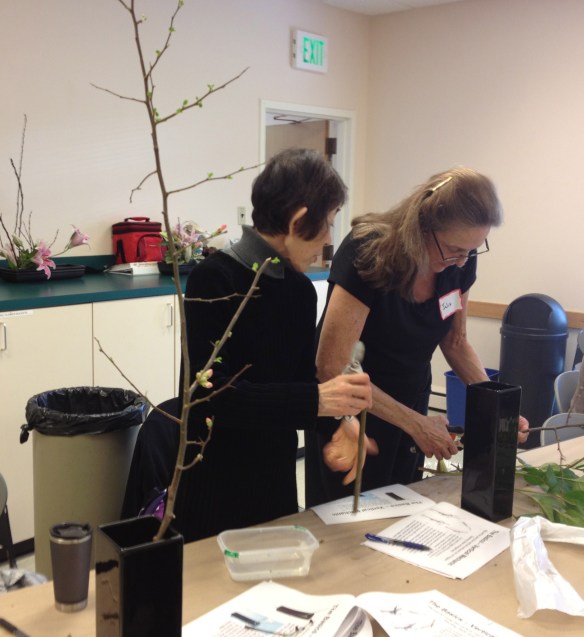
Julie trims the Shin stem to create an even straighter line

Then you will add the Hikae stem – in this case a big white Chrysanthemum.  The Hikae must be placed at a 75 degree angle towards the arranger’s right shoulder, just like in the Basic Moribana arrangement.  But in this design, there is no Soe.  The Hikae stem should be against the back wall of the container to get the proper angle away from the Shin, and you can gently bend your stems to fit them in.  Then place some supporting mums in, and then take a little left over mum foliage to hide the mechanics.  Nothing in this design should be hanging over the back edge of the container!
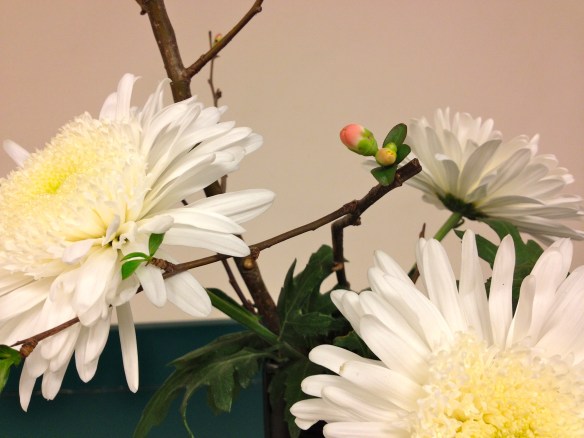
Midori helped my design by pruning back the quince branch to reveal the buds that were popping - so they became more evident
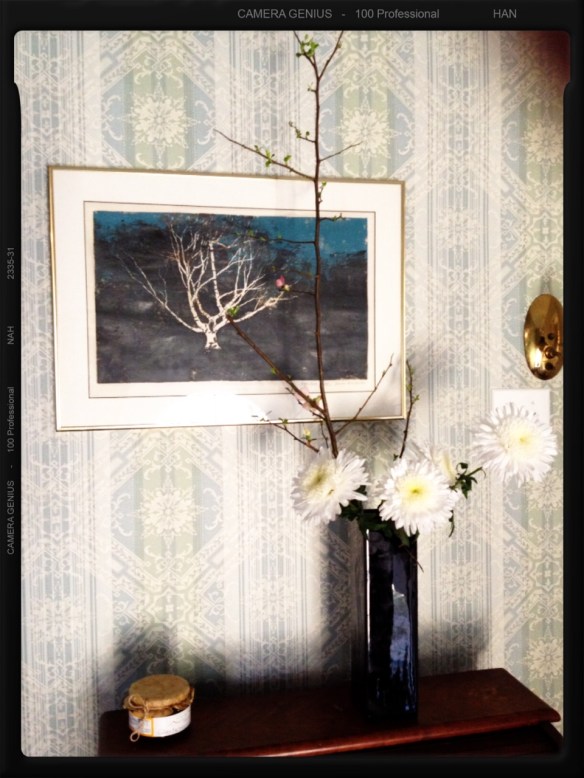
I recreated my Nageire when I got home, placing it in front of my sister's art called 'Night Birch'

I loved this class and I loved Midori.  She is such a special person and made all of us feel like we deserved an A+ for our designs.  I learned a lot this day, and also felt spiritually connected to what I was doing. Thanks, Midori!
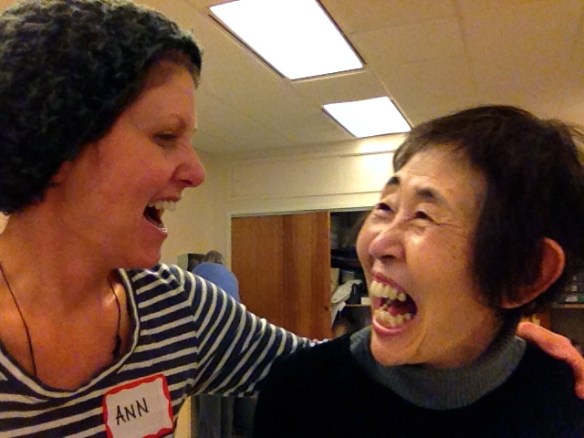
Midori and I laughing about how hard taking a picture seems to be

Photo of Midori at beginning of post courtesy of – New Castle Delaware – Arasapha May Market 2011’s Facebook page